







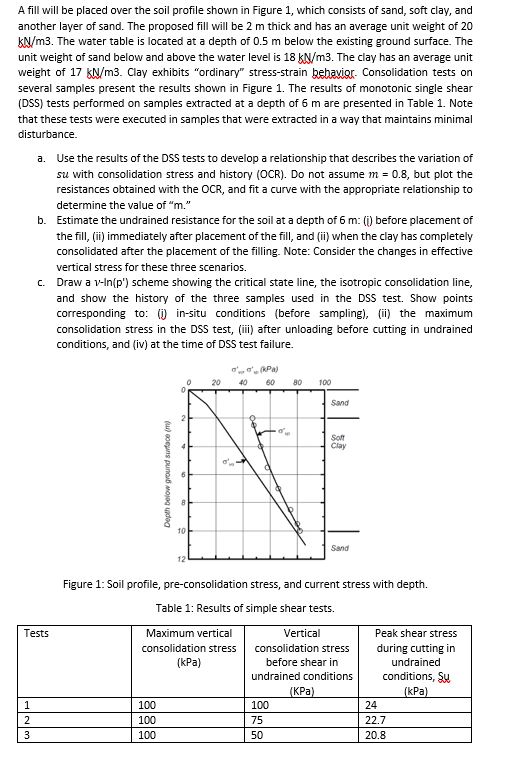
Question: A fill will be placed over the soil profile shown in Figure 1 , which consists of sand, soft clay, and another layer of sand.
A fill will be placed over the soil profile shown in Figure which consists of sand, soft clay, and
another layer of sand. The proposed fill will be thick and has an average unit weight of
The water table is located at a depth of below the existing ground surface. The
unit weight of sand below and above the water level is The clay has an average unit
weight of Clay exhibits "ordinary" stressstrain behavior. Consolidation tests on
several samples present the results shown in Figure The results of monotonic single shear
DSS tests performed on samples extracted at a depth of are presented in Table Note
that these tests were executed in samples that were extracted in a way that maintains minimal
disturbance.
a Use the results of the DSS tests to develop a relationship that describes the variation of
su with consolidation stress and history OCR Do not assume but plot the
resistances obtained with the OCR, and fit a curve with the appropriate relationship to
determine the value of
b Estimate the undrained resistance for the soil at a depth of : i before placement of
the fill, ii immediately after placement of the fill, and ii when the clay has completely
consolidated after the placement of the filling. Note: Consider the changes in effective
vertical stress for these three scenarios.
c Draw a In: scheme showing the critical state line, the isotropic consolidation line,
and show the history of the three samples used in the DSS test. Show points
corresponding to: i insitu conditions before samplingii the maximum
consolidation stress in the DSS test, iii after unloading before cutting in undrained
conditions, and iv at the time of DSS test failure.
Figure : Soil profile, preconsolidation stress, and current stress with depth.
Table : Results of simple shear tests.
Step by Step Solution
There are 3 Steps involved in it
1 Expert Approved Answer
Step: 1 Unlock

Question Has Been Solved by an Expert!
Get step-by-step solutions from verified subject matter experts
Step: 2 Unlock
Step: 3 Unlock
 Study Help