







Question: A fluid flow through pipes and tubes has great application in many areas of engineering. The resistance to flow is parameterized by a dimensionless number
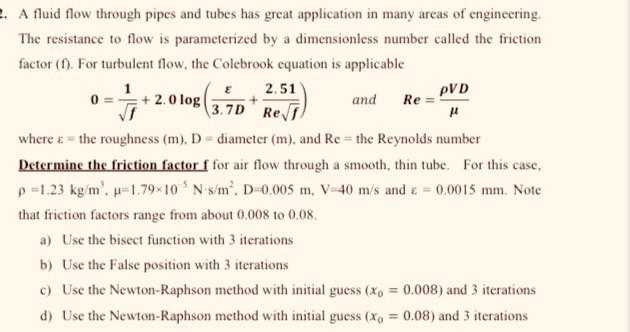
A fluid flow through pipes and tubes has great application in many areas of engineering. The resistance to flow is parameterized by a dimensionless number called the friction factor (f). For turbulent flow, the Colebrook equation is applicable 0=f1+2.0log(3.7D+Ref2.51)andRe=VD where = the roughness (m),D= diameter (m), and Re= the Reynolds number Determine the friction factor f for air flow through a smooth, thin tube. For this case, =1.23kg/m3,=1.79105Ns/m2,D=0.005m,V=40m/s and =0.0015mm. Note that friction factors range from about 0.008 to 0.08. a) Use the bisect function with 3 iterations b) Use the False position with 3 iterations c) Use the Newton-Raphson method with initial guess (x0=0.008) and 3 iterations d) Use the Newton-Raphson method with initial guess (x0=0.08) and 3 iterations
Step by Step Solution
There are 3 Steps involved in it

Get step-by-step solutions from verified subject matter experts
 Study Help