







Question: A general solution to Problem 1 can be written as n(t)=n+(n0n)et/ a) Determine the slope m0=dn/dt at t=0 in terms of the constants nx,n0 and
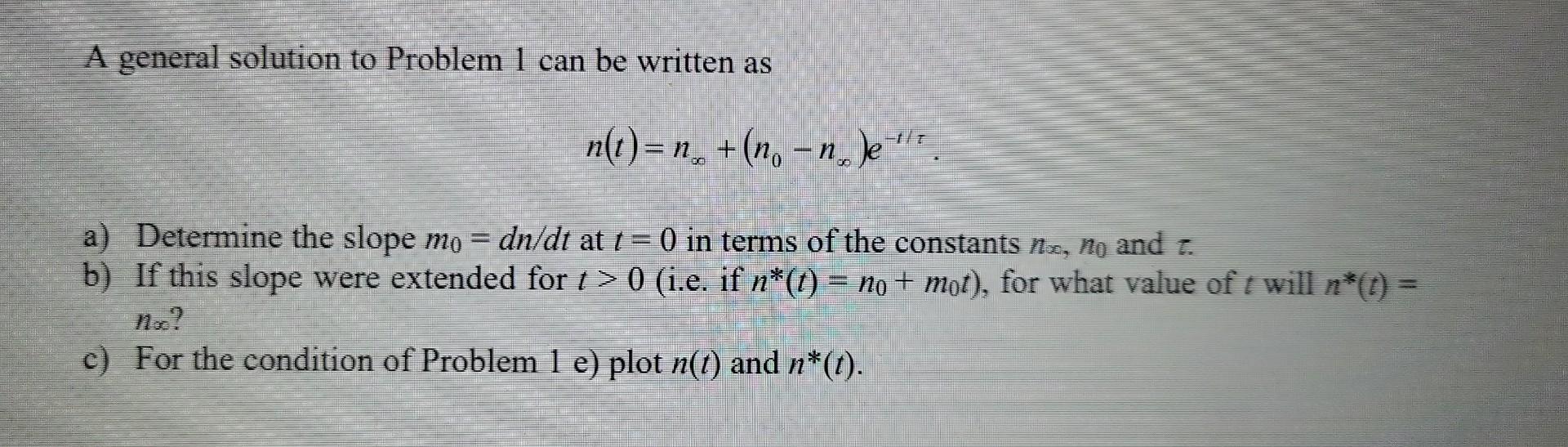
A general solution to Problem 1 can be written as n(t)=n+(n0n)et/ a) Determine the slope m0=dn/dt at t=0 in terms of the constants nx,n0 and . b) If this slope were extended for t>0 (i.e. if n(t)=n0+m0t), for what value of t will n(t)= n ? c) For the condition of Problem 1 e) plot n(t) and n(t)
Step by Step Solution
There are 3 Steps involved in it
1 Expert Approved Answer
Step: 1 Unlock

Question Has Been Solved by an Expert!
Get step-by-step solutions from verified subject matter experts
Step: 2 Unlock
Step: 3 Unlock
 Study Help