







Question: (a) In C++language, multiplication and division operations have same priority (b) In C language, C++ functions can not be used (c) In the hex-decimal notation
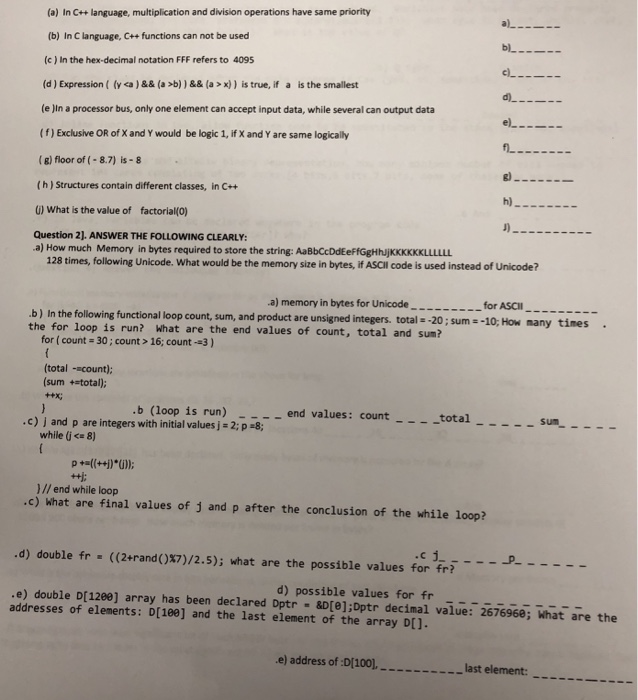
(a) In C++language, multiplication and division operations have same priority (b) In C language, C++ functions can not be used (c) In the hex-decimal notation FFF refers to 4095 (d ) Expression ( (ya)&& (a >b) ) && (a>x)) istrue, if a isthe smallest e )In a processor bus, only one element can accept input data, while several can output data (f) Exclusive OR of X and Y would be logic 1, if X and Y are same logically (8) floor of (-8.7) is-8 g) (h) Structures contain different classes, in C++ h) U) What is the value of factorial(O) Question 2). ANSWER THE FOLLOWING CLEARLY: a) How much Memory in bytes required to store the string: AaBbCcDdEeFfGgHhujKKKKKKLLLLL 128 times, following Unicode. What would be the memory size in bytes, if ASCIl code is used instead of Unicode? for ASCI . b) In the following functional loop count, sum, and product are unsigned integers. total -20; sum-10, How nany tines . the for loop is run? What are the end values of count, total and sum? for (count-30; count > 16; count -3) (total count): (sum +total); . -_- total sum b (loop is run) -end values: count .c) j and p are integers with initial values j 2: p-8; . while (j ce 8) // end while loop .c) What are final values of j and p after the conclusion of the while loop? d) double fr . ((2+rand()%7)/2.5); what are the possible values for fr? d) possible values for fr---- .e) double D[1200] array has been declared Dptr-&D[e1:Dptr decimal value: 267696e; What are the addresses of elements: D[100] and the last element of the array D[]. last element
Step by Step Solution
There are 3 Steps involved in it

Get step-by-step solutions from verified subject matter experts
 Study Help