



Question: A museum's archaeological collection includes 15 Roman (R) artifacts, 12 Persian (P) artifacts and 8 Hellenistic (H) artifacts. 4. A museum's archaeological collection includes 15
A museum's archaeological collection includes 15 Roman (R) artifacts, 12 Persian (P) artifacts and 8
Hellenistic (H) artifacts.
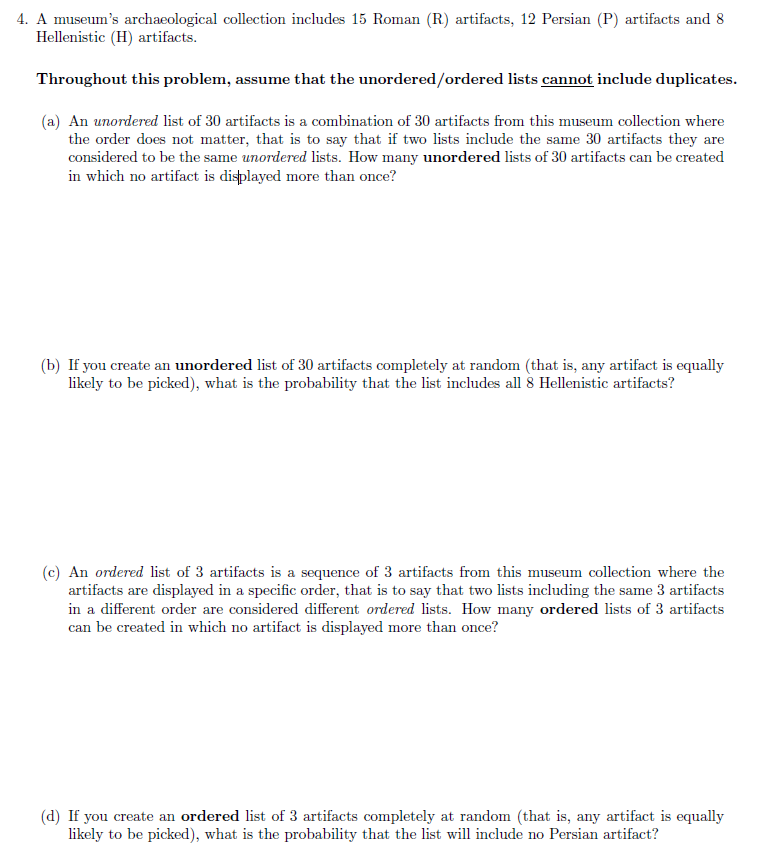
4. A museum's archaeological collection includes 15 Roman {R} artifacts, 12 Persian {P} artifacts and S Hellenistic {H} artifacts. Throughout this problem, assume that the unorderedfordered lists cannot include duplicates. [a] An unordered list of 31] artifacts is a combination of 3D artifacts from this museum collection where the order does not matter, that is to say that if two lists include the same 30 artifacts they are considered to be the same unordered lists. How many unordered lists of 3f] artifacts can he created in which no artifact is disiplayed more than once? [b] If you create an unordered list of 3D artifacts completely at random [that is, any artifact is equally likely to he picked]... what is the probability that the list includes all 3 Hellenistic artifacts? {c} An ordered list of 3 artifacts is a sequence of 3 artifacts from this museum collection where the artifacts are displayed in a specic order, that is to say that two lists including the same 3 artifacts in a di'erent order are considered di'erent ordered lists. How many ordered lists of 3 artifacts can he created in which no artifact is displayed more than once?I [d] If you create an ordered list of 3 artifacts completely at random [that is, any artifact is equally likely to he picked}j what is the probability that the list will include no Persian artifact
Step by Step Solution
There are 3 Steps involved in it

Get step-by-step solutions from verified subject matter experts