Question: i just need the last 3 done i finished 4 questions Coleman Museum Questions to consider: 1. What is the image of the Coleman Museum
i just need the last 3 done i finished 4 questions
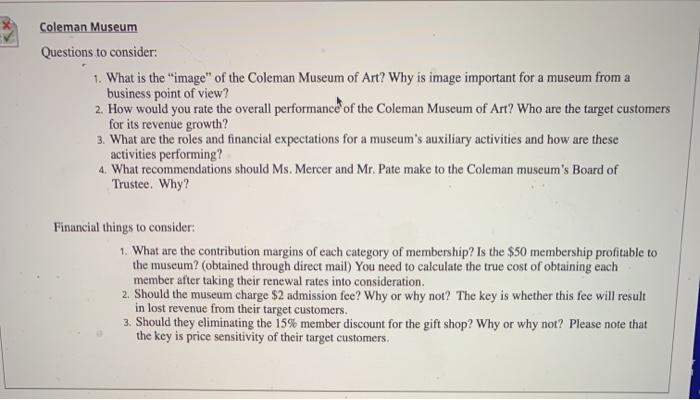
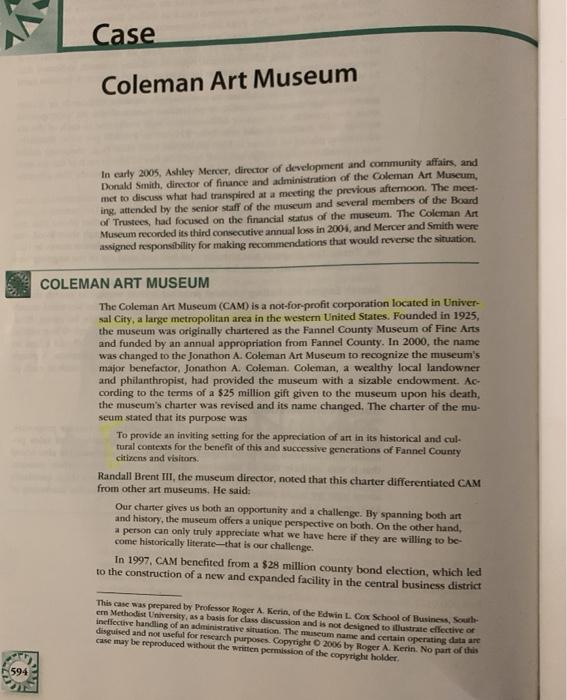
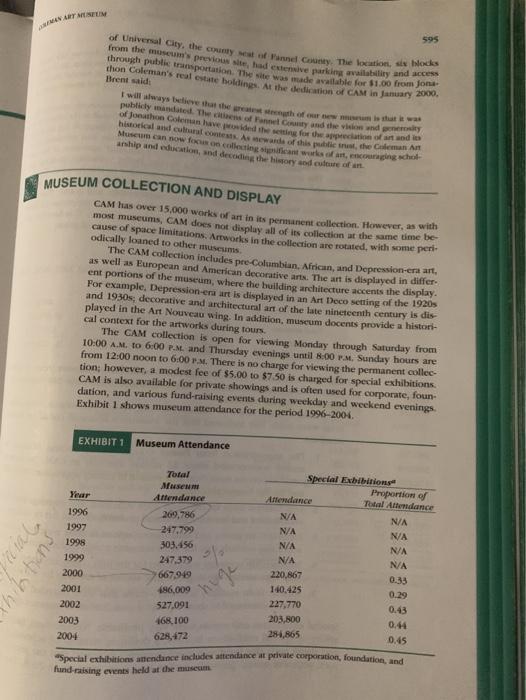
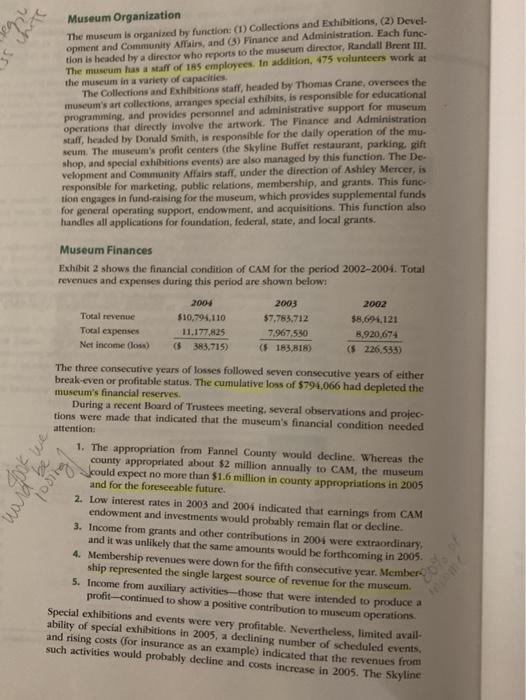
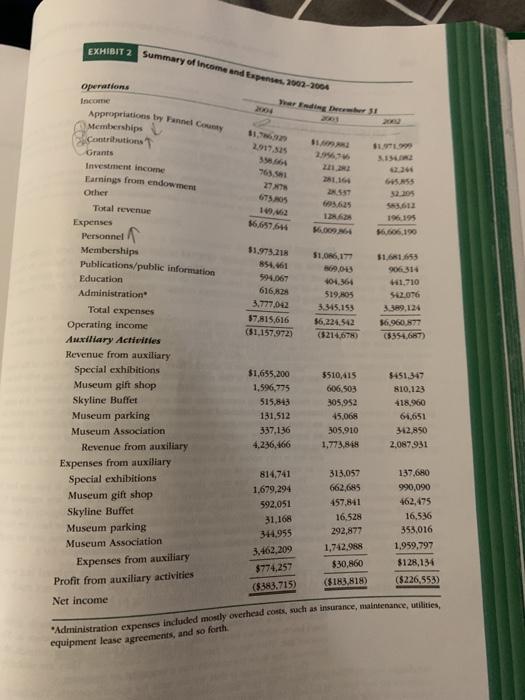
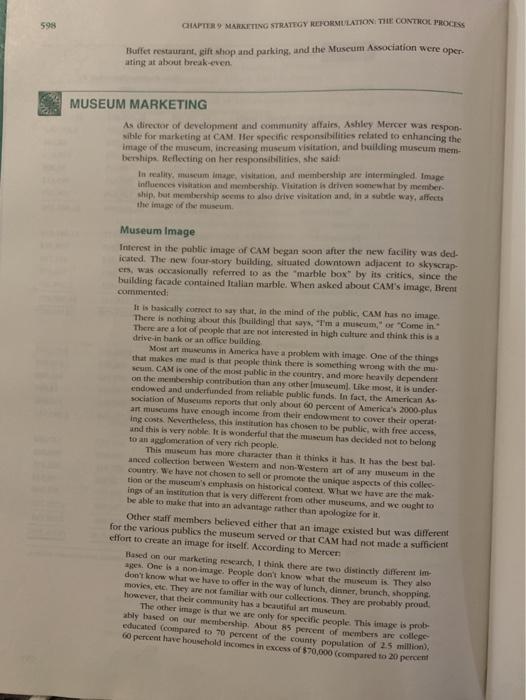
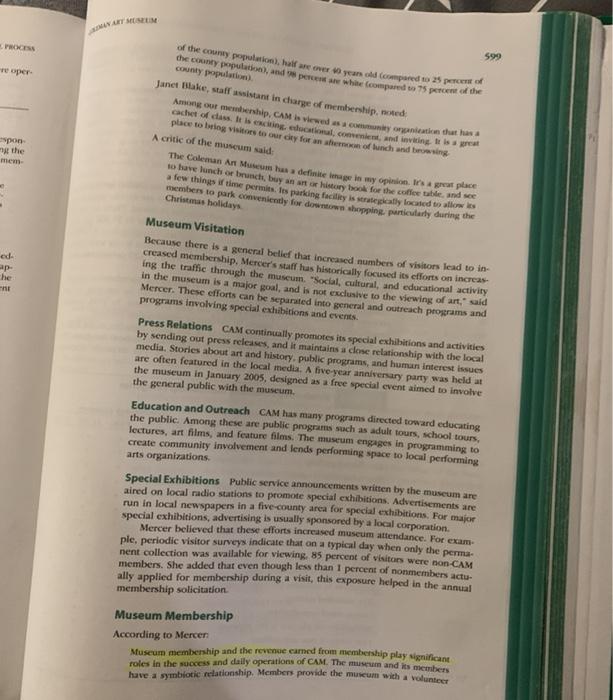
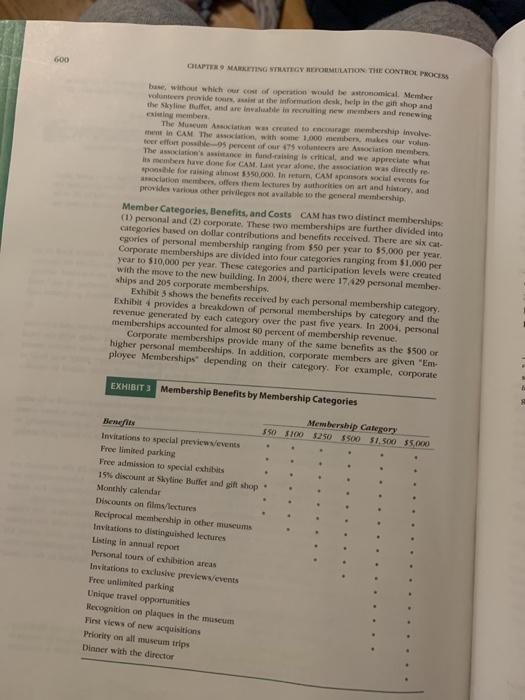
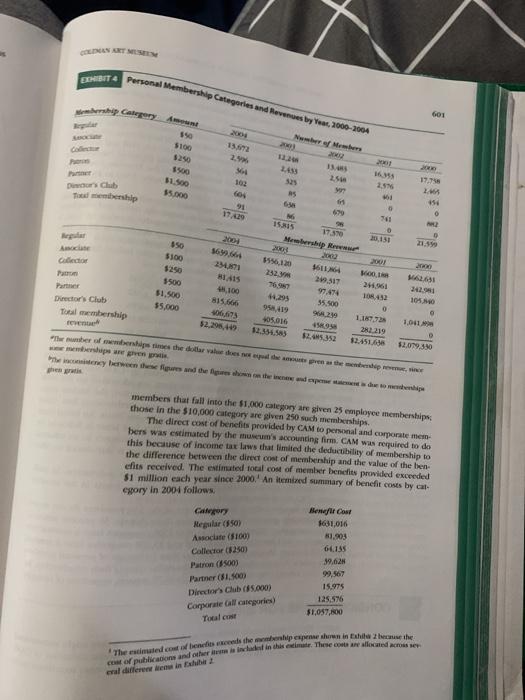
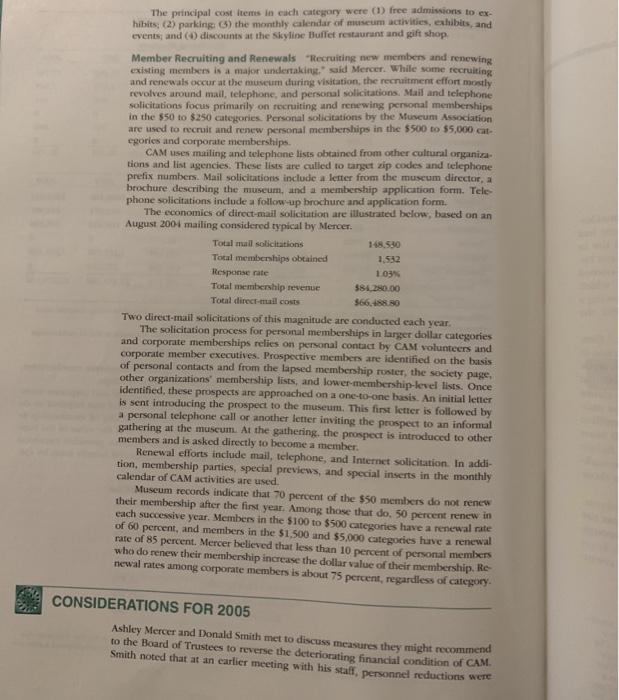
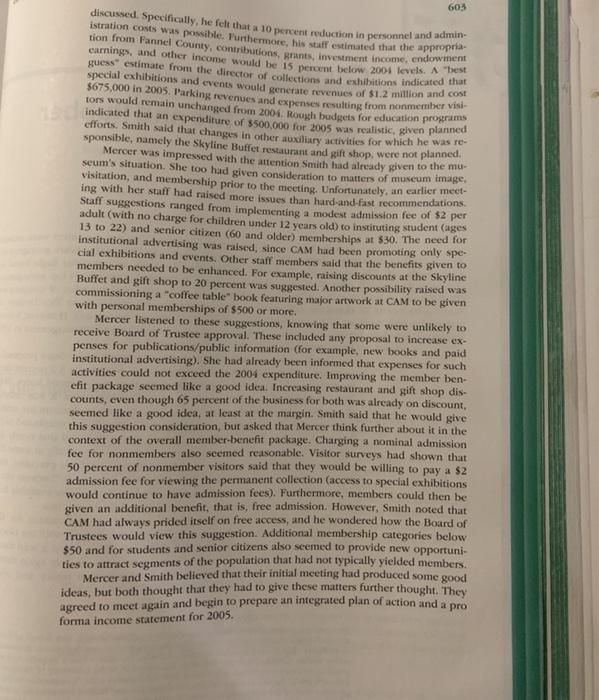
Coleman Museum Questions to consider: 1. What is the "image" of the Coleman Museum of Art? Why is image important for a museum from a business point of view? 2. How would you rate the overall performance of the Coleman Museum of Art? Who are the target customers for its revenue growth? 3. What are the roles and financial expectations for a museum's auxiliary activities and how are these activities performing? 4. What recommendations should Ms. Mercer and Mr. Pate make to the Coleman museum's Board of Trustee. Why? Financial things to consider: 1. What are the contribution margins of each category of membership? Is the $50 membership profitable to the museum? (obtained through direct mail) You need to calculate the true cost of obtaining each member after taking their renewal rates into consideration 2. Should the museum charge $2 admission fee? Why or why not? The key is whether this fee will result in lost revenue from their target customers. 3. Should they eliminating the 15% member discount for the gift shop? Why or why not? Please note that the key is price sensitivity of their target customers. Case Coleman Art Museum In early 2005, Ashley Mercer, director of development and community affairs, and Donald Smith, director of finance and administration of the Coleman Art Museum, met to discuss what had transpired at a meeting the previous afternoon. The meet ing, attended by the senior staff of the museum and several members of the Board of Trustees, had focused on the financial status of the museum. The Coleman Art Museum recorded its third consecutive annual loss in 2001, and Mercer and Smith were assigned responsibility for making recommendations that would reverse the situation. COLEMAN ART MUSEUM The Coleman Art Museum (CAM) is a not-for-profit corporation located in Univer- sal City, a large metropolitan area in the western United States. Founded in 1925, the museum was originally chartered as the Fannel County Museum of Fine Arts and funded by an annual appropriation from Fannel County. In 2000, the name was changed to the Jonathon A. Coleman Art Museum to recognize the museum's major benefactor, Jonathon A. Coleman Coleman, a wealthy local landowner and philanthropist, had provided the museum with a sizable endowment. Ac- cording to the terms of a $25 million gift given to the museum upon his death, the museum's charter was revised and its name changed. The charter of the mu- seum stated that its purpose was To provide an inviting setting for the appreciation of art in its historical and cul- tural contexts for the benefit of this and successive generations of Fannel County citizens and visitors. Randall Brent III, the museum director, noted that this charter differentiated CAM from other art museums. He said: Our charter gives us both an opportunity and a challenge. By spanning both att and history, the museum offers a unique perspective on both. On the other hand, a person can only truly appreciate what we have here if they are willing to be come historically literate that is our challenge. In 1997, CAM benefited from a $28 million county bond election, which led to the construction of a new and expanded facility in the central business district This case was prepared by Professor Roger A. Kerin, of the Edwin L. Cox School of Business, South ern Methodist University, as a basis for class discussion and is not designed to illustrate elective of ineffective handling of an administrative situation. The muscum name and certain operating data are disguised and not useful for research purposes. Copyright 2006 by Roger A. Kerin. No part of this case may be reproduced without the written permission of the copyright holder 594 MAS ART MUSEUM 595 of Universal City, the county of wely. The beatos from the museum's presion site, had extensive parkleng availability and on thon Coleman's real estate holding the diction of CAM in January 2000, through public transportation. The same wallable for $1.00 from Jone Brent said: publicly mandated. The one on the vision and more lways believe that wash of www.ba of Jonathan Coleman have proided wetting for the appreciation of art and an historical and cultura contest Aware of this policies, the reman Muscum can now foron on collecting and works of art, encouraging chet anship and education, and decoding the word core of an MUSEUM COLLECTION AND DISPLAY CAM has over 15.000 works of art in les permanent collection. However, as with most museums, CAM does not display all of its collection at the same time be cause of space limitations. Artworks in the collection are rotated, with some per odically loaned to other museums The CAM collection includes pre-Columbian, African, and Depressionera art. as well as European and American decorative arts. The art is displayed in differ ent portions of the museum, where the building architecture accents the display For example, Depression era art is displayed in an Art Deco setting of the 1920 and 1930s, decorative and architectural art of the late nineteenth century is dis played in the Art Nouveau wing. In addition, museum docents provide a histori cal context for the artworks during tours. The CAM collection is open for viewing Monday through Saturday from 10:00 AM to 6:00 PM and Thursday evenings until 8.00 PM Sunday hours are from 12:00 noon to 6:00 PM. There is no charge for viewing the permanent collec tion; however, a modest fee of $5.00 to $750 is charged for special exhibitions CAM is also available for private showings and is often used for corporate, foun dation, and various fund-raising events during weekday and weekend evenings Exhibit 1 shows museum attendance for the period 1996-2004 EXHIBIT 1 Museum Attendance vacial ole Total Special Exhibitions MNSEN Year Proportion of Attendance Attendance Total Attendance 1996 269,786 NA NA 1997 247.799 N/A NA 1998 303,456 N/A NA 1999 247.379 NA NA 2000 667949 220,867 0.33 2001 196,009 140.425 0.29 2002 527.091 227,770 0.43 2003 168.100 203,800 0.44 2004 628,472 284,865 0.45 Special exhibitions attendance includes attendance at private corporation, foundation, and fundraising events held at the museum uge EXHIBIT 2 Summary of income and spens, 2002-2004 Operations Income Appropriations try F CORY Memberships scontributions Grants Investment income 2,917.25 8. Earnings from endowment Other 52.105 Total revenue 675.00 19.2 16,257,64 1.009. 196.195 606,190 31.975.218 854.461 594.067 616.28 3,777,042 97.815,616 (51,157,972) 51,017 09.013 104,364 519 05 3,345,153 $6,224,542 $214,670 51.61653 906314 41.710 SE2076 3389,124 16.960,577 (5351617) Expenses Personnel Memberships Publications/public information Education Administration Total expenses Operating income Auxiliary Activities Revenue from auxiliary Special exhibitions Museum gift shop Skyline Buffet Museum parking Museum Association Revenue from auxiliary Expenses from auxiliary Special exhibitions Museum gift shop Skyline Buffet Museum parking Museum Association $1,655,200 1,596,775 515.813 131,512 337,136 4,236,166 5510,415 606,503 305952 45.068 305.910 1,773,818 $451.347 810,123 418.960 61,651 3:12,850 2,087931 814,741 1.679,294 592.051 31,168 344,955 3.462,209 $774,257 ($383.715) 313.057 662,685 457,841 16,528 292,877 1,742.988 $30,860 ($183,818) 137.680 990,090 462,475 16,536 353,016 1.959.797 $128,134 ($226,553) Expenses from auxiliary Profit from auxiliary activities Net Income Administration expenses included mostly overhead cones, such as insurance, maintenance, utilities, equipment lease agreements, and so forth. 598 CHAPTER 9 MARKETING STRATEGY REFORMULATION, THE CONTROL PROCESS Buffet restaurant, gift shop and parking, and the Museum Association were oper ating at about break-even. MUSEUM MARKETING As director of development and community affairs, Ashley Mercer was respon sible for marketing at CAM. Her specific responsibilities related to enhancing the image of the museum, increasing museum visitation, and building museum mem- berships Reflecting on her responsibilities, she said In reality, museum Image visitation, and membership are intermingled. Image Influences visitation and membership. Viuitation is driven somewhat by member ship, bat membership woems to also drive visitation and, in a subtle way, affects the image of the museum Museum Image Interest in the public image of CAM began soon after the new facility was ded- icated. The new four-story building, situated downtown adjacent to skyscrap ers, was occasionally referred to as the marble box" by its critics, since the building facade contained Italian marble. When asked about CAM's Image, Brent commented It is basically connect to say that in the mind of the public. CAM has no image. There is nothing about this building that says. "I'm a museum," or "Come in There are a lot of people that are not interested in high culture and think this is a drive-in bank or an office building Most art museumis in America have a problem with image. One of the things that makes me mad is that people think there is something wrong with the mu sum. CAM is one of the most public in the country, and more heavily dependent on the membership contribution than any other museum]. Like most, it is under endowed and underfunded from reliable public funds. In fact, the American As sociation of Museums reports that only about 60 percent of America's 2000 plus art museums have enough income from their endowment to cover their operat ing costs. Nevertheless, this institution has chosen to be public, with free access and this is very noble. It is wonderful that the museum has decided not to belong to an ademeration of very rich people. This museum has more character than it thinks it has. It has the best bal- anced collection between Westem and non-Western art of any museum in the country. We have not chosen to sell or promote the unique aspects of this collec tion of the museum's emphasis on historical context, What we have are the mak ings of an institution that is very different from other museums, and we sught to be able to make that into an advantage rather than apologize for it Other staff members believed either that an image existed but was different for the various publics the museum served or that CAM had not made a sufficient effort to create an image for itself. According to Mercer Based on our marketing research, I think there are two distinctly different im aper One is a non-image. People don't know what the museum is They also don't know what we have to offer in the way of lunch, dinner, brunch, shopping movies, etc. They are not familiar with our collections. They are probably proud however, that their community has a beautiful art museum The other image is that we are only for specific people. This image is prob ably based on our membership About 85 percent of members are college educated (compared to 70 percent of the county population of 25 million 6 percent have household incomes in excess of 870,000 (compared to 20 percent UIT MUSEUM PROCESS 599 e oper of the county population), half are one years old compared to 25 perhe the county population and person han compared to 75 percent of the county population) Janet Blake, staff assistant in charge of membership, noted Among our membership, CAM is viewed as a communay ranitidut has cachet of daw. It is exciting electional commanding te place to bring visitors to our chay for an emon of bunch and browsing A critic of the museum said: The Coleman Art Museum has a define tage in my opinions et place obave lunch or bmct, buy an art of history book for the coffee table and see few things i time permites parking facility is strategically located to allows members to park conveniently for downtown shopping particularly during the Christmas holidays - the mem- ed. ap- he Museum Visitation Because there is a general belief that increased numbers of visitors lead to in- creased membership, Mercer's staff hus historically focused its efforts on increas ing the traffic through the museum. Social, cultural, and educational activity in the museum is a major goal, and is not exclusive to the viewing of art," said Mercer. These efforts can be separated into general and outreach programs and programs involving special exhibitions and events. Press Relations CAM continually promotes its special exhibitions and activities by sending out press releases, and it maintains a close relationship with the local media. Stories about art and history, public programs, and human interest issues are often featured in the local media. A five-year anniversary party was held at the museum in January 2005, designed as a free special event aimed to involve the general public with the museum. Education and Outreach CAM has many programs directed toward educating the public. Among these are public programs such as adult tours, school tours, lectures, art films, and feature films. The museum engages in programming to create community involvement and lends performing space to local performing arts organizations Special Exhibitions Public service announcements written by the museum are aired on local radio stations to promote special exhibitions. Advertisements are run in local newspapers in a five county area for special exhibitions. For major special exhibitions, advertising is usually sponsored by a local corporation Mercer believed that these efforts increased museum attendance. For exam ple, periodic visitor surveys indicate that on a typical day when only the perma nent collection was available for viewing. 85 percent of visitors were non CAM members. She added that even though less than 1 percent of nonmembers actu- ally applied for membership during a visit this exposure helped in the annual membership solicitation Museum Membership According to Mercer Museum membership and the reve came from membership play significant roles in the success and daily operations of CAM. The museum and its members have a symbiotic relationship. Members provide the museum with a volunteer CHAPTER MARKETING MATIGY NEOBMULATION THE CONTROL POISS be without which cost of operation would be astronomical Member volanteen provide om, at the information desk, bep in the point shop and the skyfie Buffet, and are invaluable in recruiting new members and renewing ding member The Museum Ar was created to membership invehe. en in CAM The aim with some 1.000 members, makes our vous beer effort possible percent of our wonders are comemben The association's ice in funcils critical and we appreciate what its members have done for CAM year on the action was directly sponsible for raising most 50.000 eur, CAM powacial events for sociation members offers the lectures by authorities on art and history, and provides various other privileges not wait to the general membership Member Categories, Benefits, and Costs CAM has two distinct memberships (1) personal and (2) corporate. These two memberships are further divided into Categories based on dollar contributions and benefits received. There are six cat- egories of personal membership ranging from $50 per year to $5.000 per year, Corporate memberships are divided into four categories ranging from $1,000 per year to $10,000 per year. These categories and participation levels were created with the move to the new building. In 2004, there were 17429 personal member ships and 205 corporate memberships. Exhibit 3 shows the benefits received by each personal membership Category Exhibit prowides a breakdown of personal memberships by category and the revenue generated by each category over the past five years. In 2004, personal memberships accounted for almost 50 percent of membership revenue. Corporate memberships provide many of the same benefits as the $500 or higher personal memberships. In addition, corporate members are given "Em- ployee Memberships depending on their category. For example, corporate EXHIBIT3 Membership Benefits by Membership Categories Membership Category Benefits 550 $100 $250 $500 $1.500 55.000 Invitations to special preview events Free limited parking Free admission to special exhibits 19% discount at Skyline Buffet and gift shop Sonthly Calendar Discounts on films/lectures Reciprocal membership in other museum Invitations to distinguished lectures Listing in annual report Personal tours of exhibition areas Invitations to exclusive previews/events Free unlimited parking Unique travel opportunities Recognition on plaques in the museum First views of new acquisitions Priority on all museum trips Dinner with the director EENBET Personal Membership Categories and Revenue by Year 2000-2004 Calczory 603 2004 13.02 23 200 2001 2433 2000 1290 900 $1.500 $5.000 LS 17.75 102 GOS 91 25 0 Ace Coco 153815 0 17370 21.5 2007 Mership 200 850 $100 232. 19.317 24.96 3500 10.432 35.500 o $1.500 95,419 1.041 Director's Club 55.000 0673 05.016 45.99 282.219 Total membership 12,354.53 22 12.079.350 even Thurber one times the dollar values e depende bespre en een pers and the shown on the needed members that fall into the $1.000 calegory are given 25 employee memberships those in the $10,000 category are gen 250 sach memberships The direct cost of benefits provided by CAM to personal and corporate mem- bers was estimated by the museum's accounting firm. CAM was required to do this because of income tax laws that limited the deductibility of membership to the difference between the direct cont of membership and the value of the ben efits received. The estimated to al cost of member benefits provided exceeded $1 million each year since 2000. An itemized summary of benefit costs by cat egory in 2004 follows Category Regular (50) Associate (100) Collector (250) Patron () Partner ($1.500 Directors Club 5.000) Corporate Gall categories Tocal.com Benefit Cose $631,016 11.903 64.135 39.02 99,567 15.975 125576 $1,057,600 pucandora in this time. The band me eral die in Exhibit 603 discussed. Specifically, he felt that a 10 percent reduction in personnel and adipis istration costs was possible. Furthermore, his staff estimated that the appropriat tion from Fannel County, contributions, grans, investment income, endowment guess" estimate from the director of collections and exhibitions indicated that special exhibitions and events would generate revenues of $1.2 million and cool $675,000 in 2005. Parking revenues and expenses resulting from nonmember visi tors would remain unchanged from 2004. Rough budgets for education programa indicated that an expenditure of 8500,000 for 2005 was realistic, siven planted efforts. Smith said that changes in other auxiliary activities for which he was re sponsible, namely the Skyline Buffet restaurant and gift shop, were not planned. Mercer was impressed with the attention Smith had already given to the mu- seum's situation. She too had given consideration to matters of museum image visitation, and membership prior to the meeting. Unfortunately, an carlier meet ing with her staff had raised more issues than hard-and-fast recommendations. Staff suggestions ranged from implementing a modest admission fee of $2 per adult (with no charge for children under 12 years old) to instituting student (ages 13 to 22) and senior citizen (60 and older) memberships at $30. The need for institutional advertising was raised, since CAM had been promoting only spe- cial exhibitions and events. Other staff members said that the benefits given to members needed to be enhanced. For example, raising discounts at the Skyline Buffet and gift shop to 20 percent was suggested. Another possibility raised was commissioning a "coffee table book featuring major artwork at CAM to be given with personal memberships of $500 or more. Mercer listened to these suggestions, knowing that some were unlikely to receive Board of Trustee approval. These included any proposal to increase ex- penses for publications/publie information (for example, new books and paid institutional advertising). She had already been informed that expenses for such activities could not exceed the 2004 expenditure. Improving the member ben- efit package seemed like a good idea. Increasing restaurant and gift shop dis- counts, even though 65 percent of the business for both was already on discount, seemed like a good idea, at least at the margin. Smith said that he would give this suggestion consideration, but asked that Mercer think further about it in the context of the overall member-benefit package. Charging a nominal admission fee for nonmembers also seemed reasonable. Visitor surveys had shown that 50 percent of nonmember visitors said that they would be willing to pay a $2 admission fee for viewing the permanent collection (access to special exhibitions would continue to have admission fees). Furthermore, members could then be given an additional benefit, that is free admission. However, Smith noted that CAM had always prided itself on free access, and he wondered how the Board of Trustees would view this suggestion. Additional membership categories below $50 and for students and senior citizens also seemed to provide new opportuni- ties to attract segments of the population that had not typically yielded members. Mercer and Smith believed that their initial meeting had produced some good ideas, but both thought that they had to give these matters further thought. They agreed to meet again and begin to prepare an integrated plan of action and a pro forma income statement for 2005. Coleman Museum Questions to consider: 1. What is the "image" of the Coleman Museum of Art? Why is image important for a museum from a business point of view? 2. How would you rate the overall performance of the Coleman Museum of Art? Who are the target customers for its revenue growth? 3. What are the roles and financial expectations for a museum's auxiliary activities and how are these activities performing? 4. What recommendations should Ms. Mercer and Mr. Pate make to the Coleman museum's Board of Trustee. Why? Financial things to consider: 1. What are the contribution margins of each category of membership? Is the $50 membership profitable to the museum? (obtained through direct mail) You need to calculate the true cost of obtaining each member after taking their renewal rates into consideration 2. Should the museum charge $2 admission fee? Why or why not? The key is whether this fee will result in lost revenue from their target customers. 3. Should they eliminating the 15% member discount for the gift shop? Why or why not? Please note that the key is price sensitivity of their target customers. Case Coleman Art Museum In early 2005, Ashley Mercer, director of development and community affairs, and Donald Smith, director of finance and administration of the Coleman Art Museum, met to discuss what had transpired at a meeting the previous afternoon. The meet ing, attended by the senior staff of the museum and several members of the Board of Trustees, had focused on the financial status of the museum. The Coleman Art Museum recorded its third consecutive annual loss in 2001, and Mercer and Smith were assigned responsibility for making recommendations that would reverse the situation. COLEMAN ART MUSEUM The Coleman Art Museum (CAM) is a not-for-profit corporation located in Univer- sal City, a large metropolitan area in the western United States. Founded in 1925, the museum was originally chartered as the Fannel County Museum of Fine Arts and funded by an annual appropriation from Fannel County. In 2000, the name was changed to the Jonathon A. Coleman Art Museum to recognize the museum's major benefactor, Jonathon A. Coleman Coleman, a wealthy local landowner and philanthropist, had provided the museum with a sizable endowment. Ac- cording to the terms of a $25 million gift given to the museum upon his death, the museum's charter was revised and its name changed. The charter of the mu- seum stated that its purpose was To provide an inviting setting for the appreciation of art in its historical and cul- tural contexts for the benefit of this and successive generations of Fannel County citizens and visitors. Randall Brent III, the museum director, noted that this charter differentiated CAM from other art museums. He said: Our charter gives us both an opportunity and a challenge. By spanning both att and history, the museum offers a unique perspective on both. On the other hand, a person can only truly appreciate what we have here if they are willing to be come historically literate that is our challenge. In 1997, CAM benefited from a $28 million county bond election, which led to the construction of a new and expanded facility in the central business district This case was prepared by Professor Roger A. Kerin, of the Edwin L. Cox School of Business, South ern Methodist University, as a basis for class discussion and is not designed to illustrate elective of ineffective handling of an administrative situation. The muscum name and certain operating data are disguised and not useful for research purposes. Copyright 2006 by Roger A. Kerin. No part of this case may be reproduced without the written permission of the copyright holder 594 MAS ART MUSEUM 595 of Universal City, the county of wely. The beatos from the museum's presion site, had extensive parkleng availability and on thon Coleman's real estate holding the diction of CAM in January 2000, through public transportation. The same wallable for $1.00 from Jone Brent said: publicly mandated. The one on the vision and more lways believe that wash of www.ba of Jonathan Coleman have proided wetting for the appreciation of art and an historical and cultura contest Aware of this policies, the reman Muscum can now foron on collecting and works of art, encouraging chet anship and education, and decoding the word core of an MUSEUM COLLECTION AND DISPLAY CAM has over 15.000 works of art in les permanent collection. However, as with most museums, CAM does not display all of its collection at the same time be cause of space limitations. Artworks in the collection are rotated, with some per odically loaned to other museums The CAM collection includes pre-Columbian, African, and Depressionera art. as well as European and American decorative arts. The art is displayed in differ ent portions of the museum, where the building architecture accents the display For example, Depression era art is displayed in an Art Deco setting of the 1920 and 1930s, decorative and architectural art of the late nineteenth century is dis played in the Art Nouveau wing. In addition, museum docents provide a histori cal context for the artworks during tours. The CAM collection is open for viewing Monday through Saturday from 10:00 AM to 6:00 PM and Thursday evenings until 8.00 PM Sunday hours are from 12:00 noon to 6:00 PM. There is no charge for viewing the permanent collec tion; however, a modest fee of $5.00 to $750 is charged for special exhibitions CAM is also available for private showings and is often used for corporate, foun dation, and various fund-raising events during weekday and weekend evenings Exhibit 1 shows museum attendance for the period 1996-2004 EXHIBIT 1 Museum Attendance vacial ole Total Special Exhibitions MNSEN Year Proportion of Attendance Attendance Total Attendance 1996 269,786 NA NA 1997 247.799 N/A NA 1998 303,456 N/A NA 1999 247.379 NA NA 2000 667949 220,867 0.33 2001 196,009 140.425 0.29 2002 527.091 227,770 0.43 2003 168.100 203,800 0.44 2004 628,472 284,865 0.45 Special exhibitions attendance includes attendance at private corporation, foundation, and fundraising events held at the museum uge EXHIBIT 2 Summary of income and spens, 2002-2004 Operations Income Appropriations try F CORY Memberships scontributions Grants Investment income 2,917.25 8. Earnings from endowment Other 52.105 Total revenue 675.00 19.2 16,257,64 1.009. 196.195 606,190 31.975.218 854.461 594.067 616.28 3,777,042 97.815,616 (51,157,972) 51,017 09.013 104,364 519 05 3,345,153 $6,224,542 $214,670 51.61653 906314 41.710 SE2076 3389,124 16.960,577 (5351617) Expenses Personnel Memberships Publications/public information Education Administration Total expenses Operating income Auxiliary Activities Revenue from auxiliary Special exhibitions Museum gift shop Skyline Buffet Museum parking Museum Association Revenue from auxiliary Expenses from auxiliary Special exhibitions Museum gift shop Skyline Buffet Museum parking Museum Association $1,655,200 1,596,775 515.813 131,512 337,136 4,236,166 5510,415 606,503 305952 45.068 305.910 1,773,818 $451.347 810,123 418.960 61,651 3:12,850 2,087931 814,741 1.679,294 592.051 31,168 344,955 3.462,209 $774,257 ($383.715) 313.057 662,685 457,841 16,528 292,877 1,742.988 $30,860 ($183,818) 137.680 990,090 462,475 16,536 353,016 1.959.797 $128,134 ($226,553) Expenses from auxiliary Profit from auxiliary activities Net Income Administration expenses included mostly overhead cones, such as insurance, maintenance, utilities, equipment lease agreements, and so forth. 598 CHAPTER 9 MARKETING STRATEGY REFORMULATION, THE CONTROL PROCESS Buffet restaurant, gift shop and parking, and the Museum Association were oper ating at about break-even. MUSEUM MARKETING As director of development and community affairs, Ashley Mercer was respon sible for marketing at CAM. Her specific responsibilities related to enhancing the image of the museum, increasing museum visitation, and building museum mem- berships Reflecting on her responsibilities, she said In reality, museum Image visitation, and membership are intermingled. Image Influences visitation and membership. Viuitation is driven somewhat by member ship, bat membership woems to also drive visitation and, in a subtle way, affects the image of the museum Museum Image Interest in the public image of CAM began soon after the new facility was ded- icated. The new four-story building, situated downtown adjacent to skyscrap ers, was occasionally referred to as the marble box" by its critics, since the building facade contained Italian marble. When asked about CAM's Image, Brent commented It is basically connect to say that in the mind of the public. CAM has no image. There is nothing about this building that says. "I'm a museum," or "Come in There are a lot of people that are not interested in high culture and think this is a drive-in bank or an office building Most art museumis in America have a problem with image. One of the things that makes me mad is that people think there is something wrong with the mu sum. CAM is one of the most public in the country, and more heavily dependent on the membership contribution than any other museum]. Like most, it is under endowed and underfunded from reliable public funds. In fact, the American As sociation of Museums reports that only about 60 percent of America's 2000 plus art museums have enough income from their endowment to cover their operat ing costs. Nevertheless, this institution has chosen to be public, with free access and this is very noble. It is wonderful that the museum has decided not to belong to an ademeration of very rich people. This museum has more character than it thinks it has. It has the best bal- anced collection between Westem and non-Western art of any museum in the country. We have not chosen to sell or promote the unique aspects of this collec tion of the museum's emphasis on historical context, What we have are the mak ings of an institution that is very different from other museums, and we sught to be able to make that into an advantage rather than apologize for it Other staff members believed either that an image existed but was different for the various publics the museum served or that CAM had not made a sufficient effort to create an image for itself. According to Mercer Based on our marketing research, I think there are two distinctly different im aper One is a non-image. People don't know what the museum is They also don't know what we have to offer in the way of lunch, dinner, brunch, shopping movies, etc. They are not familiar with our collections. They are probably proud however, that their community has a beautiful art museum The other image is that we are only for specific people. This image is prob ably based on our membership About 85 percent of members are college educated (compared to 70 percent of the county population of 25 million 6 percent have household incomes in excess of 870,000 (compared to 20 percent UIT MUSEUM PROCESS 599 e oper of the county population), half are one years old compared to 25 perhe the county population and person han compared to 75 percent of the county population) Janet Blake, staff assistant in charge of membership, noted Among our membership, CAM is viewed as a communay ranitidut has cachet of daw. It is exciting electional commanding te place to bring visitors to our chay for an emon of bunch and browsing A critic of the museum said: The Coleman Art Museum has a define tage in my opinions et place obave lunch or bmct, buy an art of history book for the coffee table and see few things i time permites parking facility is strategically located to allows members to park conveniently for downtown shopping particularly during the Christmas holidays - the mem- ed. ap- he Museum Visitation Because there is a general belief that increased numbers of visitors lead to in- creased membership, Mercer's staff hus historically focused its efforts on increas ing the traffic through the museum. Social, cultural, and educational activity in the museum is a major goal, and is not exclusive to the viewing of art," said Mercer. These efforts can be separated into general and outreach programs and programs involving special exhibitions and events. Press Relations CAM continually promotes its special exhibitions and activities by sending out press releases, and it maintains a close relationship with the local media. Stories about art and history, public programs, and human interest issues are often featured in the local media. A five-year anniversary party was held at the museum in January 2005, designed as a free special event aimed to involve the general public with the museum. Education and Outreach CAM has many programs directed toward educating the public. Among these are public programs such as adult tours, school tours, lectures, art films, and feature films. The museum engages in programming to create community involvement and lends performing space to local performing arts organizations Special Exhibitions Public service announcements written by the museum are aired on local radio stations to promote special exhibitions. Advertisements are run in local newspapers in a five county area for special exhibitions. For major special exhibitions, advertising is usually sponsored by a local corporation Mercer believed that these efforts increased museum attendance. For exam ple, periodic visitor surveys indicate that on a typical day when only the perma nent collection was available for viewing. 85 percent of visitors were non CAM members. She added that even though less than 1 percent of nonmembers actu- ally applied for membership during a visit this exposure helped in the annual membership solicitation Museum Membership According to Mercer Museum membership and the reve came from membership play significant roles in the success and daily operations of CAM. The museum and its members have a symbiotic relationship. Members provide the museum with a volunteer CHAPTER MARKETING MATIGY NEOBMULATION THE CONTROL POISS be without which cost of operation would be astronomical Member volanteen provide om, at the information desk, bep in the point shop and the skyfie Buffet, and are invaluable in recruiting new members and renewing ding member The Museum Ar was created to membership invehe. en in CAM The aim with some 1.000 members, makes our vous beer effort possible percent of our wonders are comemben The association's ice in funcils critical and we appreciate what its members have done for CAM year on the action was directly sponsible for raising most 50.000 eur, CAM powacial events for sociation members offers the lectures by authorities on art and history, and provides various other privileges not wait to the general membership Member Categories, Benefits, and Costs CAM has two distinct memberships (1) personal and (2) corporate. These two memberships are further divided into Categories based on dollar contributions and benefits received. There are six cat- egories of personal membership ranging from $50 per year to $5.000 per year, Corporate memberships are divided into four categories ranging from $1,000 per year to $10,000 per year. These categories and participation levels were created with the move to the new building. In 2004, there were 17429 personal member ships and 205 corporate memberships. Exhibit 3 shows the benefits received by each personal membership Category Exhibit prowides a breakdown of personal memberships by category and the revenue generated by each category over the past five years. In 2004, personal memberships accounted for almost 50 percent of membership revenue. Corporate memberships provide many of the same benefits as the $500 or higher personal memberships. In addition, corporate members are given "Em- ployee Memberships depending on their category. For example, corporate EXHIBIT3 Membership Benefits by Membership Categories Membership Category Benefits 550 $100 $250 $500 $1.500 55.000 Invitations to special preview events Free limited parking Free admission to special exhibits 19% discount at Skyline Buffet and gift shop Sonthly Calendar Discounts on films/lectures Reciprocal membership in other museum Invitations to distinguished lectures Listing in annual report Personal tours of exhibition areas Invitations to exclusive previews/events Free unlimited parking Unique travel opportunities Recognition on plaques in the museum First views of new acquisitions Priority on all museum trips Dinner with the director EENBET Personal Membership Categories and Revenue by Year 2000-2004 Calczory 603 2004 13.02 23 200 2001 2433 2000 1290 900 $1.500 $5.000 LS 17.75 102 GOS 91 25 0 Ace Coco 153815 0 17370 21.5 2007 Mership 200 850 $100 232. 19.317 24.96 3500 10.432 35.500 o $1.500 95,419 1.041 Director's Club 55.000 0673 05.016 45.99 282.219 Total membership 12,354.53 22 12.079.350 even Thurber one times the dollar values e depende bespre en een pers and the shown on the needed members that fall into the $1.000 calegory are given 25 employee memberships those in the $10,000 category are gen 250 sach memberships The direct cost of benefits provided by CAM to personal and corporate mem- bers was estimated by the museum's accounting firm. CAM was required to do this because of income tax laws that limited the deductibility of membership to the difference between the direct cont of membership and the value of the ben efits received. The estimated to al cost of member benefits provided exceeded $1 million each year since 2000. An itemized summary of benefit costs by cat egory in 2004 follows Category Regular (50) Associate (100) Collector (250) Patron () Partner ($1.500 Directors Club 5.000) Corporate Gall categories Tocal.com Benefit Cose $631,016 11.903 64.135 39.02 99,567 15.975 125576 $1,057,600 pucandora in this time. The band me eral die in Exhibit 603 discussed. Specifically, he felt that a 10 percent reduction in personnel and adipis istration costs was possible. Furthermore, his staff estimated that the appropriat tion from Fannel County, contributions, grans, investment income, endowment guess" estimate from the director of collections and exhibitions indicated that special exhibitions and events would generate revenues of $1.2 million and cool $675,000 in 2005. Parking revenues and expenses resulting from nonmember visi tors would remain unchanged from 2004. Rough budgets for education programa indicated that an expenditure of 8500,000 for 2005 was realistic, siven planted efforts. Smith said that changes in other auxiliary activities for which he was re sponsible, namely the Skyline Buffet restaurant and gift shop, were not planned. Mercer was impressed with the attention Smith had already given to the mu- seum's situation. She too had given consideration to matters of museum image visitation, and membership prior to the meeting. Unfortunately, an carlier meet ing with her staff had raised more issues than hard-and-fast recommendations. Staff suggestions ranged from implementing a modest admission fee of $2 per adult (with no charge for children under 12 years old) to instituting student (ages 13 to 22) and senior citizen (60 and older) memberships at $30. The need for institutional advertising was raised, since CAM had been promoting only spe- cial exhibitions and events. Other staff members said that the benefits given to members needed to be enhanced. For example, raising discounts at the Skyline Buffet and gift shop to 20 percent was suggested. Another possibility raised was commissioning a "coffee table book featuring major artwork at CAM to be given with personal memberships of $500 or more. Mercer listened to these suggestions, knowing that some were unlikely to receive Board of Trustee approval. These included any proposal to increase ex- penses for publications/publie information (for example, new books and paid institutional advertising). She had already been informed that expenses for such activities could not exceed the 2004 expenditure. Improving the member ben- efit package seemed like a good idea. Increasing restaurant and gift shop dis- counts, even though 65 percent of the business for both was already on discount, seemed like a good idea, at least at the margin. Smith said that he would give this suggestion consideration, but asked that Mercer think further about it in the context of the overall member-benefit package. Charging a nominal admission fee for nonmembers also seemed reasonable. Visitor surveys had shown that 50 percent of nonmember visitors said that they would be willing to pay a $2 admission fee for viewing the permanent collection (access to special exhibitions would continue to have admission fees). Furthermore, members could then be given an additional benefit, that is free admission. However, Smith noted that CAM had always prided itself on free access, and he wondered how the Board of Trustees would view this suggestion. Additional membership categories below $50 and for students and senior citizens also seemed to provide new opportuni- ties to attract segments of the population that had not typically yielded members. Mercer and Smith believed that their initial meeting had produced some good ideas, but both thought that they had to give these matters further thought. They agreed to meet again and begin to prepare an integrated plan of action and a pro forma income statement for 2005









 Study Help