







Question: A payoff table for building a small factory and a large factory for manufacturing designer jeans is given in the accompanying table. Use the probabilities
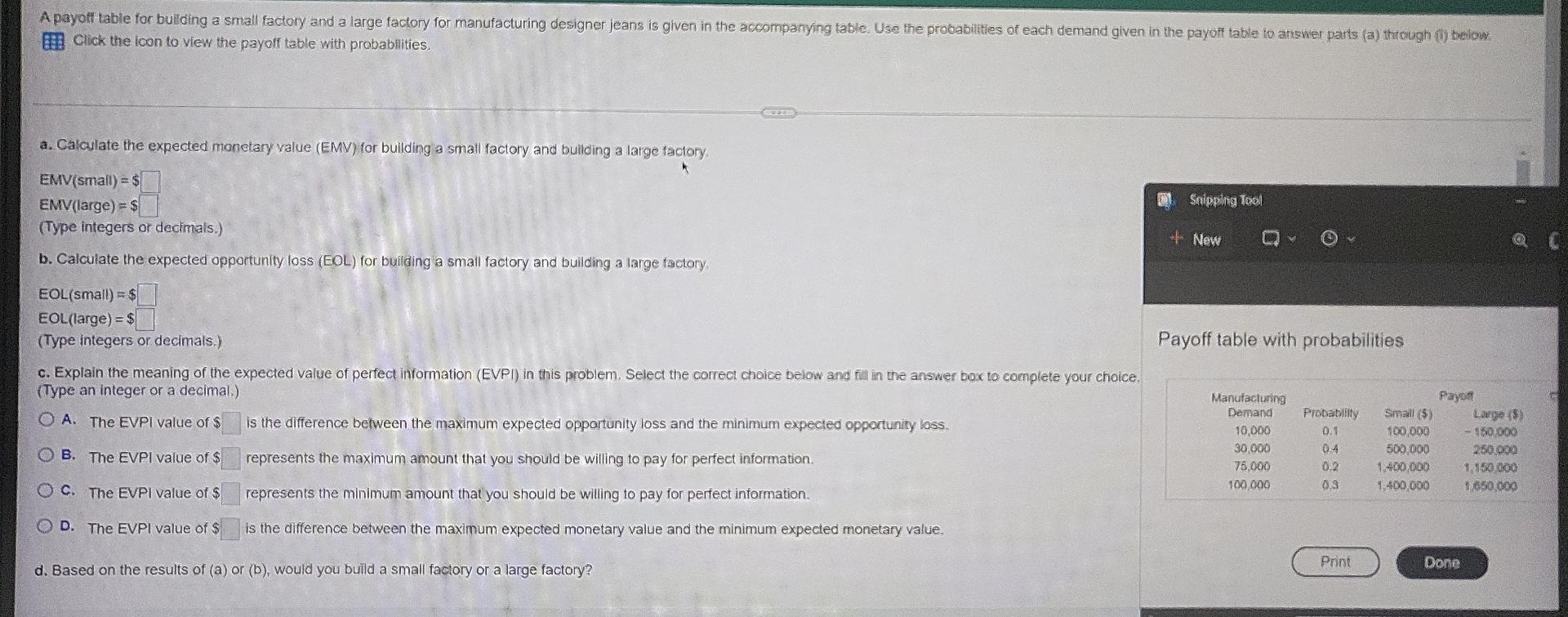
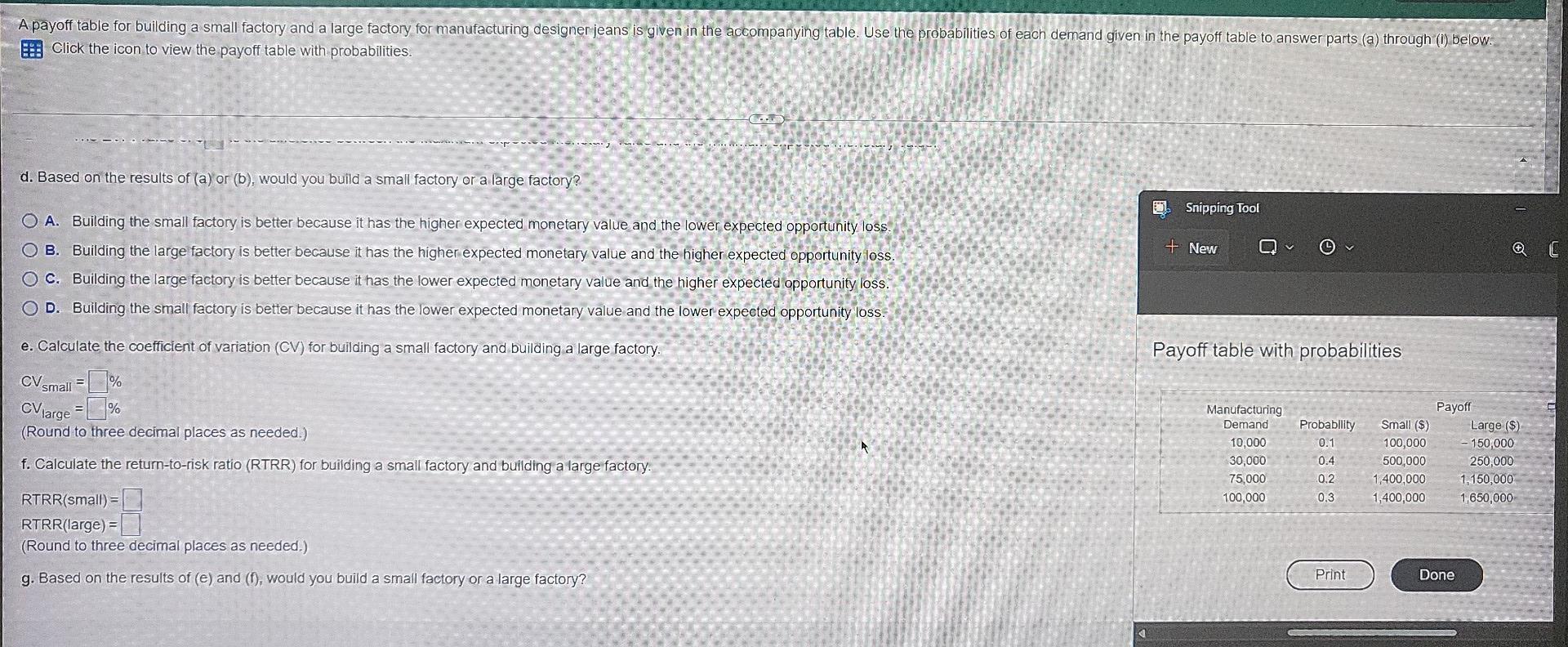
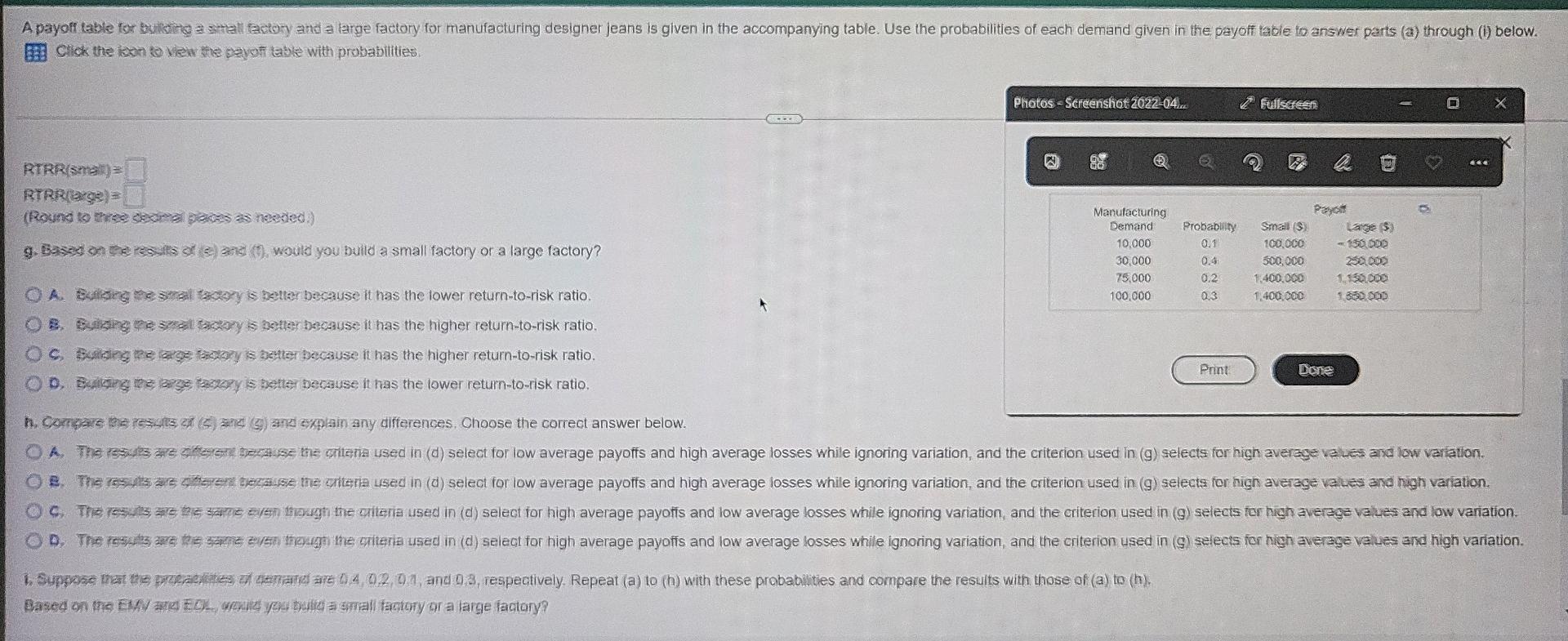

A payoff table for building a small factory and a large factory for manufacturing designer jeans is given in the accompanying table. Use the probabilities of each demand given in the payoft table to answer parts (a) through) below Click the icon to view the payoff table with probabilities. a. Calculate the expected monetary value (EMV) for building a small factory and building a large factory EMV(small) = $ EMV(large) = $ (Type integers or decimals.) EN Snipping Tool - New b. Calculate the expected opportunity loss (EOL) for building a small factory and building a large factory EOL(small) = $ EOL(large) = $ (Type integers or decimals.) Payoff table with probabilities c. Explain the meaning of the expected value of perfect information (EVPI) in this problem. Select the correct choice below and fill in the answer box to complete your choice. (Type an integer or a decimal.) O A. The EVPI value of $ is the difference between the maximum expected opportunity loss and the minimum expected opportunity loss Manufacturing Demand 10,000 30.000 75.000 100.000 Probability 0.1 04 Payon Small (5) Large (5) 100,000 100 000 500.000 250 000 1.400,000 1.150 000 1,400,000 1.650.000 B. The EVPI value of $ represents the maximum amount that you should be willing to pay for perfect information Oc. The EVPI value of $ represents the minimum amount that you should be willing to pay for perfect information. OD. The EVPI value of $ is the difference between the maximum expected monetary value and the minimum expected monetary value. Print Done d. Based on the results of (a) or (b), would you build a small factory or a large factory? A payoff table for building a small factory and a large factory for manufacturing designer jeans is given in the accompanying table. Use the probabilities of each demand given in the payoff table to answer parts (a) through (1) below. Click the icon to view the payoff table with probabilities. assis d. Based on the results of (a) or (b), would you build a small factory or a large factory? L Snipping Tool + New Qv C O A. Building the small factory is better because it has the higher expected monetary value and the lower expected opportunity loss. O B. Building the large factory is better because it has the higher expected monetary value and the higher expected opportunity loss. O c. Building the large factory is better because it has the lower expected monetary value and the higher expected opportunity loss. OD. Building the small factory is better because it has the lower expected monetary value and the lower expected opportunity loss. e. Calculate the coefficient of variation (CV) for building a small factory and building a large factory. Payoff table with probabilities CV small % % (Round to three decimal places as needed.) CViarge Manufacturing Demand 10,000 30,000 75,000 100,000 Probability 0.1 0.4 f. Calculate the return-to-risk ratio (RTRR) for building a small factory and building a large factory. Payoff Large ($) - 150,000 250,000 1,150,000 1,650,000 Small ($ 100,000 500,000 1,400,000 1,400,000 0.2 0,3 RTRR(small) = RTRR(large) = (Round to three decimal places as needed.) g. Based on the results of (e) and (), would you build a small factory or a large factory? Print Done A payoff table te buking a small factory and a large factory for manufacturing designer jeans is given in the accompanying table. Use the probabilities of each demand given in the payoff table to answer pants (a) through (1) below. Click the bone me payor table with probabilities Photos - Screenshot 2022-04. { fullscreen 0 x 04 G 7 RTRR/sma) RTRRe) = (Round to the secret os as needed.) g. Based on a results 29 would you build a small factory or a large factory? Manufacturing Demand 10.000 30.000 75.000 100,000 Probability 0.1 0.4 0.2 0.3 Psych Small (S) Larges 100.000 - 150.000 500,000 250.00 1.400.000 150.000 1.400.000 1.330.000 O A Euang sely s beter because it has the lower return-to-risk ratio. OB Buong nece tacy is better because it has the higher return-to-risk ratio. C. Saiding te ge soy is better because it has the higher return-to-risk ratio. OD. Eugi ees en is better because it has the lower return-to-risk ratio. Print Done h, compart the rest Gadg) and explain any differences. Choose the correct answer below. O A The results te cileta used in (d) select for low average payoffs and high average losses while ignoring variation, and the criterion used in (g) selects for high average veves and low variation. @ The results we heen tezause me criteria used in (d) select for low average payoffs and high average losses while ignoring variation, and the criterion used in (9) selects for high average values and high variation. OC. The results 1 307 Een trough the critena used in (d) select for high average payofis and low average losses while ignoring variation and the criterion used in (9) selects for high average values and low variation. OD. The results are the same though the criteria used in (d) select for high average payoffs and low average losses while ignoring variation and the criterion used in (9) selects for high average values and high variation. 1. Suppose that the perces, and are 04 0.2.0.0, and 02, respectively. Repeat (a) to (h) with these probabilities and compare the results with those of (a) to (h). Based on me EMV to you baba a small factory or a large factory? A payoff table for building a small factory and a large factory for manufacturing designer jeans is given in the accompanying table. Use the probabilities of each demand given in the payoff table to answer parts (a) through (i) below. B! Click the icon to view the payoff table with probabilities. COLO ILIVUUIIU UVICUUM VITIUUUU SUIVULIVI UYLVuiug puyuu ITU hyr uvuruyu vuvumiy my VUITUCIVIT, UTU WI VI VIIVIT uur 19 voru U TUI Nyli uvuruyuruluwu un ruw VULLUVIT. O B. The results are different because the criteria used in (d) select for low average payoffs and high average losses while ignoring variation, and the criterion used in (g) selects for high average values and high variation. O C. The results are the same even though the criteria used in (d) select for high average payoffs and low average losses while ignoring variation, and the criterion used in (g) selects for high average values and low variation. O D. The results are the same even though the criteria used in (d) select for high average payoffs and low average losses while ignoring variation, and the criterion used in (g) selects for high average values and high variation. Fullscreen o BE Q E i. Suppose that the probabilities of demand are 0.4,0.2, 0.1, and 0.3, respectively. Repeat (a) to (h) with these probabilities and compare the results with those of (a) to (h). Based on the EMV and EOL, would you build a small factory or a large factory? Photos - Screenshot 2022-04... O A. Building the large factory is best for the given probabilities. The decision is different than that in part (d). B. Building the small factory is best for the given probabilities. The decision is the same as that in part (d). O c. Building the small factory is best for the given probabilities. The decision is different than that in part (d). OD. Building the large factory is best for the given probabilities. The decision is the same as that in part (d). Manufacturing Demand Probability 10,000 0.1 Based on the RTRR, would you build a small factory or a large factory? 30,000 0.4 75,000 0.2 O A. Building the large factory is best for the given probabilities. The decision is different than that in part (9). 100.000 0.3 B. Building the small factory is best for the given probabilities. The decision is different than that in part (g). Small (S) 100,000 500.000 1,400,000 1,400,000 Payoff Large (S) - 150,000 250,000 1,150,000 1,650,000 OC. Building the small factory is best for the given probabilities. The decision is the same as that in part (9). O D. Building the large factory is best for the given probabilities. The decision is the same as that in part (g). Print Done A payoff table for building a small factory and a large factory for manufacturing designer jeans is given in the accompanying table. Use the probabilities of each demand given in the payoft table to answer parts (a) through) below Click the icon to view the payoff table with probabilities. a. Calculate the expected monetary value (EMV) for building a small factory and building a large factory EMV(small) = $ EMV(large) = $ (Type integers or decimals.) EN Snipping Tool - New b. Calculate the expected opportunity loss (EOL) for building a small factory and building a large factory EOL(small) = $ EOL(large) = $ (Type integers or decimals.) Payoff table with probabilities c. Explain the meaning of the expected value of perfect information (EVPI) in this problem. Select the correct choice below and fill in the answer box to complete your choice. (Type an integer or a decimal.) O A. The EVPI value of $ is the difference between the maximum expected opportunity loss and the minimum expected opportunity loss Manufacturing Demand 10,000 30.000 75.000 100.000 Probability 0.1 04 Payon Small (5) Large (5) 100,000 100 000 500.000 250 000 1.400,000 1.150 000 1,400,000 1.650.000 B. The EVPI value of $ represents the maximum amount that you should be willing to pay for perfect information Oc. The EVPI value of $ represents the minimum amount that you should be willing to pay for perfect information. OD. The EVPI value of $ is the difference between the maximum expected monetary value and the minimum expected monetary value. Print Done d. Based on the results of (a) or (b), would you build a small factory or a large factory? A payoff table for building a small factory and a large factory for manufacturing designer jeans is given in the accompanying table. Use the probabilities of each demand given in the payoff table to answer parts (a) through (1) below. Click the icon to view the payoff table with probabilities. assis d. Based on the results of (a) or (b), would you build a small factory or a large factory? L Snipping Tool + New Qv C O A. Building the small factory is better because it has the higher expected monetary value and the lower expected opportunity loss. O B. Building the large factory is better because it has the higher expected monetary value and the higher expected opportunity loss. O c. Building the large factory is better because it has the lower expected monetary value and the higher expected opportunity loss. OD. Building the small factory is better because it has the lower expected monetary value and the lower expected opportunity loss. e. Calculate the coefficient of variation (CV) for building a small factory and building a large factory. Payoff table with probabilities CV small % % (Round to three decimal places as needed.) CViarge Manufacturing Demand 10,000 30,000 75,000 100,000 Probability 0.1 0.4 f. Calculate the return-to-risk ratio (RTRR) for building a small factory and building a large factory. Payoff Large ($) - 150,000 250,000 1,150,000 1,650,000 Small ($ 100,000 500,000 1,400,000 1,400,000 0.2 0,3 RTRR(small) = RTRR(large) = (Round to three decimal places as needed.) g. Based on the results of (e) and (), would you build a small factory or a large factory? Print Done A payoff table te buking a small factory and a large factory for manufacturing designer jeans is given in the accompanying table. Use the probabilities of each demand given in the payoff table to answer pants (a) through (1) below. Click the bone me payor table with probabilities Photos - Screenshot 2022-04. { fullscreen 0 x 04 G 7 RTRR/sma) RTRRe) = (Round to the secret os as needed.) g. Based on a results 29 would you build a small factory or a large factory? Manufacturing Demand 10.000 30.000 75.000 100,000 Probability 0.1 0.4 0.2 0.3 Psych Small (S) Larges 100.000 - 150.000 500,000 250.00 1.400.000 150.000 1.400.000 1.330.000 O A Euang sely s beter because it has the lower return-to-risk ratio. OB Buong nece tacy is better because it has the higher return-to-risk ratio. C. Saiding te ge soy is better because it has the higher return-to-risk ratio. OD. Eugi ees en is better because it has the lower return-to-risk ratio. Print Done h, compart the rest Gadg) and explain any differences. Choose the correct answer below. O A The results te cileta used in (d) select for low average payoffs and high average losses while ignoring variation, and the criterion used in (g) selects for high average veves and low variation. @ The results we heen tezause me criteria used in (d) select for low average payoffs and high average losses while ignoring variation, and the criterion used in (9) selects for high average values and high variation. OC. The results 1 307 Een trough the critena used in (d) select for high average payofis and low average losses while ignoring variation and the criterion used in (9) selects for high average values and low variation. OD. The results are the same though the criteria used in (d) select for high average payoffs and low average losses while ignoring variation and the criterion used in (9) selects for high average values and high variation. 1. Suppose that the perces, and are 04 0.2.0.0, and 02, respectively. Repeat (a) to (h) with these probabilities and compare the results with those of (a) to (h). Based on me EMV to you baba a small factory or a large factory? A payoff table for building a small factory and a large factory for manufacturing designer jeans is given in the accompanying table. Use the probabilities of each demand given in the payoff table to answer parts (a) through (i) below. B! Click the icon to view the payoff table with probabilities. COLO ILIVUUIIU UVICUUM VITIUUUU SUIVULIVI UYLVuiug puyuu ITU hyr uvuruyu vuvumiy my VUITUCIVIT, UTU WI VI VIIVIT uur 19 voru U TUI Nyli uvuruyuruluwu un ruw VULLUVIT. O B. The results are different because the criteria used in (d) select for low average payoffs and high average losses while ignoring variation, and the criterion used in (g) selects for high average values and high variation. O C. The results are the same even though the criteria used in (d) select for high average payoffs and low average losses while ignoring variation, and the criterion used in (g) selects for high average values and low variation. O D. The results are the same even though the criteria used in (d) select for high average payoffs and low average losses while ignoring variation, and the criterion used in (g) selects for high average values and high variation. Fullscreen o BE Q E i. Suppose that the probabilities of demand are 0.4,0.2, 0.1, and 0.3, respectively. Repeat (a) to (h) with these probabilities and compare the results with those of (a) to (h). Based on the EMV and EOL, would you build a small factory or a large factory? Photos - Screenshot 2022-04... O A. Building the large factory is best for the given probabilities. The decision is different than that in part (d). B. Building the small factory is best for the given probabilities. The decision is the same as that in part (d). O c. Building the small factory is best for the given probabilities. The decision is different than that in part (d). OD. Building the large factory is best for the given probabilities. The decision is the same as that in part (d). Manufacturing Demand Probability 10,000 0.1 Based on the RTRR, would you build a small factory or a large factory? 30,000 0.4 75,000 0.2 O A. Building the large factory is best for the given probabilities. The decision is different than that in part (9). 100.000 0.3 B. Building the small factory is best for the given probabilities. The decision is different than that in part (g). Small (S) 100,000 500.000 1,400,000 1,400,000 Payoff Large (S) - 150,000 250,000 1,150,000 1,650,000 OC. Building the small factory is best for the given probabilities. The decision is the same as that in part (9). O D. Building the large factory is best for the given probabilities. The decision is the same as that in part (g). Print Done
Step by Step Solution
There are 3 Steps involved in it

Get step-by-step solutions from verified subject matter experts
 Study Help