







Question: A plane pendulum (length I and mass m), restrained by a linear spring with the stiffness k and a linear dashpot of damper with
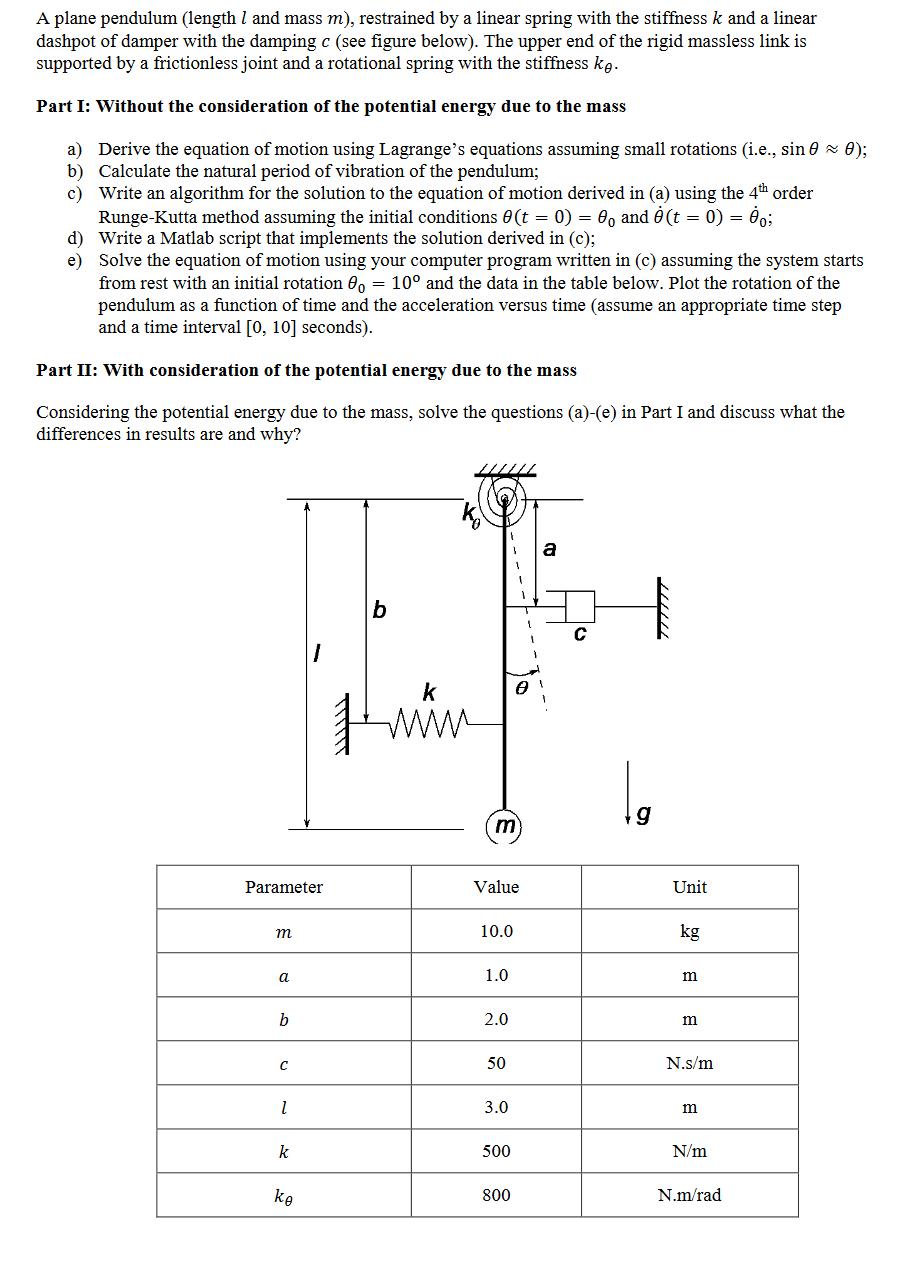
A plane pendulum (length I and mass m), restrained by a linear spring with the stiffness k and a linear dashpot of damper with the damping c (see figure below). The upper end of the rigid massless link is supported by a frictionless joint and a rotational spring with the stiffness kg. Part I: Without the consideration of the potential energy due to the mass a) Derive the equation of motion using Lagrange's equations assuming small rotations (i.e., sin 0 0); b) Calculate the natural period of vibration of the pendulum; c) Write an algorithm for the solution to the equation of motion derived in (a) using the 4th order Runge-Kutta method assuming the initial conditions 0 (t = 0) = 0 and 8 (t = 0) = 0; d) Write a Matlab script that implements the solution derived in (c); e) Solve the equation of motion using your computer program written in (c) assuming the system starts from rest with an initial rotation 0o = 10 and the data in the table below. Plot the rotation of the pendulum as a function of time and the acceleration versus time (assume an appropriate time step and a time interval [0, 10] seconds). Part II: With consideration of the potential energy due to the mass Considering the potential energy due to the mass, solve the questions (a)-(e) in Part I and discuss what the differences in results are and why? Parameter m a b C 1 k 1 ke b k 1 www m Value 10.0 1.0 2.0 50 3.0 0 500 800 a C g 777777 Unit kg m m N.s/m m N/m N.m/rad
Step by Step Solution
3.44 Rating (144 Votes )
There are 3 Steps involved in it
To solve this problem lets break it down step by step Part I Without the consideration of the potential energy due to the mass a Derive the equation of motion using Lagranges equations The Lagrangian ... View full answer

Get step-by-step solutions from verified subject matter experts
 Study Help