







Question: A probabilistic generative model for classification comprises class-conditional densities PyCk) and class priors PCk), where y ERP and k = 1, ..., K. We will
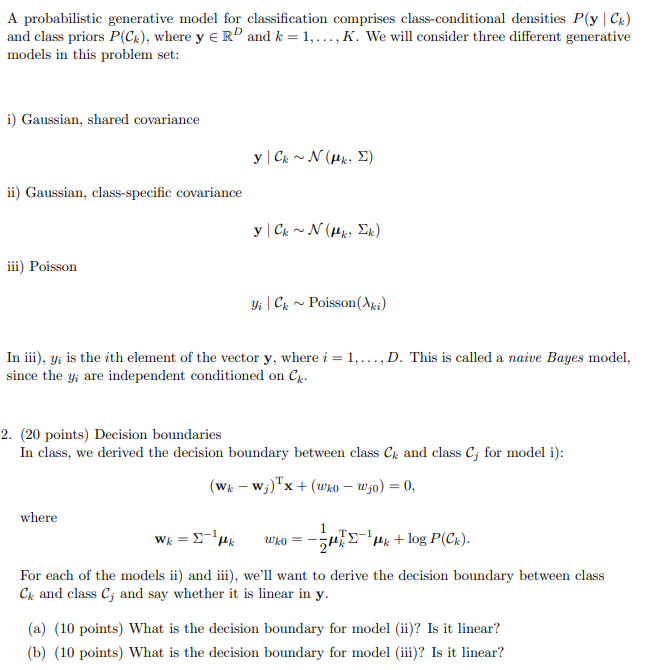
A probabilistic generative model for classification comprises class-conditional densities PyCk) and class priors PCk), where y ERP and k = 1, ..., K. We will consider three different generative models in this problem set: i) Gaussian, shared covariance ykN (S) ii) Gaussian, class-specific covariance ykN (EX) iii) Poisson yik Poisson(i) In iii), y; is the ith element of the vector y, where i = 1,..., D. This is called a naive Bayes model, since the yi are independent conditioned on Cl- 1 2. (20 points) Decision boundaries In class, we derived the decision boundary between class Ck and class C; for model i): (wk w;)*x + (Uko W;0) = 0, where WA = -'. --M5-*x + log P(C4). For each of the models ii) and iii), we'll want to derive the decision boundary between class Ck and class C; and say whether it is linear in y. (a) (10 points) What is the decision boundary for model (ii)? Is it linear? (b) (10 points) What is the decision boundary for model (iii)? Is it linear? WRO- A probabilistic generative model for classification comprises class-conditional densities PyCk) and class priors PCk), where y ERP and k = 1, ..., K. We will consider three different generative models in this problem set: i) Gaussian, shared covariance ykN (S) ii) Gaussian, class-specific covariance ykN (EX) iii) Poisson yik Poisson(i) In iii), y; is the ith element of the vector y, where i = 1,..., D. This is called a naive Bayes model, since the yi are independent conditioned on Cl- 1 2. (20 points) Decision boundaries In class, we derived the decision boundary between class Ck and class C; for model i): (wk w;)*x + (Uko W;0) = 0, where WA = -'. --M5-*x + log P(C4). For each of the models ii) and iii), we'll want to derive the decision boundary between class Ck and class C; and say whether it is linear in y. (a) (10 points) What is the decision boundary for model (ii)? Is it linear? (b) (10 points) What is the decision boundary for model (iii)? Is it linear? WRO
Step by Step Solution
There are 3 Steps involved in it

Get step-by-step solutions from verified subject matter experts
 Study Help