







Question: A process engineer wants to determine the right process setting so that the brightness of the television tube is as per the specification. Since brightness
A process engineer wants to determine the right process setting so that the brightness of the television tube is as per the specification. Since brightness is a function of current, he recorded the current necessary in microamps to get a specified brightness level. looked for factors affecting brightness level.
CRT phosphors are specific chemical compounds, which are luminescent and are arranged on the inside of the TV tube in a certain order and are available in various colors, starting with basic red, green and blue for color CRTs with precise grain size control, dispersion control and surface treatment to match exact tube specifications. Upon excited by a scanning electron beam in the CRT the phosphors will glow momentarily until refreshed again many times per second forming a picture composed of colors by utilizing the red, green and blue combinations. If you look at your TV screen while it is turned on with a magnifying glass, you can see the colored elements. Over many years of use, the phosphors will gradually fade in brilliance and the color of your TV screen will lose its original richness.
The glass used in CRTs arrives from the glass factory to the CRT factory as either separate screens and funnels with fused necks, for Color CRTs or as bulbs made up of a fused screen, funnel and neck. There were several glass formulations for different types of CRTs that were classified using codes specific to each glass manufacturer. The compositions of the melts were also specific to each manufacturer. Those optimized for high color purity and contrast were doped with Neodymium, while those for monochrome CRTs were tinted to differing levels, depending on the formulation used and had transmittances of or Purity is ensuring that the correct colors are
activated for example, ensuring that red is displayed uniformly across the screen while convergence ensures that images are not distorted. Convergence may be modified using a crosshatch pattern.
The quality manager has to decide between two glass formulation types, and has to choose among three phosphor grades.
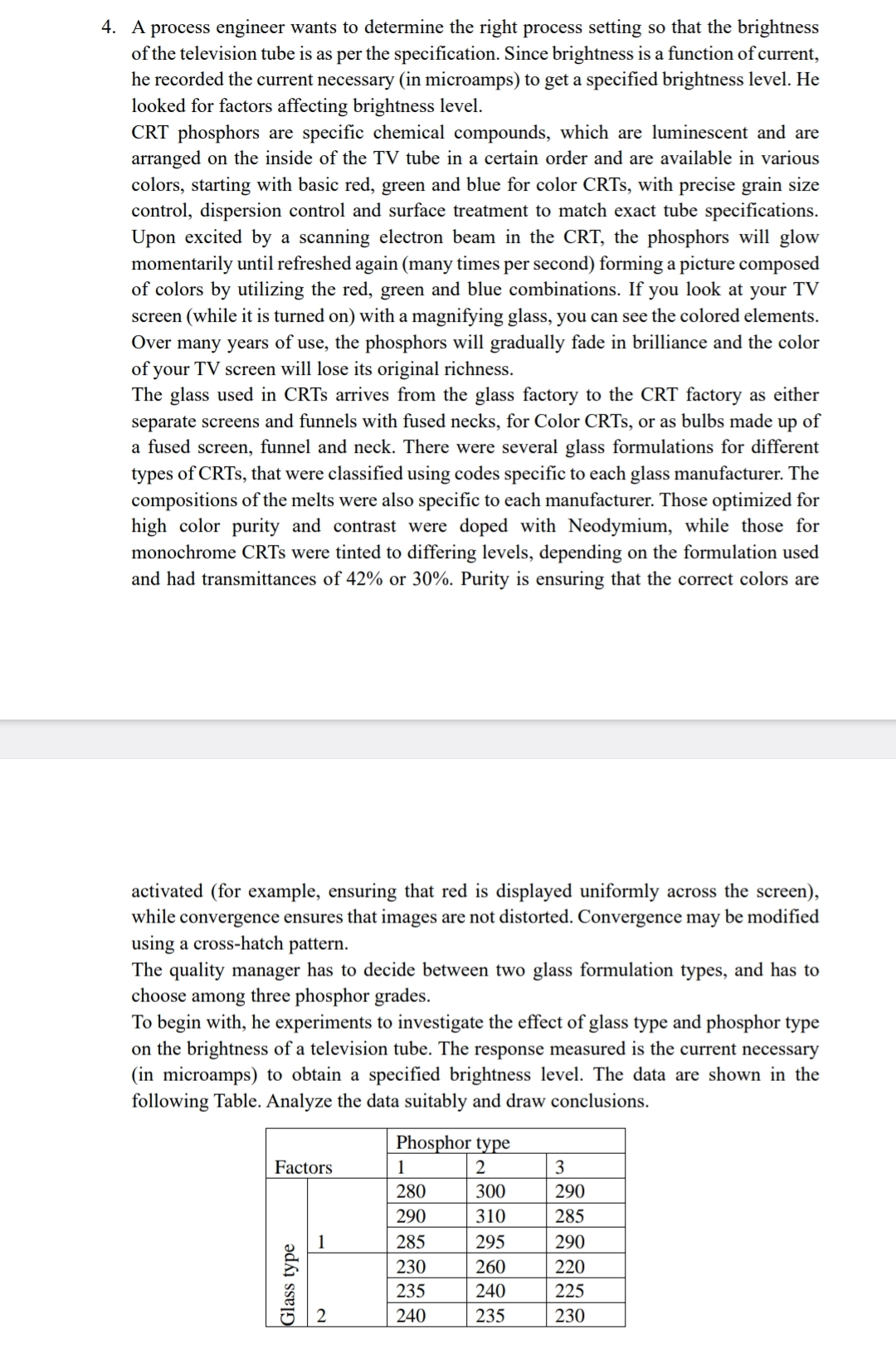
To begin with, he experiments to investigate the effect of glass type and phosphor type on the brightness of a television tube. The response measured is the current necessary in microamps to obtain a specified brightness level. The data are shown in the following Table. Analyze the data suitably and draw conclusions.
table
tableFactorsPhosphor typetable
Step by Step Solution
There are 3 Steps involved in it
1 Expert Approved Answer
Step: 1 Unlock

Question Has Been Solved by an Expert!
Get step-by-step solutions from verified subject matter experts
Step: 2 Unlock
Step: 3 Unlock
 Study Help