







Question: A project has four activities (A, B, C, and D) that must be performed sequentially. The probability distributions for the time required to complete each
A project has four activities (A, B, C, and D) that must be performed sequentially. The probability distributions for the time required to complete each of the activities are as follows:
| Activity | Activity Time (weeks) | Probability | ||
| A | 3 | 0.33 | ||
| 4 | 0.30 | |||
| 5 | 0.27 | |||
| 6 | 0.10 | |||
| B | 3 | 0.22 | ||
| 5 | 0.50 | |||
| 7 | 0.28 | |||
| C | 12 | 0.10 | ||
| 14 | 0.23 | |||
| 16 | 0.39 | |||
| 18 | 0.20 | |||
| 20 | 0.08 | |||
| D | 9 | 0.66 | ||
| 11 | 0.34 | |||
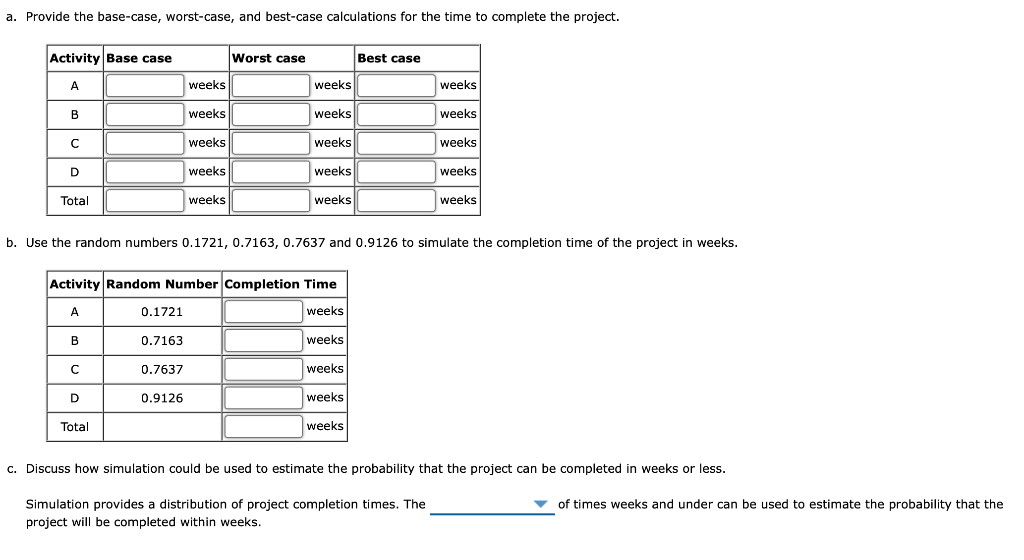
Part C options, mean/percentage
a. Provide the base-case, worst-case, and best-case calculations for the time to complete the project. Activity Base case Worst case Best case A weeks weeks weeks B weeks weeks weeks weeks weeks weeks D weeks weeks weeks Total weeks weeks weeks b. Use the random numbers 0.1721, 0.7163, 0.7637 and 0.9126 to simulate the completion time of the project in weeks. Activity Random Number Completion Time 0.1721 weeks B 0.7163 weeks 0.7637 weeks D 0.9126 weeks Total weeks c. Discuss how simulation could be used to estimate the probability that the project can be completed in weeks or less. of times weeks and under can be used to estimate the probability that the Simulation provides a distribution of project completion times. The project will be completed within weeksStep by Step Solution
There are 3 Steps involved in it
1 Expert Approved Answer
Step: 1 Unlock

Question Has Been Solved by an Expert!
Get step-by-step solutions from verified subject matter experts
Step: 2 Unlock
Step: 3 Unlock
 Study Help