





Question: A project team has started gathering information necessary to develop a project network- predecessor activities and activity time in days. The results of their meeting
A project team has started gathering information
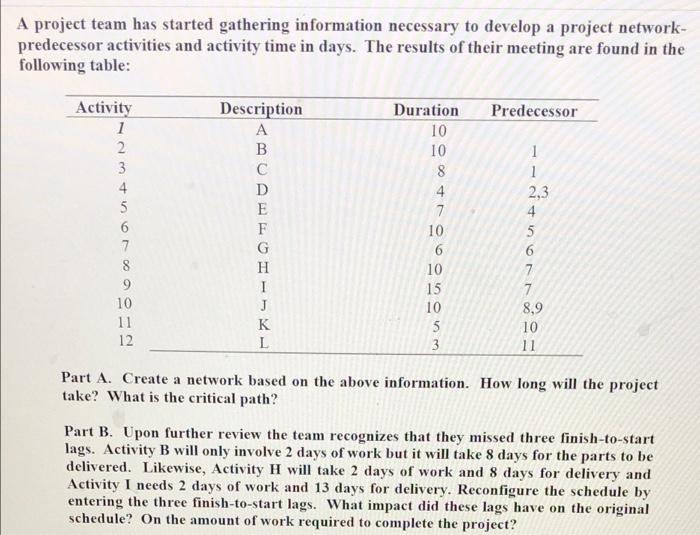
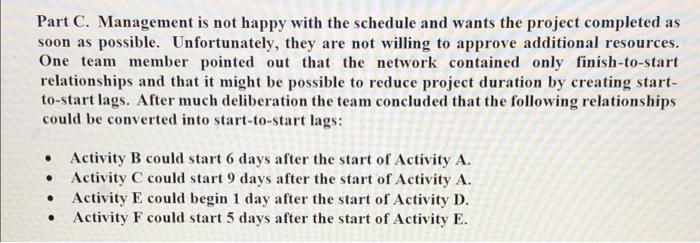
A project team has started gathering information necessary to develop a project network- predecessor activities and activity time in days. The results of their meeting are found in the following table: Predecessor ? Activity 1 2 3 4 5 6 7 8 9 10 11 12 Description A B D E F G H I J K Duration 10 10 8 4 7 10 6 10 15 10 5 3 1 1 2,3 4. 5 ON 8,9 10 11 Part A. Create a network based on the above information. How long will the project take? What is the critical path? Part B. Upon further review the team recognizes that they missed three finish-to-start lags. Activity B will only involve 2 days of work but it will take 8 days for the parts to be delivered. Likewise, Activity H will take 2 days of work and 8 days for delivery and Activity I needs 2 days of work and 13 days for delivery. Reconfigure the schedule by entering the three finish-to-start lags. What impact did these lags have on the original schedule? On the amount of work required to complete the project? Part C. Management is not happy with the schedule and wants the project completed as soon as possible. Unfortunately, they are not willing to approve additional resources. One team member pointed out that the network contained only finish-to-start relationships and that it might be possible to reduce project duration by creating start- to-start lags. After much deliberation the team concluded that the following relationships could be converted into start-to-start lags: Activity B could start 6 days after the start of Activity A. Activity C could start 9 days after the start of Activity A. Activity E could begin 1 day after the start of Activity D. Activity F could start 5 days after the start of Activity E. . . Activity G could begin 7 days after the start of Activity F. Activity H and Activity I could begin 5 days after Activity G. Activity K could begin 9 days after the start of Activity J. Activity L could start 3 days after the start of Activity K. What impact did these lags have on the original schedule (Part A)? How long will the project take? Is there a change in the critical path? Is there a change in the sensitivity of the network? Why would management like this solution? A project team has started gathering information necessary to develop a project network- predecessor activities and activity time in days. The results of their meeting are found in the following table: Predecessor ? Activity 1 2 3 4 5 6 7 8 9 10 11 12 Description A B D E F G H I J K Duration 10 10 8 4 7 10 6 10 15 10 5 3 1 1 2,3 4. 5 ON 8,9 10 11 Part A. Create a network based on the above information. How long will the project take? What is the critical path? Part B. Upon further review the team recognizes that they missed three finish-to-start lags. Activity B will only involve 2 days of work but it will take 8 days for the parts to be delivered. Likewise, Activity H will take 2 days of work and 8 days for delivery and Activity I needs 2 days of work and 13 days for delivery. Reconfigure the schedule by entering the three finish-to-start lags. What impact did these lags have on the original schedule? On the amount of work required to complete the project? Part C. Management is not happy with the schedule and wants the project completed as soon as possible. Unfortunately, they are not willing to approve additional resources. One team member pointed out that the network contained only finish-to-start relationships and that it might be possible to reduce project duration by creating start- to-start lags. After much deliberation the team concluded that the following relationships could be converted into start-to-start lags: Activity B could start 6 days after the start of Activity A. Activity C could start 9 days after the start of Activity A. Activity E could begin 1 day after the start of Activity D. Activity F could start 5 days after the start of Activity E. . . Activity G could begin 7 days after the start of Activity F. Activity H and Activity I could begin 5 days after Activity G. Activity K could begin 9 days after the start of Activity J. Activity L could start 3 days after the start of Activity K. What impact did these lags have on the original schedule (Part A)? How long will the project take? Is there a change in the critical path? Is there a change in the sensitivity of the network? Why would management like this solution
Step by Step Solution

There are 3 Steps involved in it

1 Expert Approved Answer
Step: 1 Unlock blur-text-image

Question Has Been Solved by an Expert!

Get step-by-step solutions from verified subject matter experts

Step: 2 Unlock
Step: 3 Unlock

Students Have Also Explored These Related General Management Questions!