







Question: A recent technology upgrade has given you access to the building's fleet of delivery bots, which can carry your bagels from the lobby to
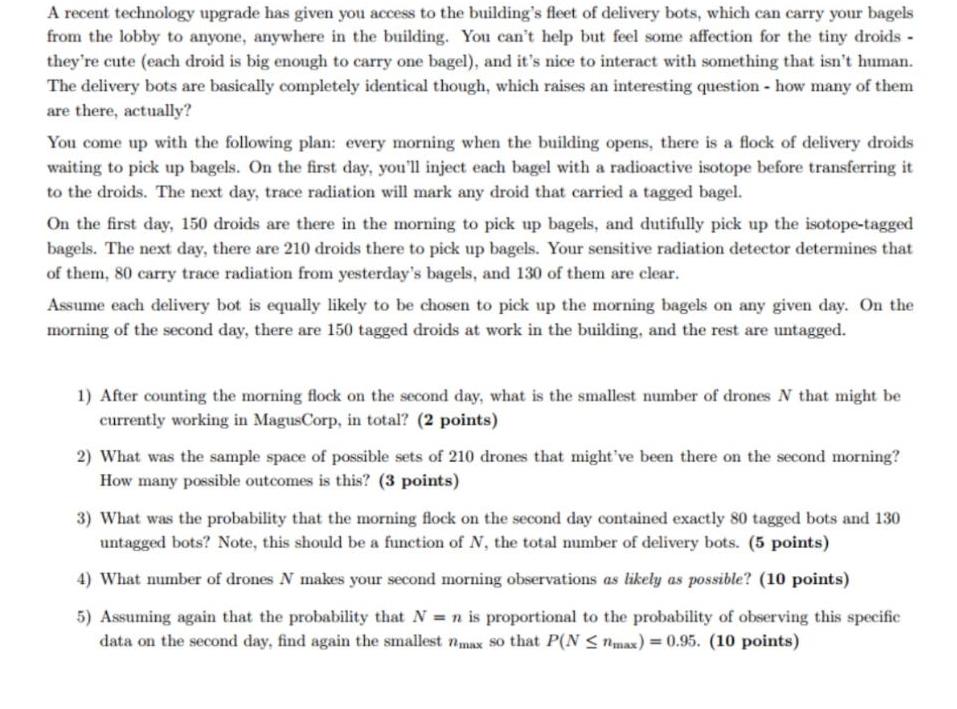

A recent technology upgrade has given you access to the building's fleet of delivery bots, which can carry your bagels from the lobby to anyone, anywhere in the building. You can't help but feel some affection for the tiny droids - they're cute (each droid is big enough to carry one bagel), and it's nice to interact with something that isn't human. The delivery bots are basically completely identical though, which raises an interesting question - how many of them are there, actually? You come up with the following plan: every morning when the building opens, there is a flock of delivery droids waiting to pick up bagels. On the first day, you'll inject each bagel with a radioactive isotope before transferring it to the droids. The next day, trace radiation will mark any droid that carried a tagged bagel. On the first day, 150 droids are there in the morning to pick up bagels, and dutifully pick up the isotope-tagged bagels. The next day, there are 210 droids there to pick up bagels. Your sensitive radiation detector determines that of them, 80 carry trace radiation from yesterday's bagels, and 130 of them are clear. Assume each delivery bot is equally likely to be chosen to pick up the morning bagels on any given day. On the morning of the second day, there are 150 tagged droids at work in the building, and the rest are untagged. 1) After counting the morning flock on the second day, what is the smallest number of drones N that might be currently working in MagusCorp, in total? (2 points) 2) What was the sample space of possible sets of 210 drones that might've been there on the second morning? How many possible outcomes is this? (3 points) 3) What was the probability that the morning flock on the second day contained exactly 80 tagged bots and 130 untagged bots? Note, this should be a function of N, the total number of delivery bots. (5 points) 4) What number of drones N makes your second morning observations as likely as possible? (10 points) 5) Assuming again that the probability that N = n is proportional to the probability of observing this specific data on the second day, find again the smallest nmax so that P(N nmax)=0.95. (10 points) By tagging each bagel with different amounts of isotope, you could potentially tag each droid with a uniquely identifiable amount of radiation. Is this useful? Be Thorough. (5 points) Why did I frame this problem with a queue of bots waiting each morning for bagels, rather than in terms of bots arriving to pick up bagels over the course of the day? (3 points)
Step by Step Solution
3.41 Rating (157 Votes )
There are 3 Steps involved in it
1 Smallest Number of Drones N The smallest number of drones N that might be currently working in Mag... View full answer

Get step-by-step solutions from verified subject matter experts
 Study Help