



Question: A robot exists in the world shown below where the black lines indicate walls and the gray arrow shows the direction of travel (forward) for
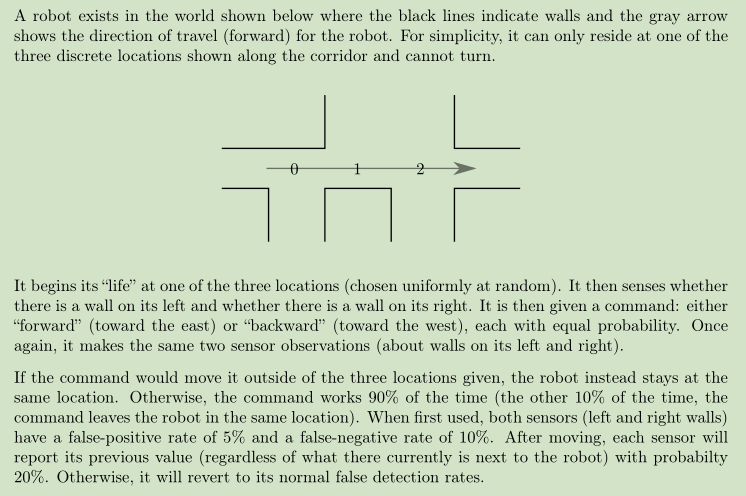
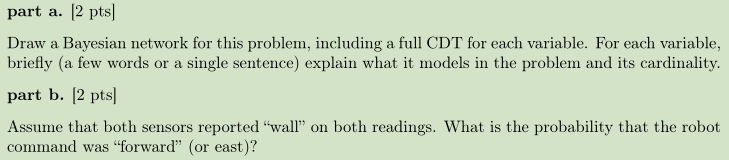
A robot exists in the world shown below where the black lines indicate walls and the gray arrow shows the direction of travel (forward) for the robot. For simplicity, it can only reside at one of the three discrete locations shown along the corridor and cannot turn. It begins its "life" at one of the three locations (chosen uniformly at random). It then senses whether there is a wall on its left and whether there is a wall on its right. It is then given a command: either "forward" (toward the east) or "backward" (toward the west), each with equal probability. Once again, it makes the same two sensor observations (about walls on its left and right). If the command would move it outside of the three locations given, the robot instead stays at the same location. Otherwise, the command works 90% of the time (the other 10% of the time, the command leaves the robot in the same location). When first used, both sensors (left and right walls) have a false-positive rate of 5% and a false-negative rate of 10%. After moving, each sensor will report its previous value (regardless of what there currently is next to the robot) with probabilty 20%. Otherwise, it will revert to its normal false detection rates
Step by Step Solution
There are 3 Steps involved in it

Get step-by-step solutions from verified subject matter experts