



Question: (a) Show that the proper time along a timelike) geodesic (parametrized by some parameter other than the proper time) is an affine parameter. (Hint: write
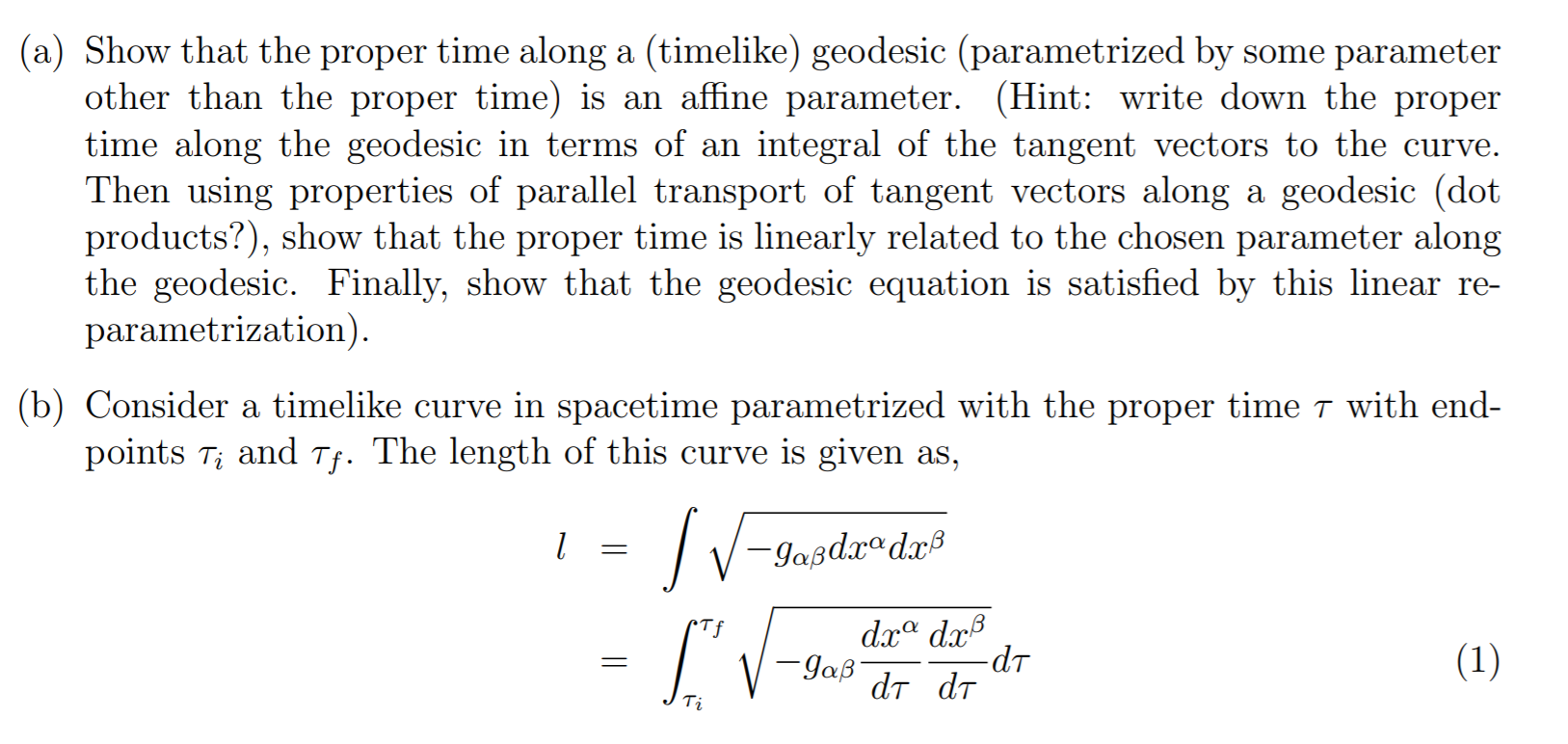
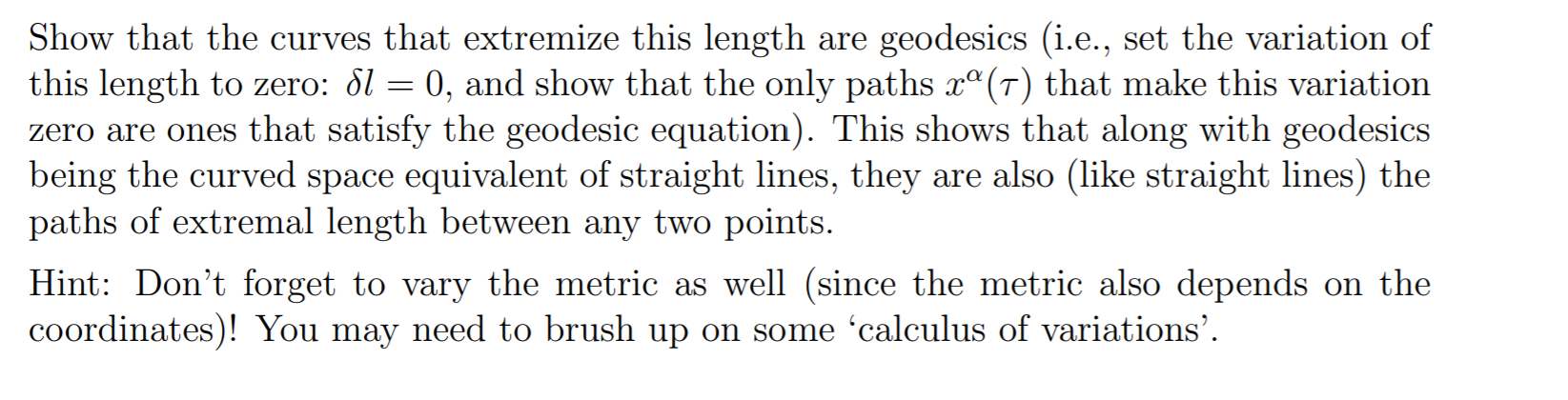
(a) Show that the proper time along a timelike) geodesic (parametrized by some parameter other than the proper time) is an affine parameter. (Hint: write down the proper time along the geodesic in terms of an integral of the tangent vectors to the curve. Then using properties of parallel transport of tangent vectors along a geodesic (dot products?), show that the proper time is linearly related to the chosen parameter along the geodesic. Finally, show that the geodesic equation is satisfied by this linear re- parametrization). (b) Consider a timelike curve in spacetime parametrized with the proper time t with end- points Ti and Tf. The length of this curve is given as, 1 -9adrad.rs / IM = dra dxB - Ga -dt dt dt (1) Show that the curves that extremize this length are geodesics (i.e., set the variation of this length to zero: 81 = 0, and show that the only paths x(1) that make this variation zero are ones that satisfy the geodesic equation). This shows that along with geodesics being the curved space equivalent of straight lines, they are also like straight lines) the paths of extremal length between any two points. Hint: Don't forget to vary the metric as well (since the metric also depends on the coordinates)! You may need to brush up on some 'calculus of variations'. (a) Show that the proper time along a timelike) geodesic (parametrized by some parameter other than the proper time) is an affine parameter. (Hint: write down the proper time along the geodesic in terms of an integral of the tangent vectors to the curve. Then using properties of parallel transport of tangent vectors along a geodesic (dot products?), show that the proper time is linearly related to the chosen parameter along the geodesic. Finally, show that the geodesic equation is satisfied by this linear re- parametrization). (b) Consider a timelike curve in spacetime parametrized with the proper time t with end- points Ti and Tf. The length of this curve is given as, 1 -9adrad.rs / IM = dra dxB - Ga -dt dt dt (1) Show that the curves that extremize this length are geodesics (i.e., set the variation of this length to zero: 81 = 0, and show that the only paths x(1) that make this variation zero are ones that satisfy the geodesic equation). This shows that along with geodesics being the curved space equivalent of straight lines, they are also like straight lines) the paths of extremal length between any two points. Hint: Don't forget to vary the metric as well (since the metric also depends on the coordinates)! You may need to brush up on some 'calculus of variations
Step by Step Solution
There are 3 Steps involved in it

Get step-by-step solutions from verified subject matter experts