







Question: A simple random sample 4. Consider a discrete-time Markov chain with the following probability transition matrix 0 0 P= I-T- VVO 0 0 1 Is
A simple random sample
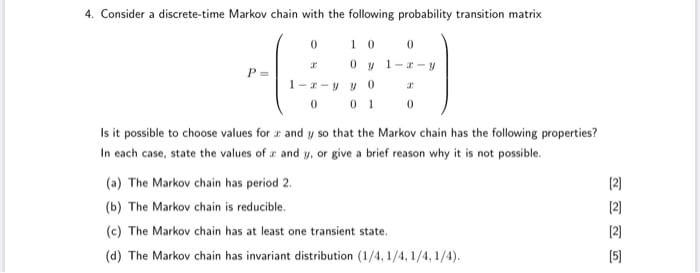
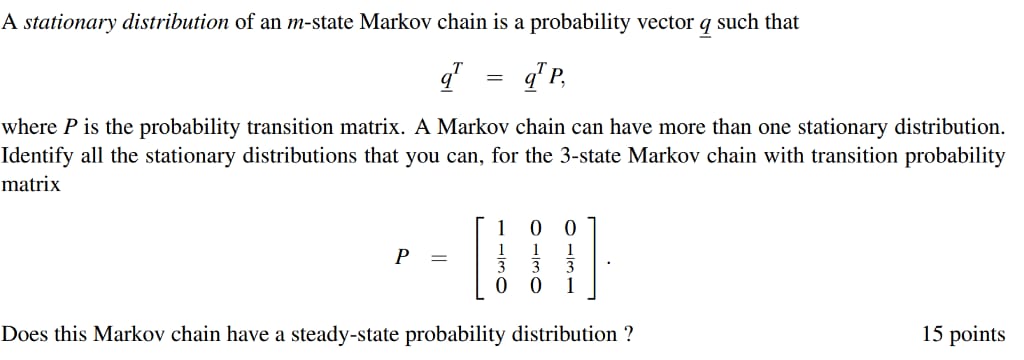
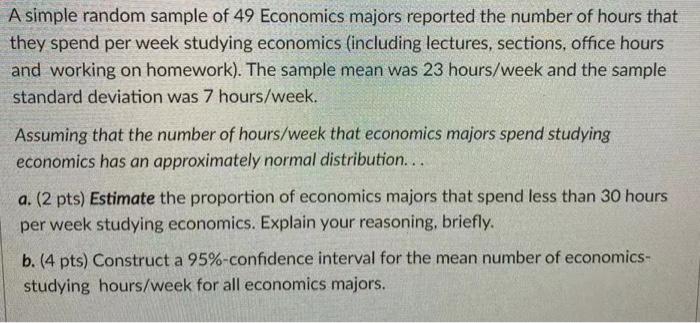
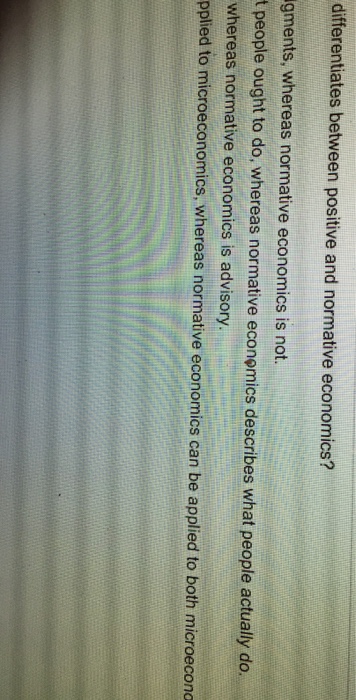
4. Consider a discrete-time Markov chain with the following probability transition matrix 0 0 P= I-T- VVO 0 0 1 Is it possible to choose values for ar and y so that the Markov chain has the following properties? In each case, state the values of a and y, or give a brief reason why it is not possible. (a) The Markov chain has period 2. (b) The Markov chain is reducible. UNNN (c) The Markov chain has at least one transient state. (d) The Markov chain has invariant distribution (1/4, 1/4, 1/4, 1/4).A stationary distribution of an m-state Markov chain is a probability vector q such that = q P, where P is the probability transition matrix. A Markov chain can have more than one stationary distribution. Identify all the stationary distributions that you can, for the 3-state Markov chain with transition probability matrix O O P Owl Does this Markov chain have a steady-state probability distribution ? 15 pointsA simple random sample of 49 Economics majors reported the number of hours that they spend per week studying economics (including lectures, sections, office hours and working on homework). The sample mean was 23 hours/week and the sample standard deviation was 7 hours/week. Assuming that the number of hours/week that economics majors spend studying economics has an approximately normal distribution. .. a. (2 pts) Estimate the proportion of economics majors that spend less than 30 hours per week studying economics. Explain your reasoning, briefly. b. (4 pts) Construct a 95%-confidence interval for the mean number of economics- studying hours/week for all economics majors.differentiates between positive and normative economics? gments, whereas normative economics is not. t people ought to do, whereas normative economics describes what people actually do whereas normative economics is advisory. pplied to microeconomics, whereas normative economics can be applied to both microecono
Step by Step Solution
There are 3 Steps involved in it

Get step-by-step solutions from verified subject matter experts
 Study Help