







Question: A string of length L is fixed at both ends such that its tension is T. It is pulled aside a transverse distance d
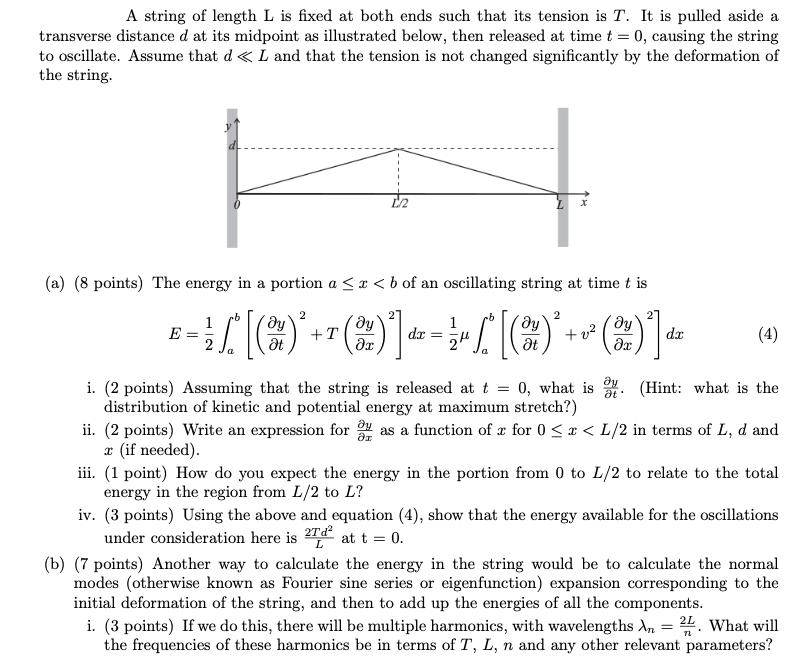
A string of length L is fixed at both ends such that its tension is T. It is pulled aside a transverse distance d at its midpoint as illustrated below, then released at time t = 0, causing the string to oscillate. Assume that d < L and that the tension is not changed significantly by the deformation of the string. (a) (8 points) The energy in a portion a x < b of an oscillating string at time t is 2 2 - - / [()* + ) ] - [()*+- (2) ] - | dx = r / * dy 1 E dy = +T t 24 +2 dx t (4) i. (2 points) Assuming that the string is released at t = 0, what is . (Hint: what is the distribution of kinetic and potential energy at maximum stretch?) t ii. (2 points) Write an expression for as a function of x for 0 < x < L/2 in terms of L, d and x (if needed). x iii. (1 point) How do you expect the energy in the portion from 0 to L/2 to relate to the total energy in the region from L/2 to L? iv. (3 points) Using the above and equation (4), show that the energy available for the oscillations under consideration here is 27d at t = 0. L (b) (7 points) Another way to calculate the energy in the string would be to calculate the normal modes (otherwise known as Fourier sine series or eigenfunction) expansion corresponding to the initial deformation of the string, and then to add up the energies of all the components. i. (3 points) If we do this, there will be multiple harmonics, with wavelengths An = 2. What will the frequencies of these harmonics be in terms of T, L, n and any other relevant parameters?
Step by Step Solution
3.32 Rating (158 Votes )
There are 3 Steps involved in it
1 Given Wavelength An 2nL then frequency is ve fn An ... View full answer

Get step-by-step solutions from verified subject matter experts
 Study Help