







Question: A study has shown that the time it takes for a driver to react to the brake lights on the car directly in front is
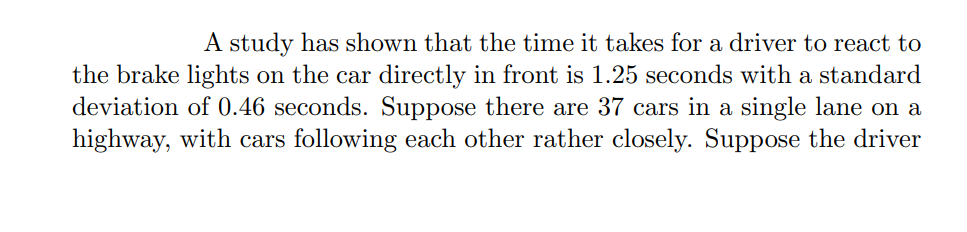
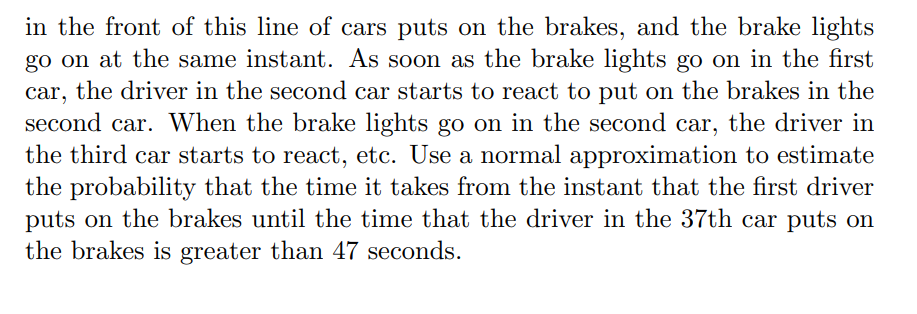
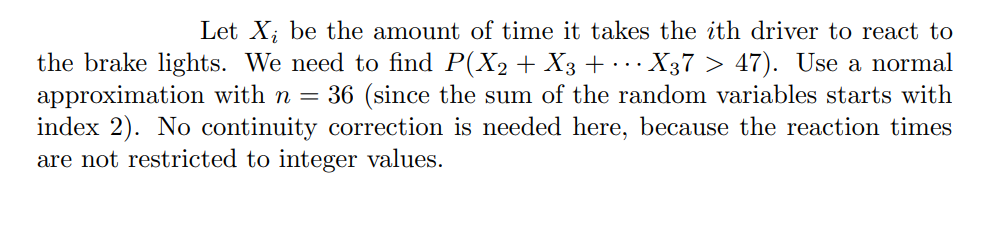
A study has shown that the time it takes for a driver to react to the brake lights on the car directly in front is 1.25 seconds with a standard deviation of 0.46 seconds. Suppose there are 37 cars in a single lane on a highway, with cars following each other rather closely. Suppose the driver in the front of this line of cars puts on the brakes, and the brake lights go on at the same instant. As soon as the brake lights go on in the rst car, the driver in the second car starts to react to put on the brakes in the second car. When the brake lights go on in the second car, the driver in the third car starts to react, etc. Use a normal approximation to estimate the probabilit}r that the time it takes from the instant that the rst driver puts on the brakes until the time that the driver in the 37th car puts on the brakes is greater than 47 seconds. Let Xi be the amount of time it takes the ith driver to react to the brake lights. We need to find P(X2 + X3 + ... X37 > 47). Use a normal approximation with n = 36 (since the sum of the random variables starts with index 2). No continuity correction is needed here, because the reaction times are not restricted to integer values
Step by Step Solution
There are 3 Steps involved in it

Get step-by-step solutions from verified subject matter experts
 Study Help