







Question: (a) Suppose the data in the table below represents total revenues (in $ millions} for one real estate agency in the GTA. Fill in the
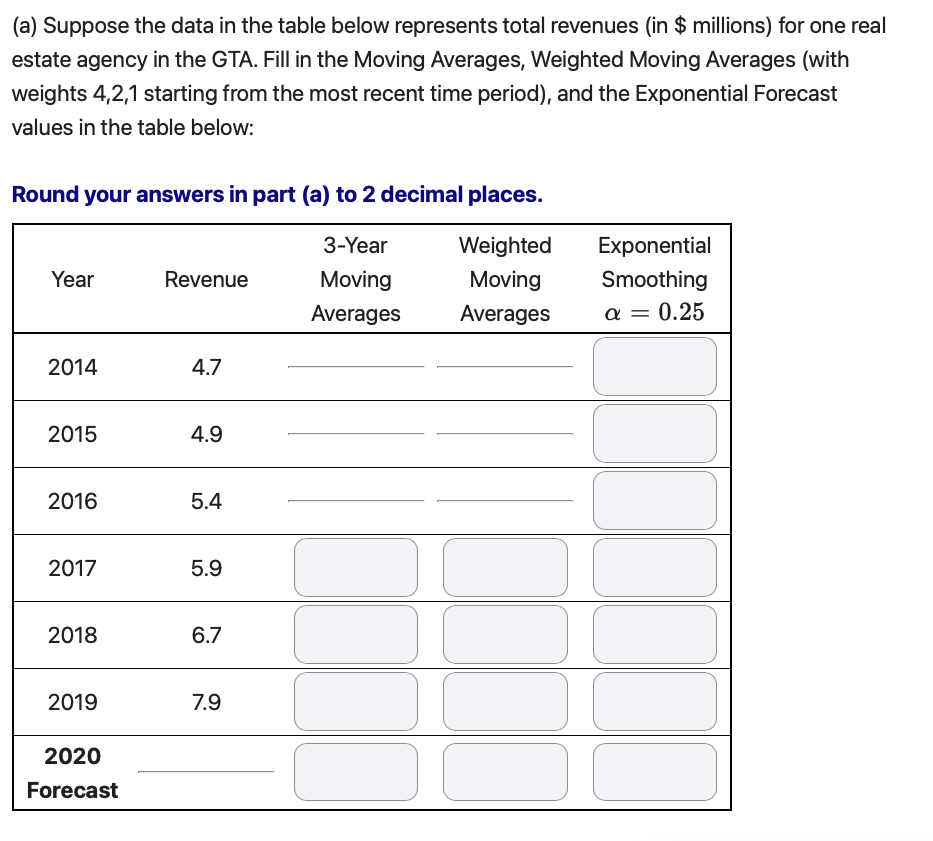
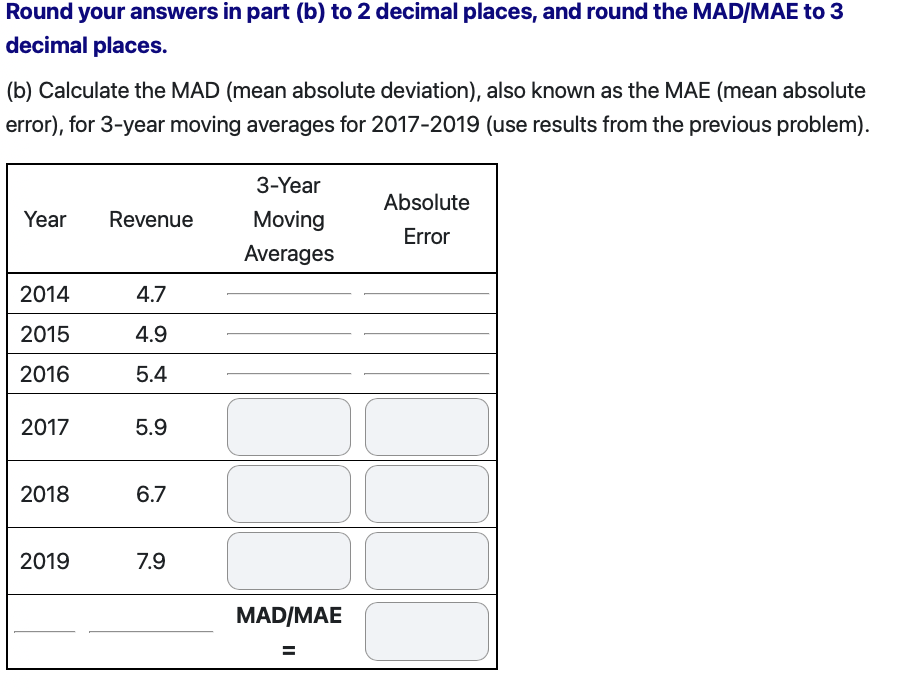
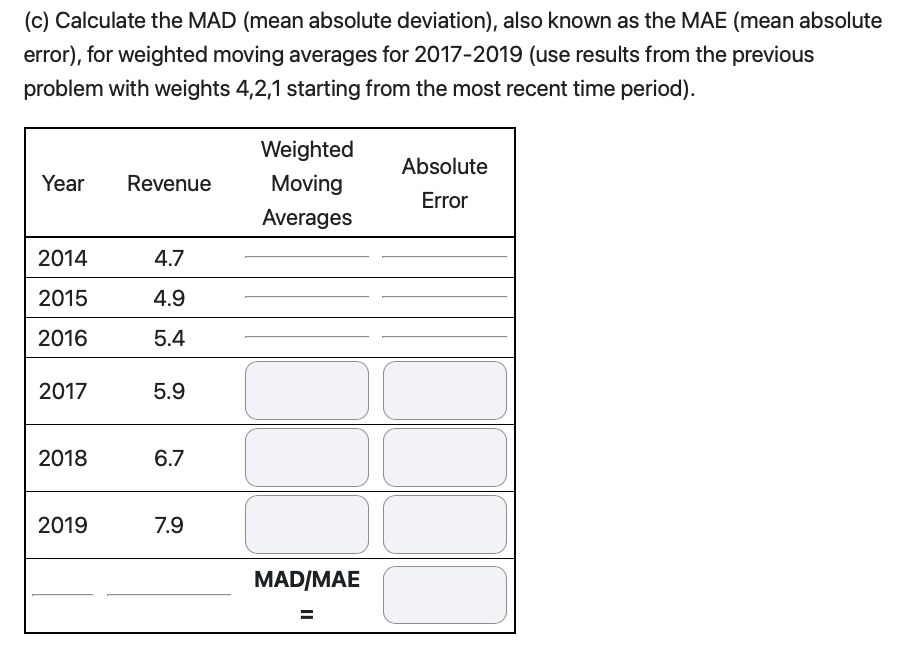
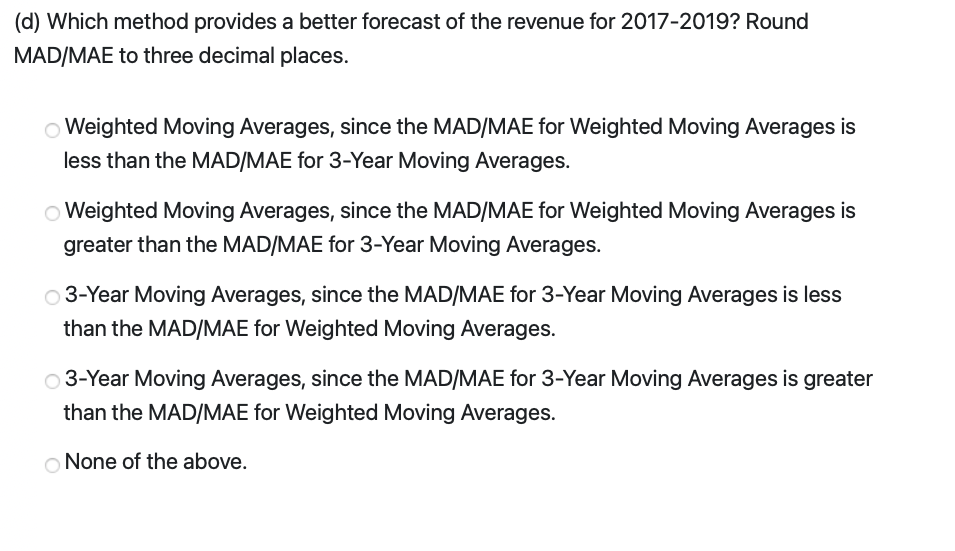
(a) Suppose the data in the table below represents total revenues (in $ millions} for one real estate agency in the GTA. Fill in the Moving Averages, Weighted Moving Averages (with weights 4,2,1 starting from the most recent time period), and the Exponential Forecast values in the table below: Round your answers in part (a) to 2 decimal places. 3-Year Weighted Exponential Revenue Moving Moving Smoothing Averages Averages o: = 0.25 Round your answers in part (b) to 2 decimal places, and round the MADIMAE to 3 decimal places. (b) Calculate the MAD (mean absolute deviation), also known as the MAE (mean absolute error}r for 3-year moving averages for 2017-2019 (use results from the previous problem). 3-Year _ Absolute Year Revenue Moving Error Averages 2014 4.7 2015 4.9 2016 5.4 [_l 7.9 [_] MADIMAE (c) Calculate the MAD (mean absolute deviation), also known as the MAE (mean absolute error), for weighted moving averages for 201?-2019 (use results from the previous problem with weights 4,2,1 starting from the most recent time period). Weighted Year Revenue Moving Averages 2014 4.7 2015 4.9 2016 5.4 Absolute Error 2018 [1 _ 2019 7.9 (d) Which method provides a better forecast of the revenue for 2017-2019? Round MAD/MAE to three decimal places. o Weighted Moving Averages, since the MAD/MAE for Weighted Moving Averages is less than the MAD/MAE for 3-Year Moving Averages. o Weighted Moving Averages, since the MAD/MAE for Weighted Moving Averages is greater than the MAD/MAE for 3-Year Moving Averages. 3-Year Moving Averages, since the MAD/MAE for 3-Year Moving Averages is less than the MAD/MAE for Weighted Moving Averages. 3-Year Moving Averages, since the MAD/MAE for 3-Year Moving Averages is greater than the MAD/MAE for Weighted Moving Averages. None of the above
Step by Step Solution
There are 3 Steps involved in it

Get step-by-step solutions from verified subject matter experts
 Study Help