







Question: (a) Suppose you are given the following (X, y) data pairs. x235 y436 l USE SALT Find the least-squares equation for these data {rounded to
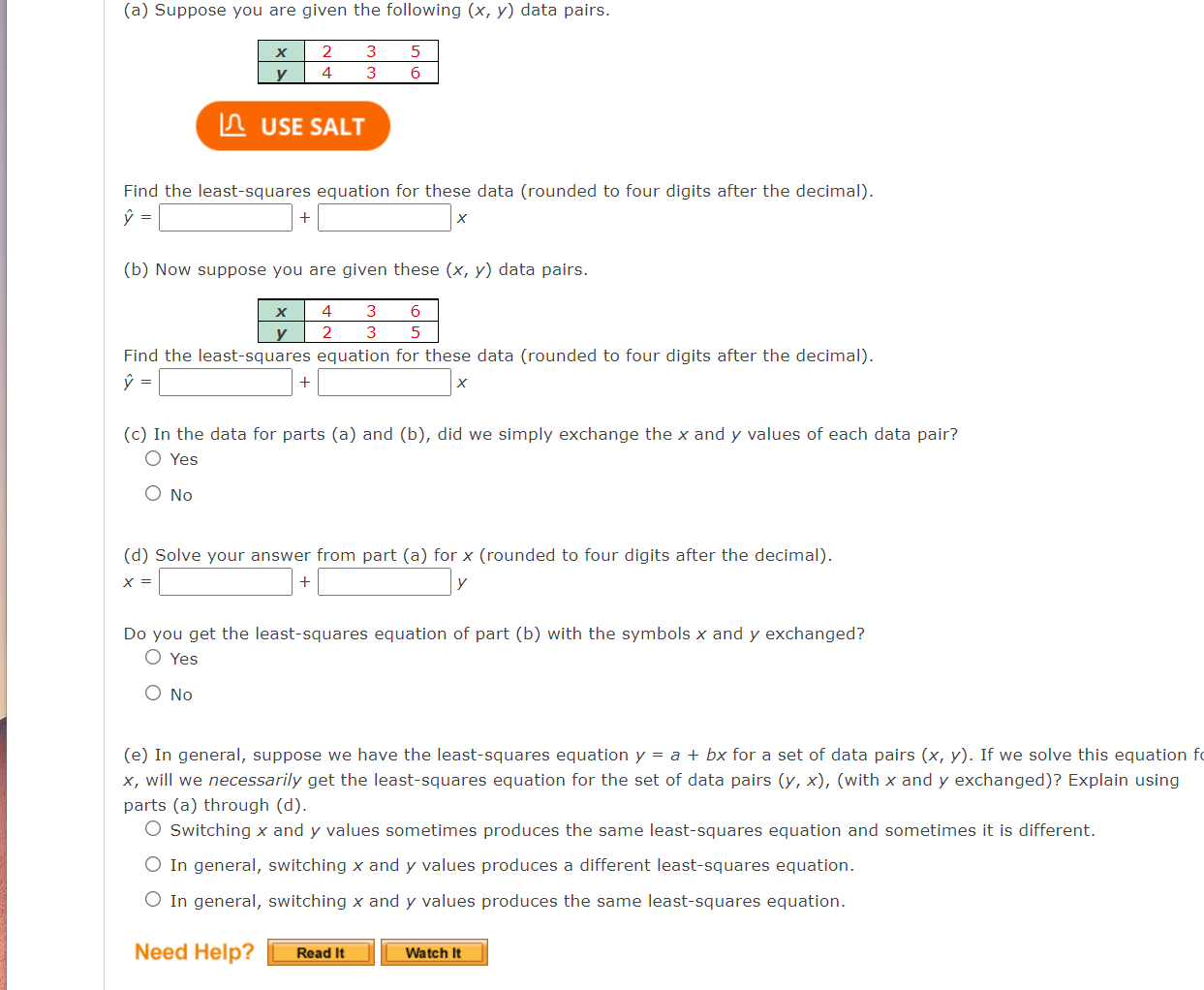
(a) Suppose you are given the following (X, y) data pairs. x235 y436 l USE SALT Find the least-squares equation for these data {rounded to four digits after the decimal). r = | M |X (b) Now suppose you are given these (X, y) data pairs. x436 y235 Find the leastsquares equation for these data {rounded to four digits after the decimal). Jv"=| |+| IX (c) In the data for parts (a) and (b), did we simply exchange the x and y values of each data pair? 0 Yes ONo (d) Solve your answer from part (a) for X (rounded to four digits after the decimal). X = | |+| Iv Do you get the leastsquares equation of part (b) with the symbols X and y exchanged? 0 Yes ONo (e) In general, suppose we have the leastisquares equation y = a + bx for a set of data pairs (X, y). If we solve this equation f( X, will we necessarily get the leastsquares equation for the set of data pairs (y, X), (with X and y exchanged)? Explain using parts (a) through (d). 0 Switching X and y values sometimes produces the same leastsquares equation and sometimes it is different. 0 In general, switching X and 1/ values produces a different leastsquares equation. 0 In general, switching X and 1/ values produces the same leastisquares equation. Need Help
Step by Step Solution
There are 3 Steps involved in it

Get step-by-step solutions from verified subject matter experts
 Study Help