Question: A system is observed from time 0 to time 30. There is one processor. Jobs 1 through 12 arrive at times 1, 4, 4, 5,
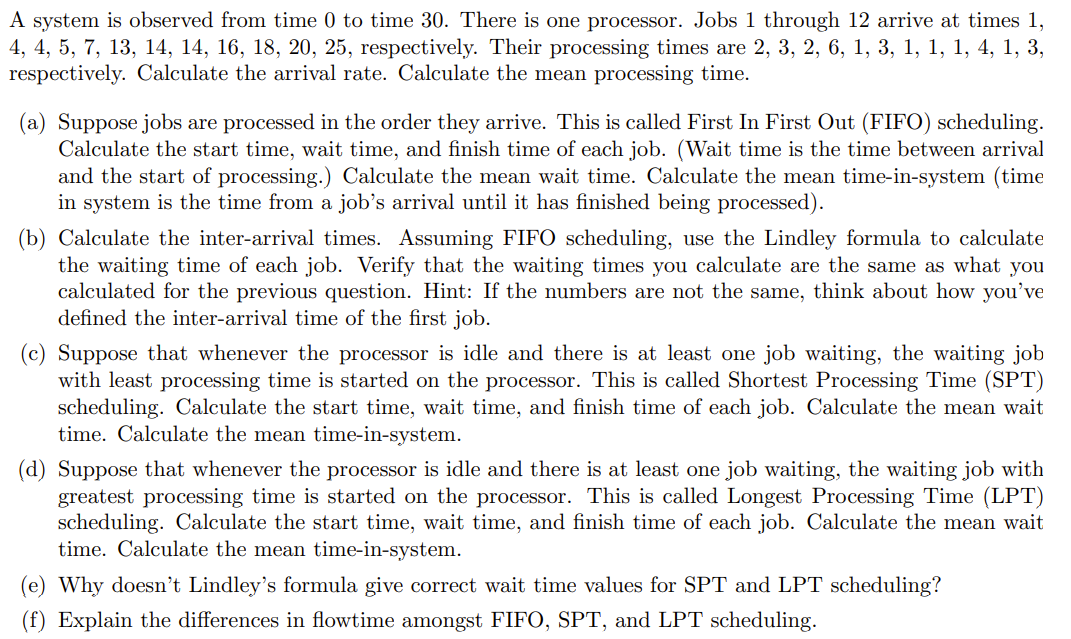
A system is observed from time 0 to time 30. There is one processor. Jobs 1 through 12 arrive at times 1, 4, 4, 5, 7, 13, 14, 14, 16, 18, 20, 25, respectively. Their processing times are 2, 3, 2, 6, 1, 3, 1, 1, 1, 4, 1, 3, respectively. Calculate the arrival rate. Calculate the mean processing time. (a) Suppose jobs are processed in the order they arrive. This is called First In First Out (FIFO) scheduling. Calculate the start time, wait time, and finish time of each job. (Wait time is the time between arrival and the start of processing.) Calculate the mean wait time. Calculate the mean time-in-system (time in system is the time from a job's arrival until it has finished being processed). (b) Calculate the inter-arrival times. Assuming FIFO scheduling, use the Lindley formula to calculate the waiting time of each job. Verify that the waiting times you calculate are the same as what you calculated for the previous question. Hint: If the numbers are not the same, think about how you've defined the inter-arrival time of the first job. (C) Suppose that whenever the processor is idle and there is at least one job waiting, the waiting job with least processing time is started on the processor. This is called Shortest Processing Time (SPT) scheduling. Calculate the start time, wait time, and finish time of each job. Calculate the mean wait time. Calculate the mean time-in-system. (d) Suppose that whenever the processor is idle and there is at least one job waiting, the waiting job with greatest processing time is started on the processor. This is called Longest Processing Time (LPT) scheduling. Calculate the start time, wait time, and finish time of each job. Calculate the mean wait time. Calculate the mean time-in-system. (e) Why doesn't Lindley's formula give correct wait time values for SPT and LPT scheduling? (f) Explain the differences in flowtime amongst FIFO, SPT, and LPT scheduling. A system is observed from time 0 to time 30. There is one processor. Jobs 1 through 12 arrive at times 1, 4, 4, 5, 7, 13, 14, 14, 16, 18, 20, 25, respectively. Their processing times are 2, 3, 2, 6, 1, 3, 1, 1, 1, 4, 1, 3, respectively. Calculate the arrival rate. Calculate the mean processing time. (a) Suppose jobs are processed in the order they arrive. This is called First In First Out (FIFO) scheduling. Calculate the start time, wait time, and finish time of each job. (Wait time is the time between arrival and the start of processing.) Calculate the mean wait time. Calculate the mean time-in-system (time in system is the time from a job's arrival until it has finished being processed). (b) Calculate the inter-arrival times. Assuming FIFO scheduling, use the Lindley formula to calculate the waiting time of each job. Verify that the waiting times you calculate are the same as what you calculated for the previous question. Hint: If the numbers are not the same, think about how you've defined the inter-arrival time of the first job. (C) Suppose that whenever the processor is idle and there is at least one job waiting, the waiting job with least processing time is started on the processor. This is called Shortest Processing Time (SPT) scheduling. Calculate the start time, wait time, and finish time of each job. Calculate the mean wait time. Calculate the mean time-in-system. (d) Suppose that whenever the processor is idle and there is at least one job waiting, the waiting job with greatest processing time is started on the processor. This is called Longest Processing Time (LPT) scheduling. Calculate the start time, wait time, and finish time of each job. Calculate the mean wait time. Calculate the mean time-in-system. (e) Why doesn't Lindley's formula give correct wait time values for SPT and LPT scheduling? (f) Explain the differences in flowtime amongst FIFO, SPT, and LPT scheduling









 Study Help