







Question: A system undergoes simple harmonic motion, this motion is modeled using the following quantitative model: x(1) = (4.00 m) cos(3.00nt + 7:), where t is
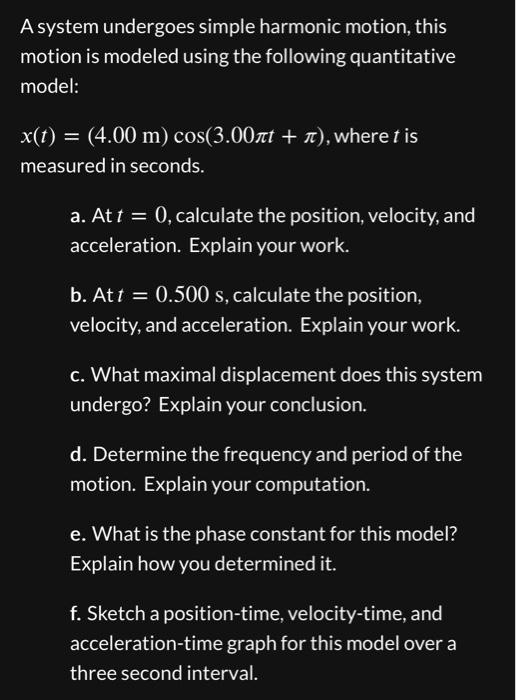
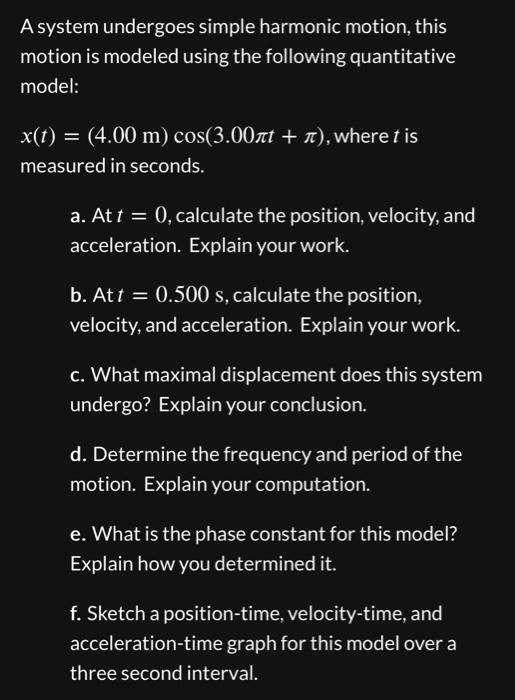
A system undergoes simple harmonic motion, this motion is modeled using the following quantitative model: x(1) = (4.00 m) cos(3.00nt + 7:), where t is measured in seconds. a. At t = 0, calculate the position, velocity, and acceleration. Explain your work. b. Att = 0.500 s, calculate the position, velocity, and acceleration. Explain your work. c. What maximal displacement does this system undergo? Explain your conclusion. d. Determine the frequency and period of the motion. Explain your computation. e. What is the phase constant for this model? Explain how you determined it. f. Sketch a position-time, velocity-time, and acceleration-time graph for this model over a three second interval
Step by Step Solution
There are 3 Steps involved in it

Get step-by-step solutions from verified subject matter experts
 Study Help