







Question: A system using an 8052 micro-controller with a 24 MHz crystal needs to communicate with another system using an 8051 micro-controller with an 11.059
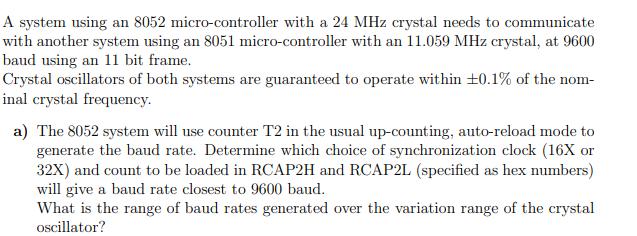


A system using an 8052 micro-controller with a 24 MHz crystal needs to communicate with another system using an 8051 micro-controller with an 11.059 MHz crystal, at 9600 baud using an 11 bit frame. Crystal oscillators of both systems are guaranteed to operate within 10.1% of the nom- inal crystal frequency. a) The 8052 system will use counter T2 in the usual up-counting, auto-reload mode to generate the baud rate. Determine which choice of synchronization clock (16X or 32X) and count to be loaded in RCAP2H and RCAP2L (specified as hex numbers) will give a baud rate closest to 9600 baud. What is the range of baud rates generated over the variation range of the crystal oscillator? b) The 8051 system will use counter T1 in mode 2 to generate the baud rate. Find the choice of synchronization clock (16X or 32X) and the count to be loaded in TH1 which will give a baud rate closest to 9600 baud with least synchronization error. What is the range of baud rates generated over the variation range of the crystal oscillator? c) Assume that the 8052 system is the receiver and 8051 is the talker. In the worst case scenario, by how much time will the actual sampling time in the receiver differ from the optimum sampling instant? What fraction of the receive bit time is this error? When will this worst case arise?
Step by Step Solution
3.43 Rating (153 Votes )
There are 3 Steps involved in it
The detailed ... View full answer

Get step-by-step solutions from verified subject matter experts
 Study Help