







Question: *A text data file is required. Download the link below don't worry it's from google drive and its safe. Thank you. https://drive.google.com/file/d/1T6eMZ-fr_qnhoqv6nQ3-s0SsaN-xwWZI/view?usp=sharing Goals: practice Processing
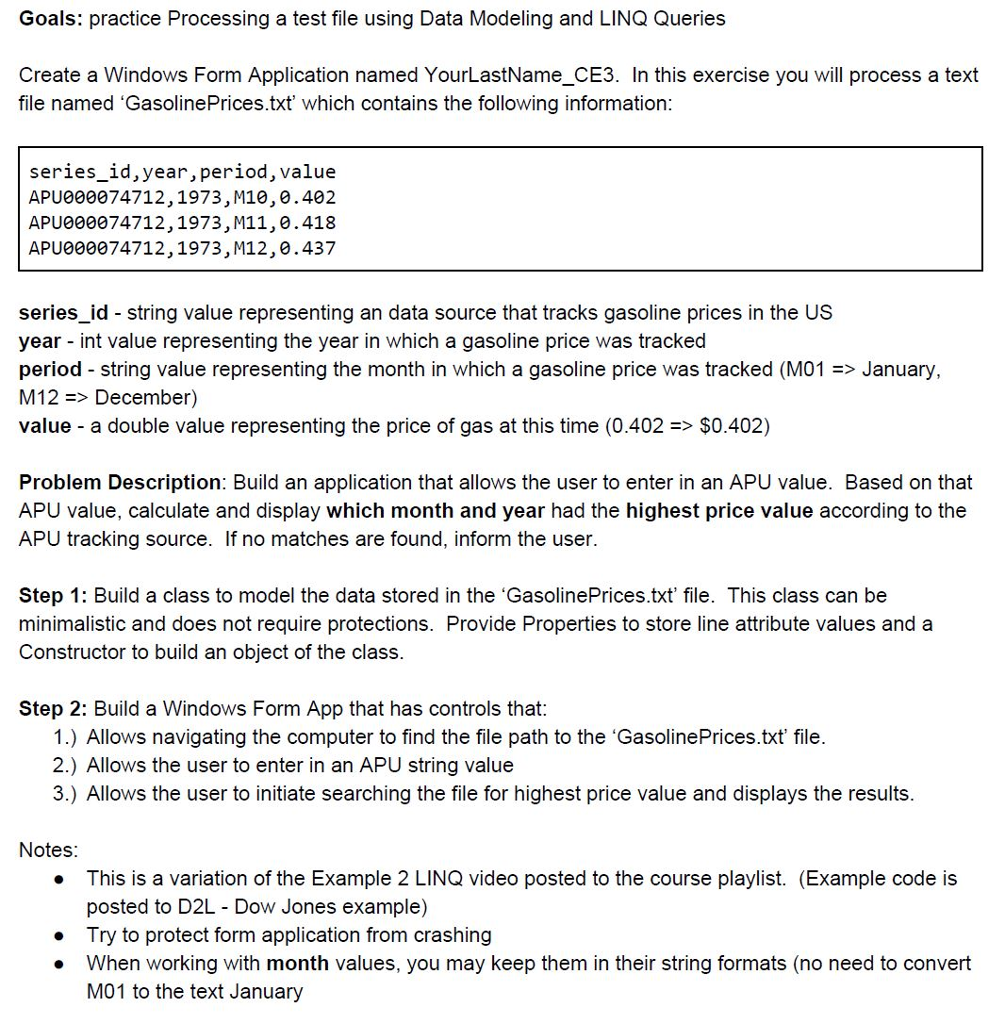
*A text data file is required. Download the link below don't worry it's from google drive and its safe. Thank you.
https://drive.google.com/file/d/1T6eMZ-fr_qnhoqv6nQ3-s0SsaN-xwWZI/view?usp=sharing
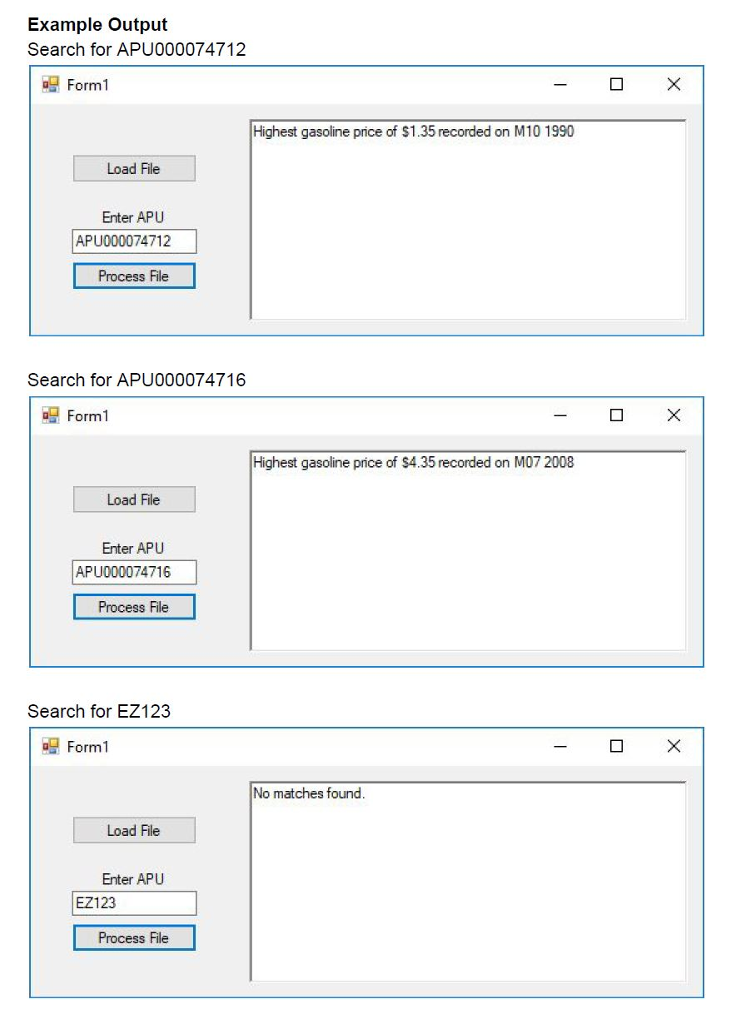
Goals: practice Processing a test file using Data Modeling and LINQ Queries Create a Windows Form Application named YourLastName CE3. In this exercise you will process a text file named 'GasolinePrices.txt which contains the following information series_id,year, period, value APU000074712,1973,M10,0.402 APU000074712,1973,M11,0.418 APU000074712,1973,M12,0.437 series id - string value representing an data source that tracks gasoline prices in the US year int value representing the year in which a gasoline price was tracked period-string value representing the month in which a gasoline price was tracked (MOI => January. M12 December) value a double value representing the price of gas at this time (0.402$0.402) Problem Description: Build an application that allows the user to enter in an APU value. Based on that APU value, calculate and display which month and year had the highest price value according to the APU tracking source. If no matches are found, inform the user. Step 1: Build a class to model the data stored in the 'GasolinePrices.txt' file. This class can be minimalistic and does not require protections. Provide Properties to store line attribute values and a Constructor to build an object of the class Step 2: Build a Windows Form App that has controls that 1.) Allows navigating the computer to find the file path to the 'GasolinePrices.txt' file. 2.) Allows the user to enter in an APU string value 3.) Allows the user to initiate searching the file for highest price value and displays the results Notes . This is a variation of the Example 2 LINQ video posted to the course playlist. (Example code is posted to D2L Dow Jones example) ry to protect form application from crashing When working with month values, you may keep them in their string formats (no need to convert M01 to the text January . Goals: practice Processing a test file using Data Modeling and LINQ Queries Create a Windows Form Application named YourLastName CE3. In this exercise you will process a text file named 'GasolinePrices.txt which contains the following information series_id,year, period, value APU000074712,1973,M10,0.402 APU000074712,1973,M11,0.418 APU000074712,1973,M12,0.437 series id - string value representing an data source that tracks gasoline prices in the US year int value representing the year in which a gasoline price was tracked period-string value representing the month in which a gasoline price was tracked (MOI => January. M12 December) value a double value representing the price of gas at this time (0.402$0.402) Problem Description: Build an application that allows the user to enter in an APU value. Based on that APU value, calculate and display which month and year had the highest price value according to the APU tracking source. If no matches are found, inform the user. Step 1: Build a class to model the data stored in the 'GasolinePrices.txt' file. This class can be minimalistic and does not require protections. Provide Properties to store line attribute values and a Constructor to build an object of the class Step 2: Build a Windows Form App that has controls that 1.) Allows navigating the computer to find the file path to the 'GasolinePrices.txt' file. 2.) Allows the user to enter in an APU string value 3.) Allows the user to initiate searching the file for highest price value and displays the results Notes . This is a variation of the Example 2 LINQ video posted to the course playlist. (Example code is posted to D2L Dow Jones example) ry to protect form application from crashing When working with month values, you may keep them in their string formats (no need to convert M01 to the text January
Step by Step Solution
There are 3 Steps involved in it

Get step-by-step solutions from verified subject matter experts
 Study Help