







Question: (a) The numerals 1, 2, 3, 4, 5, 6, 7, 8, 9 are arranged in a manner that the sums of the 3 numerals at
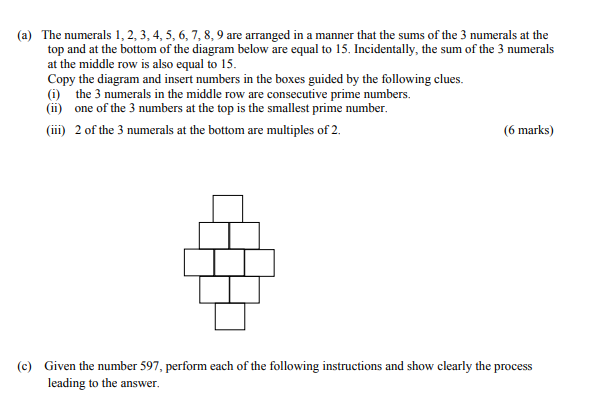
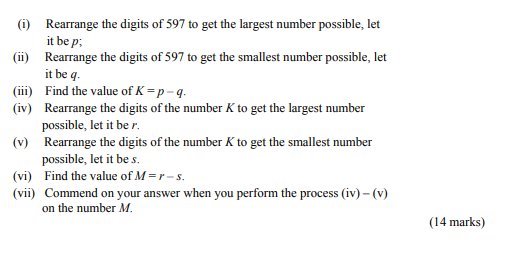
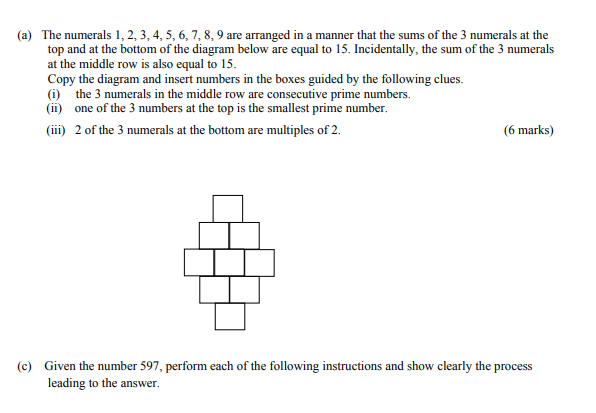
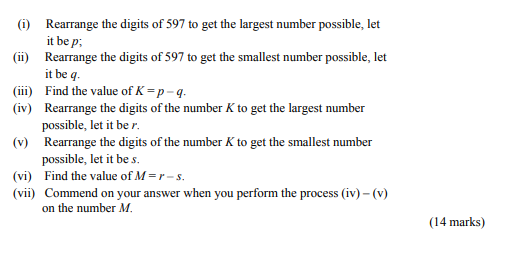
(a) The numerals 1, 2, 3, 4, 5, 6, 7, 8, 9 are arranged in a manner that the sums of the 3 numerals at the top and at the bottom of the diagram below are equal to 15. Incidentally, the sum of the 3 numerals at the middle row is also equal to 15. Copy the diagram and insert numbers in the boxes guided by the following clues. (i) the 3 numerals in the middle row are consecutive prime numbers. (ii) one of the 3 numbers at the top is the smallest prime number. (iii) 2 of the 3 numerals at the bottom are multiples of 2. (6 marks) (c) Given the number 597, perform each of the following instructions and show clearly the process leading to the answer.(i) Rearrange the digits of 597 to get the largest number possible, let it be p; (ii) Rearrange the digits of 597 to get the smallest number possible, let it be q. (iii) Find the value of K = p - q. (iv) Rearrange the digits of the number & to get the largest number possible, let it be r. (v) Rearrange the digits of the number K to get the smallest number possible, let it be s. (vi) Find the value of M= r -5. (vii) Commend on your answer when you perform the process (iv) - (v) on the number M. (14 marks)
Step by Step Solution
There are 3 Steps involved in it

Get step-by-step solutions from verified subject matter experts
 Study Help