







Question: (a) To simplify the calculation, we'll make a simple physics model take the ion and the two hydrogens as each having a charge +e, while
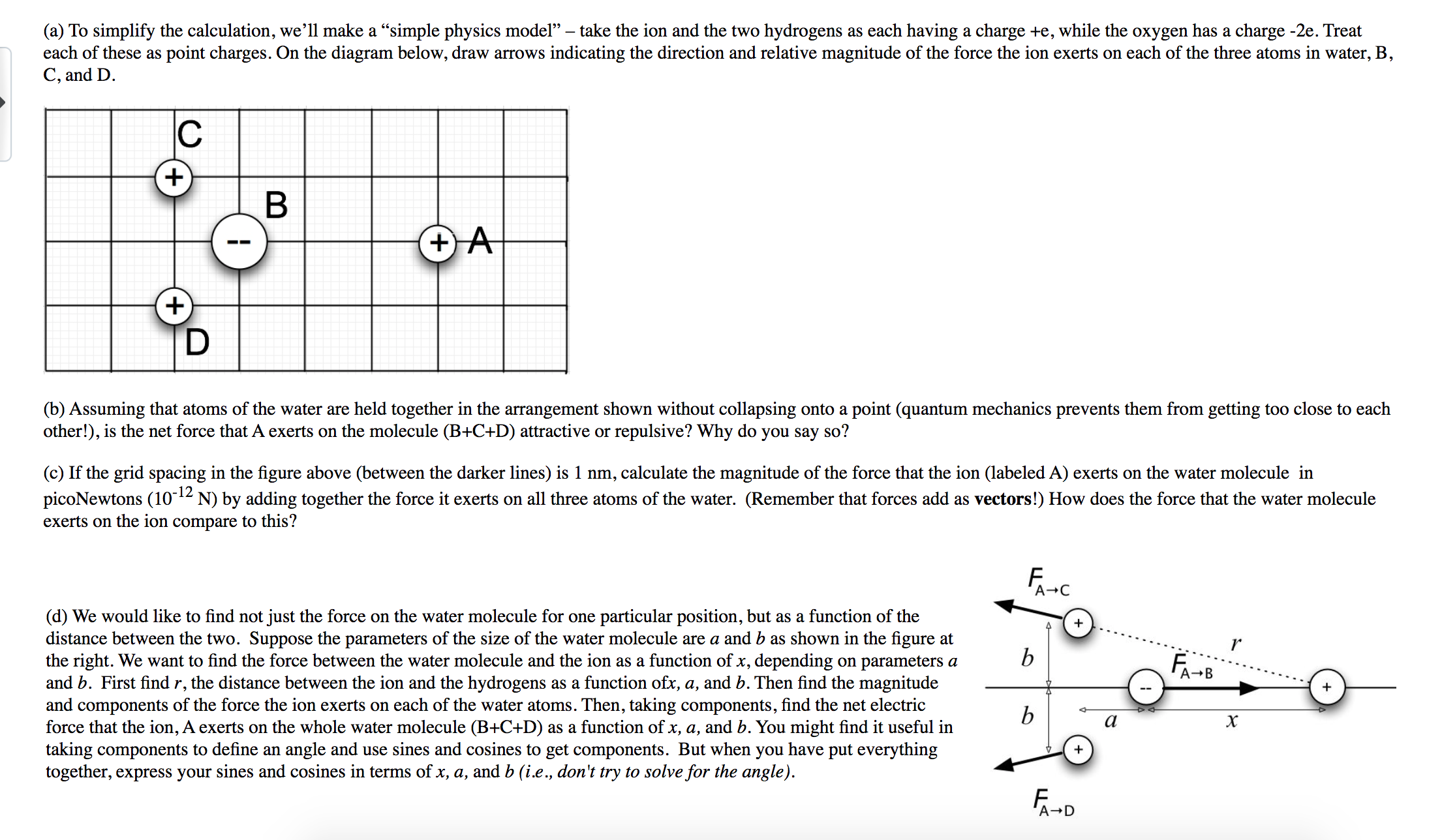
(a) To simplify the calculation, we'll make a \"simple physics model\" take the ion and the two hydrogens as each having a charge +e, while the oxygen has a charge -2e. Treat each of these as point charges. 0n the diagram below, draw arrows indicating the direction and relative magnitude of the force the ion exerts on each of the three atoms in water, B, C, and D. (b) Assuming that atoms of the water are held together in the arrangement shown without collapsing onto a point (quantum mechanics prevents them from getting too close to each other!), is the net force that A exerts on the molecule (B+C+D) attractive or repulsive? Why do you say so? (c) If the grid spacing in the gure above (between the darker lines) is 1 nm, calculate the magnitude of the force that the ion (labeled A) exerts on the water molecule in picoNewtons (10'12 N) by adding together the force it exerts on all three atoms of the water. (Remember that forces add as vectors!) How does the force that the water molecule exerts on the ion compare to this? (d) We would like to nd not just the force on the water molecule for one particular position, but as a function of the distance between the two. Suppose the parameters of the size of the water molecule are a and b as shown in the gure at the right. We want to nd the force between the water molecule and the ion as a function of x, depending on parameters a and I). First nd r, the distance between the ion and the hydrogens as a function ofx, a, and b. Then nd the magnitude and components of the force the ion exerts on each of the water atoms. Then, taking components, nd the net electric force that the ion, A exerts on the whole water molecule (B+C+D) as a function of x, a, and b. You might nd it useful in taking components to dene an angle and use sines and cosines to get components. But when you have put everything together, express your sines and cosines in terms of x, a, and b (i.e., don't try to solve for the angle)
Step by Step Solution
There are 3 Steps involved in it

Get step-by-step solutions from verified subject matter experts
 Study Help