







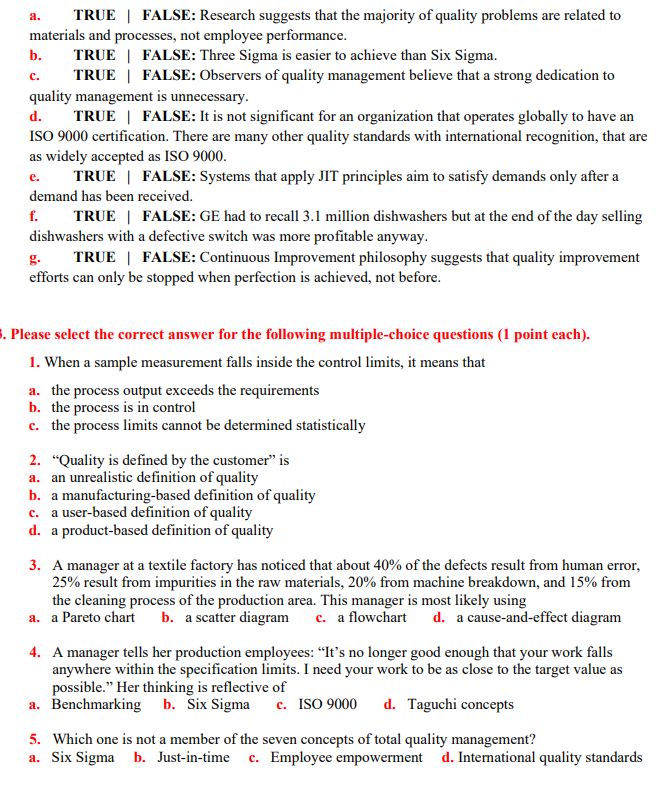
Question: a . TRUE | FALSE: Research suggests that the majority of quality problems are related to materials and processes, not employee performance. b . TRUE
a TRUE FALSE: Research suggests that the majority of quality problems are related to
materials and processes, not employee performance.
b TRUE FALSE: Three Sigma is easier to achieve than Six Sigma.
c TRUE FALSE: Observers of quality management believe that a strong dedication to
quality management is unnecessary.
d TRUE FALSE: It is not significant for an organization that operates globally to have an
ISO certification. There are many other quality standards with international recognition, that are
as widely accepted as ISO
e TRUE FALSE: Systems that apply JIT principles aim to satisfy demands only after a
demand has been received.
f TRUE FALSE: GE had to recall million dishwashers but at the end of the day selling
dishwashers with a defective switch was more profitable anyway.
g TRUE FALSE: Continuous Improvement philosophy suggests that quality improvement
efforts can only be stopped when perfection is achieved, not before.
Please select the correct answer for the following multiplechoice questions point each
When a sample measurement falls inside the control limits it means that
a the process output exceeds the requirements
b the process is in control
c the process limits cannot be determined statistically
"Quality is defined by the customer" is
a an unrealistic definition of quality
b a manufacturingbased definition of quality
c a userbased definition of quality
d a productbased definition of quality
A manager at a textile factory has noticed that about of the defects result from human error,
result from impurities in the raw materials, from machine breakdown, and from
the cleaning process of the production area. This manager is most likely using
a a Pareto chart
b a scatter diagram
c a flowchart
d a causeandeffect diagram
A manager tells her production employees: "It's no longer good enough that your work falls
anywhere within the specification limits I need your work to be as close to the target value as
possible." Her thinking is reflective of
a Benchmarking
b Six Sigma
c ISO
d Taguchi concepts
Which one is not a member of the seven concepts of total quality management?
a Six Sigma
b Justintime
c Employee empowerment
d International quality standardsa. TRUE FALSE: Research suggests that the majority of quality problems are related to
materials and processes, not employee performance.
b TRUE FALSE: Three Sigma is easier to achieve than Six Sigma.
c TRUE FALSE: Observers of quality management believe that a strong dedication to
quality management is unnecessary.
d TRUE FALSE: It is not significant for an organization that operates globally to have an
ISO certification. There are many other quality standards with international recognition, that are
as widely accepted as ISO
e TRUE FALSE: Systems that apply JIT principles aim to satisfy demands only after a
demand has been received.
f TRUE FALSE: GE had to recall million dishwashers but at the end of the day selling
dishwashers with a defective switch was more profitable anyway.
g TRUE FALSE: Continuous Improvement philosophy suggests that quality improvement
efforts can only be stopped when perfection is achieved, not before.
Please select the correct answer for the following multiplechoice questions point each
When a sample measurement falls inside the control limits it means that
a the process output exceeds the requirements
b the process is in control
c the process limits cannot be determined statistically
"Quality is defined by the customer" is
a an unrealistic definition of quality
b a manufacturingbased definition of quality
c a userbased definition of quality
d a productbased definition of quality
A manager at a textile factory has noticed that about of the defects result from human error,
result from impurities in the raw materials, from machine breakdown, and from
the cleaning process of the production area. This manager is most likely using
a a Pareto chart
b a scatter diagram
c a flowchart
d a causeandeffect diagram
A manager tells her production employees: "It's no longer good enough that your work falls
anywhere within the specification limits I need your work to be as close to the target value as
possible." Her thinking is reflective of
a Benchmarking
b Six Sigma
c ISO
d Taguchi concepts
Which one is not a member of the seven concepts of total quality management?
a Six Sigma
b Justintime
c Employee empowerment
d International quality standards
Step by Step Solution
There are 3 Steps involved in it
1 Expert Approved Answer
Step: 1 Unlock

Question Has Been Solved by an Expert!
Get step-by-step solutions from verified subject matter experts
Step: 2 Unlock
Step: 3 Unlock
 Study Help