







Question: A. What is the main difference between a lattice primitive unit cell and a crystal primitive unit cell? B. What is a conventional or convenient
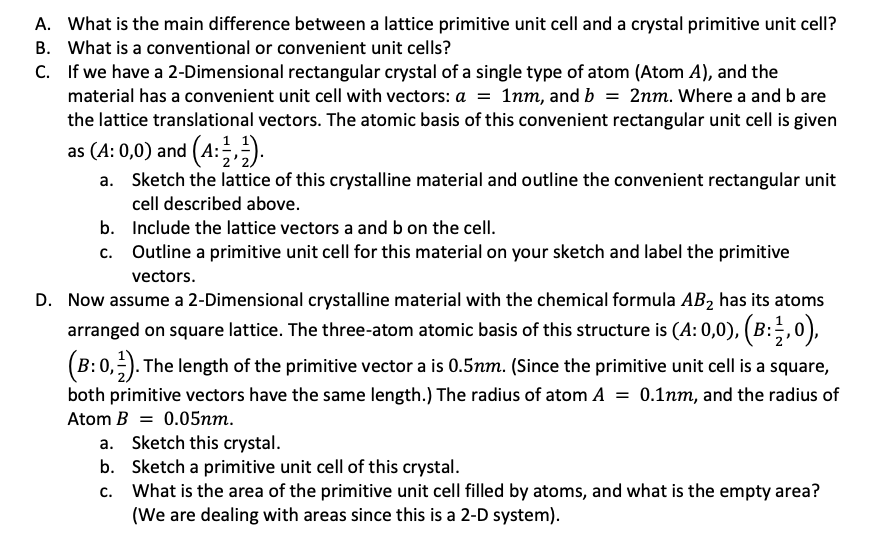
A. What is the main difference between a lattice primitive unit cell and a crystal primitive unit cell? B. What is a conventional or convenient unit cells? C. If we have a 2-Dimensional rectangular crystal of a single type of atom (Atom A), and the material has a convenient unit cell with vectors: a = 1nm, and b = 2nm. Where a and b are the lattice translational vectors. The atomic basis of this convenient rectangular unit cell is given as (A: 0,0) and (4:23) A a. Sketch the lattice of this crystalline material and outline the convenient rectangular unit cell described above. b. Include the lattice vectors a and b on the cell. C. Outline a primitive unit cell for this material on your sketch and label the primitive vectors. D. Now assume a 2-Dimensional crystalline material with the chemical formula AB has its atoms arranged on square lattice. The three-atom atomic basis of this structure is (A: 0,0), (B: 3,0), (B: 0,4). The length of the primitive vector a is 0.5nm. (Since the primitive unit cell is a square, both primitive vectors have the same length.) The radius of atom A = 0.1nm, and the radius of Atom B = 0.05nm. a. Sketch this crystal. b. Sketch a primitive unit cell of this crystal. C. What is the area of the primitive unit cell filled by atoms, and what is the empty area? (We are dealing with areas since this is a 2-D system)
Step by Step Solution
There are 3 Steps involved in it

Get step-by-step solutions from verified subject matter experts
 Study Help