





Question: A. What is the relation between transportation cost and inventory cost? B. Why is sorting a major task in transportation? C. Explain the relationship between
A. What is the relation between transportation
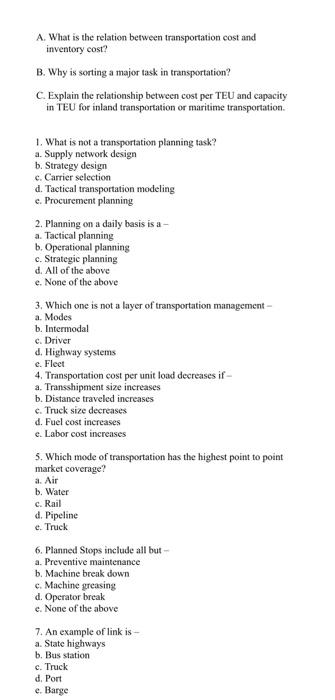
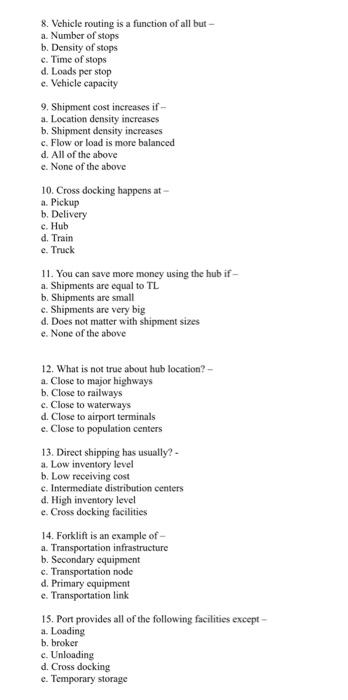
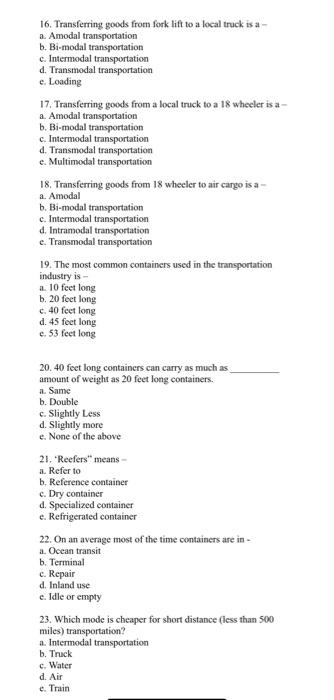
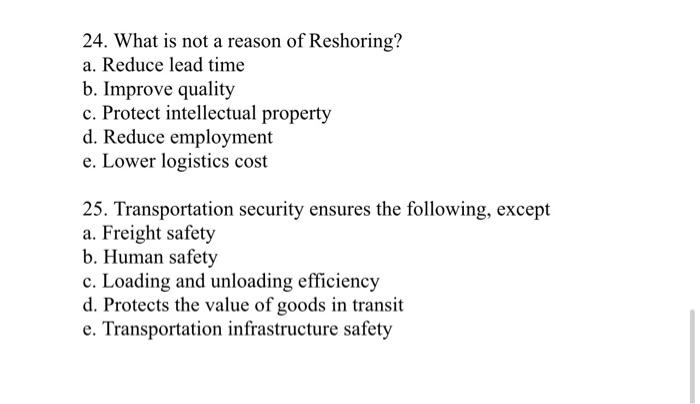
A. What is the relation between transportation cost and inventory cost? B. Why is sorting a major task in transportation? C. Explain the relationship between cost per TEU and capacity in TEU for inland transportation or maritime transportation. 1. What is not a transportation planning task? a. Supply network design b. Strategy design c. Carrier selection d. Tactical transportation modeling c. Procurement planning 2. Planning on a daily basis is a- a. Tactical planning b. Operational planning c. Strategic planning d. All of the above e. None of the above 3. Which one is not a layer of transportation management - a. Modes b. Intermodal c. Driver d. Highway systems c. Fleet 4. Transportation cost per unit load decreases if - a. Transshipment size increases b. Distance traveled increases c. Truck sice decreases d. Fuel cost increases c. Labor cost increases 5. Which mode of transportation has the highest point to point market coverage? a. Air b. Water c. Rail d. Pipeline e. Truck 6. Planned Stops include all but - a. Preventive maintenance b. Machine break down c. Machine greasing d. Operator break c. None of the above 7. An example of link is - a. State highways b. Bus station c. Truck d. Port c. Barge 8. Vehicle routing is a function of all but - a. Number of stops b. Density of stops c. Time of stops d. Losds per stop c. Vehicle capacity 9. Shipment cost increases if - a. Location density increases b. Shipment density increases c. Flow or load is more balanced d. All of the above e. None of the above 10. Cross docking happens at - a. Pickup b. Delivery c. Hub d. Train c. Truck 11. You can save more money using the hub if - a. Shipments are equal to TL b. Shipments are small c. Shipments are very big d. Does not matter with shipment sizes e. None of the above 12. What is not true about hub location? - a. Close to major highways b. Close to railways c. Close to waterways d. Close to airport terminals e. Close to population centers 13. Direct shipping has usually? - a. Low inventory level b. Low receiving cost c. Intermediate distribution centers d. High inventory level e. Cross docking facilities 14. Forklift is an example of - a. Transportation infrastructure b. Secondary equipment c. Transportation node d. Primary equipment e. Transportation link 15. Port provides all of the following facilities except - a. Loading b. broker c. Unloading d. Cross docking e. Temporary storage 16. Transferring goods from fork lift to a local truck is a - a. Amodal transportation b. Bi-modal transportation c. Intermodal transportation d. Transmodal transportation e. Loading 17. Transferring goods from a local truck to a 18 wheeler is a- a. Amodal transportation b. Bi-modal transportation c. Intermodal transportation d. Transmodal transportation e. Multimodal transportation 18. Transferring goods from 18 wheeler to air cargo is a - a. Amodal b. Bi-modal transportation c. Intermodal transportation d, Intramodal transportation c. Transmodal transportation 19. The most common containers used in the transportation industry is - a. 10 fect long b. 20 fect long c. 40 feet long d. 45 foet long e. 53 fect long 20. 40 feet long containers can carry as much as amount of weight as 20 feet long containers. a. Same b. Double c. Slightly Less d. Slightly more e. None of the above 21. 'Reefers" means - a. Refer to b. Reference container c. Dry container d. Specialized container e. Refrigerated container 22. On an average most of the time containers are in - a. Ocean transit b. Terminal c. Repair d. Inland use e. Idle or empty 23. Which mode is cheaper for short distance (less than 500 miles) transportation? a. Intermodal transportation b. Truck c. Water d. Air e. Train 24 . What is not a reason of Reshoring? a. Reduce lead time b. Improve quality c. Protect intellectual property d. Reduce employment e. Lower logistics cost 25. Transportation security ensures the following, except a. Freight safety b. Human safety c. Loading and unloading efficiency d. Protects the value of goods in transit e. Transportation infrastructure safety A. What is the relation between transportation cost and inventory cost? B. Why is sorting a major task in transportation? C. Explain the relationship between cost per TEU and capacity in TEU for inland transportation or maritime transportation. 1. What is not a transportation planning task? a. Supply network design b. Strategy design c. Carrier selection d. Tactical transportation modeling c. Procurement planning 2. Planning on a daily basis is a- a. Tactical planning b. Operational planning c. Strategic planning d. All of the above e. None of the above 3. Which one is not a layer of transportation management - a. Modes b. Intermodal c. Driver d. Highway systems c. Fleet 4. Transportation cost per unit load decreases if - a. Transshipment size increases b. Distance traveled increases c. Truck sice decreases d. Fuel cost increases c. Labor cost increases 5. Which mode of transportation has the highest point to point market coverage? a. Air b. Water c. Rail d. Pipeline e. Truck 6. Planned Stops include all but - a. Preventive maintenance b. Machine break down c. Machine greasing d. Operator break c. None of the above 7. An example of link is - a. State highways b. Bus station c. Truck d. Port c. Barge 8. Vehicle routing is a function of all but - a. Number of stops b. Density of stops c. Time of stops d. Losds per stop c. Vehicle capacity 9. Shipment cost increases if - a. Location density increases b. Shipment density increases c. Flow or load is more balanced d. All of the above e. None of the above 10. Cross docking happens at - a. Pickup b. Delivery c. Hub d. Train c. Truck 11. You can save more money using the hub if - a. Shipments are equal to TL b. Shipments are small c. Shipments are very big d. Does not matter with shipment sizes e. None of the above 12. What is not true about hub location? - a. Close to major highways b. Close to railways c. Close to waterways d. Close to airport terminals e. Close to population centers 13. Direct shipping has usually? - a. Low inventory level b. Low receiving cost c. Intermediate distribution centers d. High inventory level e. Cross docking facilities 14. Forklift is an example of - a. Transportation infrastructure b. Secondary equipment c. Transportation node d. Primary equipment e. Transportation link 15. Port provides all of the following facilities except - a. Loading b. broker c. Unloading d. Cross docking e. Temporary storage 16. Transferring goods from fork lift to a local truck is a - a. Amodal transportation b. Bi-modal transportation c. Intermodal transportation d. Transmodal transportation e. Loading 17. Transferring goods from a local truck to a 18 wheeler is a- a. Amodal transportation b. Bi-modal transportation c. Intermodal transportation d. Transmodal transportation e. Multimodal transportation 18. Transferring goods from 18 wheeler to air cargo is a - a. Amodal b. Bi-modal transportation c. Intermodal transportation d, Intramodal transportation c. Transmodal transportation 19. The most common containers used in the transportation industry is - a. 10 fect long b. 20 fect long c. 40 feet long d. 45 foet long e. 53 fect long 20. 40 feet long containers can carry as much as amount of weight as 20 feet long containers. a. Same b. Double c. Slightly Less d. Slightly more e. None of the above 21. 'Reefers" means - a. Refer to b. Reference container c. Dry container d. Specialized container e. Refrigerated container 22. On an average most of the time containers are in - a. Ocean transit b. Terminal c. Repair d. Inland use e. Idle or empty 23. Which mode is cheaper for short distance (less than 500 miles) transportation? a. Intermodal transportation b. Truck c. Water d. Air e. Train 24 . What is not a reason of Reshoring? a. Reduce lead time b. Improve quality c. Protect intellectual property d. Reduce employment e. Lower logistics cost 25. Transportation security ensures the following, except a. Freight safety b. Human safety c. Loading and unloading efficiency d. Protects the value of goods in transit e. Transportation infrastructure safety
Step by Step Solution

There are 3 Steps involved in it

1 Expert Approved Answer
Step: 1 Unlock blur-text-image

Question Has Been Solved by an Expert!

Get step-by-step solutions from verified subject matter experts

Step: 2 Unlock
Step: 3 Unlock

Students Have Also Explored These Related General Management Questions!