







Question: AB is carried out over a solid catalyst in a tubular packed-bed reactor. If the reaction is so rapid that mas transfer between the catalyst
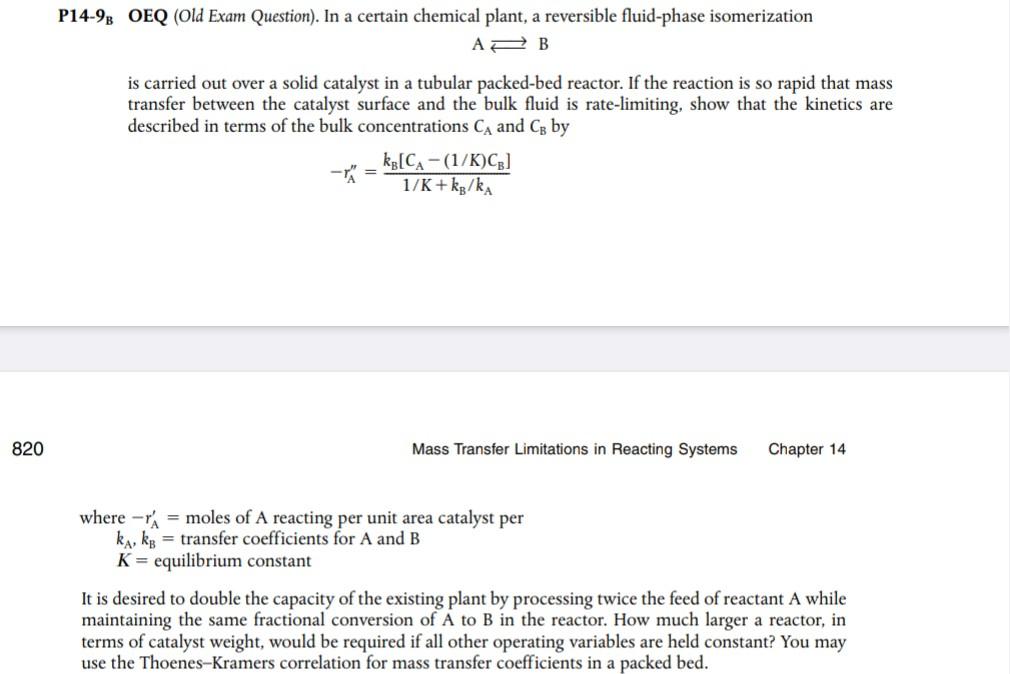
AB is carried out over a solid catalyst in a tubular packed-bed reactor. If the reaction is so rapid that mas transfer between the catalyst surface and the bulk fluid is rate-limiting, show that the kinetics ar described in terms of the bulk concentrations CA and CB by rA=1/K+kB/kAkB[CA(1/K)CB] Mass Transfer Limitations in Reacting Systems where rA= moles of A reacting per unit area catalyst per kA,kB= transfer coefficients for A and B K= equilibrium constant It is desired to double the capacity of the existing plant by processing twice the feed of reactant A while maintaining the same fractional conversion of A to B in the reactor. How much larger a reactor, in terms of catalyst weight, would be required if all other operating variables are held constant? You may use the Thoenes-Kramers correlation for mass transfer coefficients in a packed bed. AB is carried out over a solid catalyst in a tubular packed-bed reactor. If the reaction is so rapid that mas transfer between the catalyst surface and the bulk fluid is rate-limiting, show that the kinetics ar described in terms of the bulk concentrations CA and CB by rA=1/K+kB/kAkB[CA(1/K)CB] Mass Transfer Limitations in Reacting Systems where rA= moles of A reacting per unit area catalyst per kA,kB= transfer coefficients for A and B K= equilibrium constant It is desired to double the capacity of the existing plant by processing twice the feed of reactant A while maintaining the same fractional conversion of A to B in the reactor. How much larger a reactor, in terms of catalyst weight, would be required if all other operating variables are held constant? You may use the Thoenes-Kramers correlation for mass transfer coefficients in a packed bed
Step by Step Solution
There are 3 Steps involved in it

Get step-by-step solutions from verified subject matter experts
 Study Help