







Question: ABC develops computer products for consumers in Australia. In June 2014, a team of analysts issued a research report that valued ABC s stock at
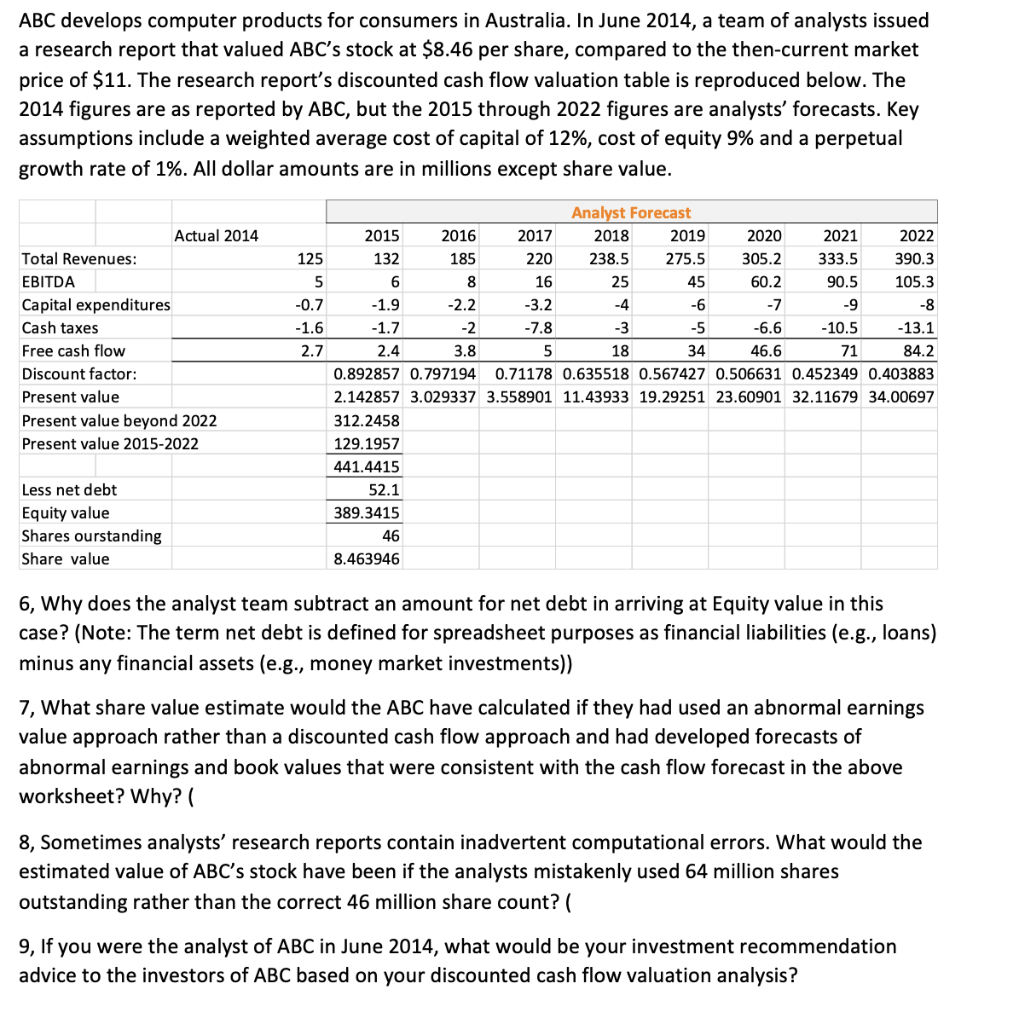
ABC develops computer products for consumers in Australia. In June 2014, a team of analysts issued a research report that valued ABC s stock at $8.46 per share, compared to the then-current market price of $11. The research report's discounted cash flow valuation table is reproduced below. The 2014 figures are as reported by ABC, but the 2015 through 2022 figures are analysts' forecasts. Key assumptions include a weighted average cost of capital of 12%, cost of equity 9% and a perpetual growth rate of 1%. All dollar amounts are in millions except share value. 6, Why does the analyst team subtract an amount for net debt in arriving at Equity value in this case? (Note: The term net debt is defined for spreadsheet purposes as financial liabilities (e.g., loans) minus any financial assets (e.g., money market investments)) 7, What share value estimate would the ABC have calculated if they had used an abnormal earnings value approach rather than a discounted cash flow approach and had developed forecasts of abnormal earnings and book values that were consistent with the cash flow forecast in the above worksheet? Why? ( 8, Sometimes analysts' research reports contain inadvertent computational errors. What would the estimated value of ABC 's stock have been if the analysts mistakenly used 64 million shares outstanding rather than the correct 46 million share count? ( 9, If you were the analyst of ABC in June 2014, what would be your investment recommendation advice to the investors of ABC based on your discounted cash flow valuation analysis? ABC develops computer products for consumers in Australia. In June 2014, a team of analysts issued a research report that valued ABC s stock at $8.46 per share, compared to the then-current market price of $11. The research report's discounted cash flow valuation table is reproduced below. The 2014 figures are as reported by ABC, but the 2015 through 2022 figures are analysts' forecasts. Key assumptions include a weighted average cost of capital of 12%, cost of equity 9% and a perpetual growth rate of 1%. All dollar amounts are in millions except share value. 6, Why does the analyst team subtract an amount for net debt in arriving at Equity value in this case? (Note: The term net debt is defined for spreadsheet purposes as financial liabilities (e.g., loans) minus any financial assets (e.g., money market investments)) 7, What share value estimate would the ABC have calculated if they had used an abnormal earnings value approach rather than a discounted cash flow approach and had developed forecasts of abnormal earnings and book values that were consistent with the cash flow forecast in the above worksheet? Why? ( 8, Sometimes analysts' research reports contain inadvertent computational errors. What would the estimated value of ABC 's stock have been if the analysts mistakenly used 64 million shares outstanding rather than the correct 46 million share count? ( 9, If you were the analyst of ABC in June 2014, what would be your investment recommendation advice to the investors of ABC based on your discounted cash flow valuation analysis
Step by Step Solution
There are 3 Steps involved in it

Get step-by-step solutions from verified subject matter experts
 Study Help