







Question: ABC develops computer products for consumers in Australia. In June 2014 , a team of analysts issued a research report that valued ABC s stock
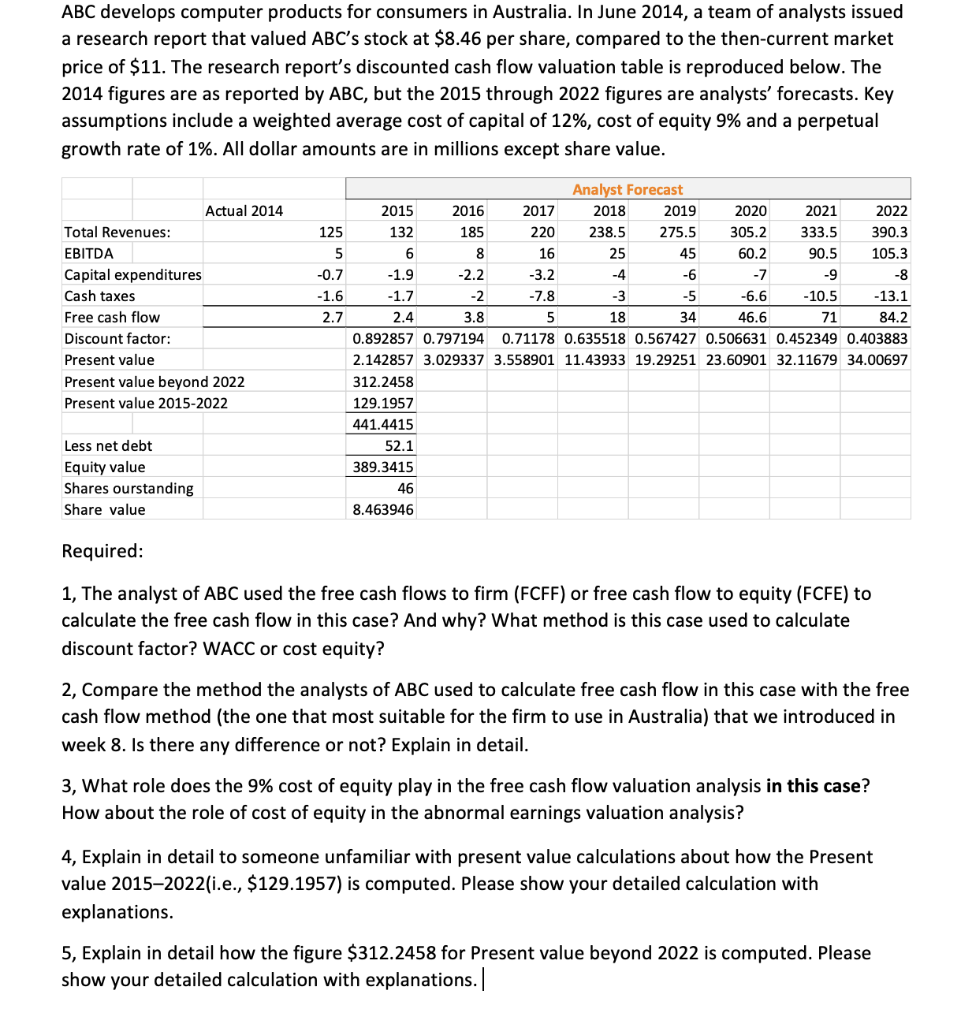
ABC develops computer products for consumers in Australia. In June 2014 , a team of analysts issued a research report that valued ABC s stock at $8.46 per share, compared to the then-current market price of \$11. The research report's discounted cash flow valuation table is reproduced below. The 2014 figures are as reported by ABC, but the 2015 through 2022 figures are analysts' forecasts. Key assumptions include a weighted average cost of capital of 12%, cost of equity 9% and a perpetual growth rate of 1%. All dollar amounts are in millions except share value. Required: 1, The analyst of ABC used the free cash flows to firm (FCFF) or free cash flow to equity (FCFE) to calculate the free cash flow in this case? And why? What method is this case used to calculate discount factor? WACC or cost equity? 2, Compare the method the analysts of ABC used to calculate free cash flow in this case with the free cash flow method (the one that most suitable for the firm to use in Australia) that we introduced in week 8 . Is there any difference or not? Explain in detail. 3. What role does the 9% cost of equity play in the free cash flow valuation analysis in this case? How about the role of cost of equity in the abnormal earnings valuation analysis? 4, Explain in detail to someone unfamiliar with present value calculations about how the Present value 2015-2022(i.e., \$129.1957) is computed. Please show your detailed calculation with explanations. 5, Explain in detail how the figure $312.2458 for Present value beyond 2022 is computed. Please show your detailed calculation with explanations. ABC develops computer products for consumers in Australia. In June 2014 , a team of analysts issued a research report that valued ABC s stock at $8.46 per share, compared to the then-current market price of \$11. The research report's discounted cash flow valuation table is reproduced below. The 2014 figures are as reported by ABC, but the 2015 through 2022 figures are analysts' forecasts. Key assumptions include a weighted average cost of capital of 12%, cost of equity 9% and a perpetual growth rate of 1%. All dollar amounts are in millions except share value. Required: 1, The analyst of ABC used the free cash flows to firm (FCFF) or free cash flow to equity (FCFE) to calculate the free cash flow in this case? And why? What method is this case used to calculate discount factor? WACC or cost equity? 2, Compare the method the analysts of ABC used to calculate free cash flow in this case with the free cash flow method (the one that most suitable for the firm to use in Australia) that we introduced in week 8 . Is there any difference or not? Explain in detail. 3. What role does the 9% cost of equity play in the free cash flow valuation analysis in this case? How about the role of cost of equity in the abnormal earnings valuation analysis? 4, Explain in detail to someone unfamiliar with present value calculations about how the Present value 2015-2022(i.e., \$129.1957) is computed. Please show your detailed calculation with explanations. 5, Explain in detail how the figure $312.2458 for Present value beyond 2022 is computed. Please show your detailed calculation with explanations
Step by Step Solution
There are 3 Steps involved in it

Get step-by-step solutions from verified subject matter experts
 Study Help