







Question: According to the case provided below, What is the current exposure management strategy at Porsche? Explain. CASE Case 8.2 Porsche: Fighting with currency swinging Porsche's
According to the case provided below, What is the current exposure management strategy at Porsche? Explain.
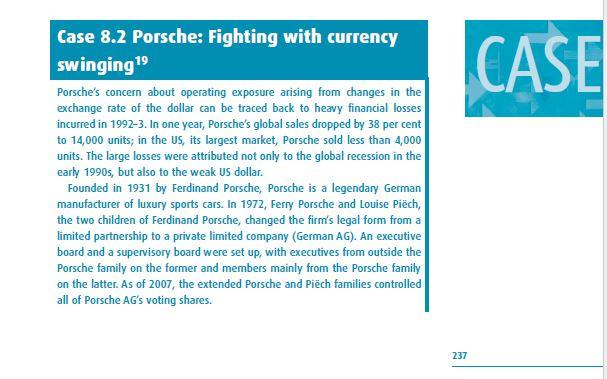
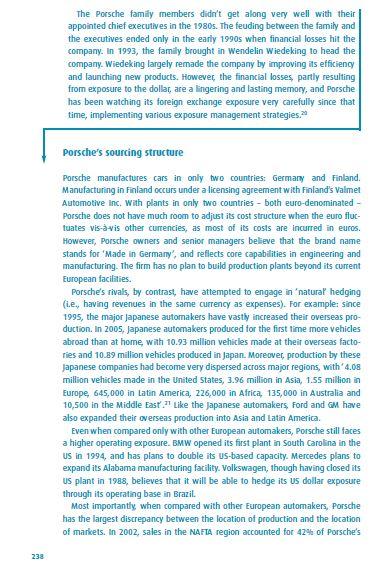
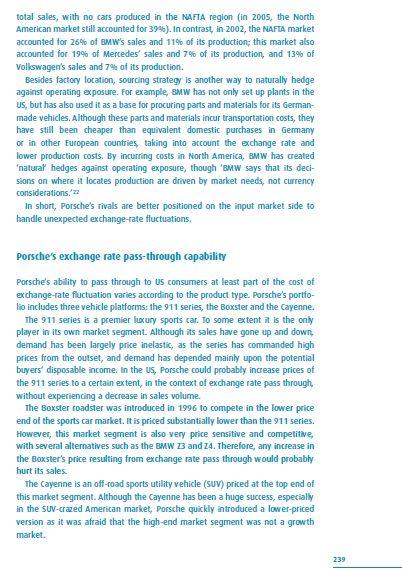
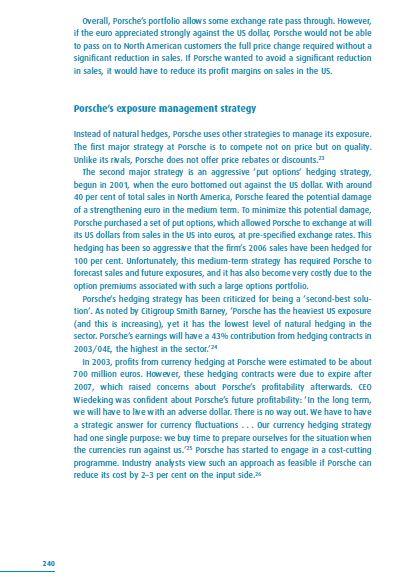
CASE Case 8.2 Porsche: Fighting with currency swinging Porsche's concern about operating exposure arising from changes in the exchange rate of the dollar can be traced back to heavy financial losses incurred in 1992-3. In one year, Porsche's global sales dropped by 38 per cent to 14,000 units; in the US, its largest market, Porsche sold less than 4,000 units. The large losses were attributed not only to the global recession in the early 1990s, but also to the weak US dollar. Founded in 1931 by Ferdinand Porsche, Porsche is a legendary German manufacturer of luxury sports cars. In 1972, Ferry Porsche and Louise Piech, the two children of Ferdinand Porsche, changed the firm's legal form from a limited partnership to a private limited company (German AG). An executive board and a supervisory board were set up, with executives from outside the Porsche family on the former and members mainly from the Porsche family on the latter. As of 2007, the extended Porsche and Pich families controlled all of Porsche AG's voting shares. 237 The Porsche family members didn't get along very well with their appointed chief executives in the 1980s. The feuding between the family and the executives ended only in the early 1990s when financial losses hit the company. In 1993, the family brought in Wendelin Wiedeking to head the company. Wiedeking largely remade the company by improving its efficiency and launching new products. However, the financial losses, partly resulting from exposure to the dollar, are a lingering and lasting memory, and Porsche has been watching its foreign exchange exposure very carefully since that time, implementing various exposure management strategies. Porsche's sourcing structure Porsche manufactures cars in only two countries: Germany and Finland. Manufacturing in Finland occurs under a licensing agreement with Finland's Valmet Automotive Inc. With plants in only two countries - both euro-denominated Porsche does not have much room to adjust its cost structure when the euro fluc- tuates vis-avis other currencies, as most of its costs are incurred in euros. However, Porsche owners and senior managers believe that the brand name stands for "Made in Germany', and reflects core capabilities in engineering and manufacturing. The firm has no plan to build production plants beyond its current European facilities. Porsche's rivals, by contrast, have attempted to engage in 'natural hedging (ie, having revenues in the same currency as expenses). For example: since 1995, the major Japanese automakers have vastly increased their overseas pro- duction. In 2005, Japanese automakers produced for the first time more vehicles abroad than at home with 10.93 million vehicles made at their overseas facto- ries and 10.89 million vehicles produced in Japan. Moreover, production by these Japanese companies had become very dispersed across major regions, with 4.08 million vehicles made in the United States, 3.96 million in Asia, 1.55 million in Europe, 645,000 in Latin America, 226,000 in Africa, 135,000 in Australia and 10,500 in the Middle East Like the Japanese automakers, Ford and GM have also expanded their overseas production into Asia and Latin America. Even when compared only with other European automakers, Porsche still faces a higher operating exposure. BMW opened its first plant in South Carolina in the us in 1994, and has plans to double its US-based capacity. Mercedes plans to expand its Alabama manufacturing facility. Volkswagen, though having closed its Us plant in 1988, believes that it will be able to hedge its US dollar exposure through its operating base in Brazil. Most importantly, when compared with other European automakers, Porsche has the largest discrepancy between the location of production and the location of markets. In 2002, sales in the NAFTA region accounted for 42% of Porsche's 238 total sales, with no cars produced in the NAFTA region in 2005, the North American market still accounted for 394). In contrast, in 2002, the NAFTA market accounted for 25% of BMW's sales and 11% of its production; this market also accounted for 19% of Mercedes sales and 7% of its production, and 13% of Volkswagen's sales and 7% of its production. Besides factory location, sourcing strategy is another way to naturally hedge against operating exposure. For example, smw has not only set up plants in the US, but has also used it as a base for procuring parts and materials for its German- made vehicles. Although these parts and materials incur transportation costs, they have still been cheaper than equivalent domestic purchases in Germany or in other European countries, taking into account the exchange rate and lower production costs. By incurring costs in North America, BMW has created natural hedges against operating exposure, though 'BMW says that its deci- sions on where it locates production are driven by market needs, not currency considerations, In short, Porsche's rivals are better positioned on the input market side to handle unexpected exchange-rate fluctuations. Porsche's exchange rate pass-through capability Porsche's ability to pass through to Us consumers at least part of the cost of exchange-rate fluctuation varies according to the product type. Porsche's portfo- lio includes three vehicle platforms: the 911 series, the Boxster and the Cayenne. The 911 series is a premier luxury sports car. To some extent it is the only player in its own market segment. Although its sales have gone up and down, demand has been largely price inelastic, as the series has commanded high prices from the outset, and demand has depended mainly upon the potential buyers' disposable income. In the US, Porsche could probably increase prices of the 911 series to a certain extent, in the context of exchange rate pass through without experiencing a decrease in sales volume. The Boxster roadster was introduced in 1996 to compete in the lower price end of the sports car market. It is priced substantially lower than the 911 series. However, this market segment is also very price sensitive and competitive with several alternatives such as the BMW 3 and 24. Therefore, any increase in the Boxster's price resulting from exchange rate pass through would probably hurtits sales The Cayenne is an off-road sports utility vehicle (SUV) priced at the top end of this market segment. Although the Cayenne has been a huge success, especially in the SUV-crazed American market, Porsche quickly introduced a lower-priced version as it was afraid that the high-end market segment was not a growth market. 239 Overall, Porsche's portfolio allows some exchange rate pass through. However, if the euro appreciated strongly against the US dollar, Porsche would not be able to pass on to North American customers the full price change required without a significant reduction in sales. If Porsche wanted to avoid a significant reduction in sales, it would have to reduce its profit margins on sales in the US. Porsche's exposure management strategy Instead of natural hedges, Porsche uses other strategies to manage its exposure. The first major strategy at Porsche is to compete not on price but on quality Unlike its rivals, Porsche does not offer price rebates or discounts." The second major strategy is an aggressive 'put options hedging strategy, begun in 2001, when the euro bottomed out against the US dollar. With around 40 per cent of total sales in North America, Porsche feared the potential damage of a strengthening euro in the medium term. To minimize this potential damage. Porsche purchased a set of put options, which allowed Porsche to exchange at will its US dollars from sales in the US into euros, at pre-specified exchange rates. This hedging has been so aggressive that the firm's 2006 sales have been hedged for 100 per cent. Unfortunately, this medium-term strategy has required Porsche to forecast sales and future exposures, and it has also become very costly due to the option premiums associated with such a large options portfolio. Porsche's hedging strategy has been criticized for being a 'second-best solu- tion. As noted by Citigroup Smith Barney, Porsche has the heaviest US exposure (and this is increasing), yet it has the lowest level of natural hedging in the sector. Porsche's earnings will have a 43% contribution from hedging contracts in 2003/04, the highest in the sector." in 2003, profits from currency hedging at Porsche were estimated to be about 700 million euros. However, these hedging contracts were due to expire after 2007, which raised concerns about Porsche's profitability afterwards. CEO Wiedeking was confident about Porsche's future profitability: 'In the long term, we will have to live with an adverse dollar. There is no way out. We have to have a strategic answer for currency fluctuations... Our currency hedging strategy had one single purpose: we buy time to prepare ourselves for the situation when the currencies run against us. as Porsche has started to engage in a cost-cutting programme. Industry analysts view such an approach as feasible if Porsche can reduce its cost by 2-3 per cent on the input sides 240 CASE Case 8.2 Porsche: Fighting with currency swinging Porsche's concern about operating exposure arising from changes in the exchange rate of the dollar can be traced back to heavy financial losses incurred in 1992-3. In one year, Porsche's global sales dropped by 38 per cent to 14,000 units; in the US, its largest market, Porsche sold less than 4,000 units. The large losses were attributed not only to the global recession in the early 1990s, but also to the weak US dollar. Founded in 1931 by Ferdinand Porsche, Porsche is a legendary German manufacturer of luxury sports cars. In 1972, Ferry Porsche and Louise Piech, the two children of Ferdinand Porsche, changed the firm's legal form from a limited partnership to a private limited company (German AG). An executive board and a supervisory board were set up, with executives from outside the Porsche family on the former and members mainly from the Porsche family on the latter. As of 2007, the extended Porsche and Pich families controlled all of Porsche AG's voting shares. 237 The Porsche family members didn't get along very well with their appointed chief executives in the 1980s. The feuding between the family and the executives ended only in the early 1990s when financial losses hit the company. In 1993, the family brought in Wendelin Wiedeking to head the company. Wiedeking largely remade the company by improving its efficiency and launching new products. However, the financial losses, partly resulting from exposure to the dollar, are a lingering and lasting memory, and Porsche has been watching its foreign exchange exposure very carefully since that time, implementing various exposure management strategies. Porsche's sourcing structure Porsche manufactures cars in only two countries: Germany and Finland. Manufacturing in Finland occurs under a licensing agreement with Finland's Valmet Automotive Inc. With plants in only two countries - both euro-denominated Porsche does not have much room to adjust its cost structure when the euro fluc- tuates vis-avis other currencies, as most of its costs are incurred in euros. However, Porsche owners and senior managers believe that the brand name stands for "Made in Germany', and reflects core capabilities in engineering and manufacturing. The firm has no plan to build production plants beyond its current European facilities. Porsche's rivals, by contrast, have attempted to engage in 'natural hedging (ie, having revenues in the same currency as expenses). For example: since 1995, the major Japanese automakers have vastly increased their overseas pro- duction. In 2005, Japanese automakers produced for the first time more vehicles abroad than at home with 10.93 million vehicles made at their overseas facto- ries and 10.89 million vehicles produced in Japan. Moreover, production by these Japanese companies had become very dispersed across major regions, with 4.08 million vehicles made in the United States, 3.96 million in Asia, 1.55 million in Europe, 645,000 in Latin America, 226,000 in Africa, 135,000 in Australia and 10,500 in the Middle East Like the Japanese automakers, Ford and GM have also expanded their overseas production into Asia and Latin America. Even when compared only with other European automakers, Porsche still faces a higher operating exposure. BMW opened its first plant in South Carolina in the us in 1994, and has plans to double its US-based capacity. Mercedes plans to expand its Alabama manufacturing facility. Volkswagen, though having closed its Us plant in 1988, believes that it will be able to hedge its US dollar exposure through its operating base in Brazil. Most importantly, when compared with other European automakers, Porsche has the largest discrepancy between the location of production and the location of markets. In 2002, sales in the NAFTA region accounted for 42% of Porsche's 238 total sales, with no cars produced in the NAFTA region in 2005, the North American market still accounted for 394). In contrast, in 2002, the NAFTA market accounted for 25% of BMW's sales and 11% of its production; this market also accounted for 19% of Mercedes sales and 7% of its production, and 13% of Volkswagen's sales and 7% of its production. Besides factory location, sourcing strategy is another way to naturally hedge against operating exposure. For example, smw has not only set up plants in the US, but has also used it as a base for procuring parts and materials for its German- made vehicles. Although these parts and materials incur transportation costs, they have still been cheaper than equivalent domestic purchases in Germany or in other European countries, taking into account the exchange rate and lower production costs. By incurring costs in North America, BMW has created natural hedges against operating exposure, though 'BMW says that its deci- sions on where it locates production are driven by market needs, not currency considerations, In short, Porsche's rivals are better positioned on the input market side to handle unexpected exchange-rate fluctuations. Porsche's exchange rate pass-through capability Porsche's ability to pass through to Us consumers at least part of the cost of exchange-rate fluctuation varies according to the product type. Porsche's portfo- lio includes three vehicle platforms: the 911 series, the Boxster and the Cayenne. The 911 series is a premier luxury sports car. To some extent it is the only player in its own market segment. Although its sales have gone up and down, demand has been largely price inelastic, as the series has commanded high prices from the outset, and demand has depended mainly upon the potential buyers' disposable income. In the US, Porsche could probably increase prices of the 911 series to a certain extent, in the context of exchange rate pass through without experiencing a decrease in sales volume. The Boxster roadster was introduced in 1996 to compete in the lower price end of the sports car market. It is priced substantially lower than the 911 series. However, this market segment is also very price sensitive and competitive with several alternatives such as the BMW 3 and 24. Therefore, any increase in the Boxster's price resulting from exchange rate pass through would probably hurtits sales The Cayenne is an off-road sports utility vehicle (SUV) priced at the top end of this market segment. Although the Cayenne has been a huge success, especially in the SUV-crazed American market, Porsche quickly introduced a lower-priced version as it was afraid that the high-end market segment was not a growth market. 239 Overall, Porsche's portfolio allows some exchange rate pass through. However, if the euro appreciated strongly against the US dollar, Porsche would not be able to pass on to North American customers the full price change required without a significant reduction in sales. If Porsche wanted to avoid a significant reduction in sales, it would have to reduce its profit margins on sales in the US. Porsche's exposure management strategy Instead of natural hedges, Porsche uses other strategies to manage its exposure. The first major strategy at Porsche is to compete not on price but on quality Unlike its rivals, Porsche does not offer price rebates or discounts." The second major strategy is an aggressive 'put options hedging strategy, begun in 2001, when the euro bottomed out against the US dollar. With around 40 per cent of total sales in North America, Porsche feared the potential damage of a strengthening euro in the medium term. To minimize this potential damage. Porsche purchased a set of put options, which allowed Porsche to exchange at will its US dollars from sales in the US into euros, at pre-specified exchange rates. This hedging has been so aggressive that the firm's 2006 sales have been hedged for 100 per cent. Unfortunately, this medium-term strategy has required Porsche to forecast sales and future exposures, and it has also become very costly due to the option premiums associated with such a large options portfolio. Porsche's hedging strategy has been criticized for being a 'second-best solu- tion. As noted by Citigroup Smith Barney, Porsche has the heaviest US exposure (and this is increasing), yet it has the lowest level of natural hedging in the sector. Porsche's earnings will have a 43% contribution from hedging contracts in 2003/04, the highest in the sector." in 2003, profits from currency hedging at Porsche were estimated to be about 700 million euros. However, these hedging contracts were due to expire after 2007, which raised concerns about Porsche's profitability afterwards. CEO Wiedeking was confident about Porsche's future profitability: 'In the long term, we will have to live with an adverse dollar. There is no way out. We have to have a strategic answer for currency fluctuations... Our currency hedging strategy had one single purpose: we buy time to prepare ourselves for the situation when the currencies run against us. as Porsche has started to engage in a cost-cutting programme. Industry analysts view such an approach as feasible if Porsche can reduce its cost by 2-3 per cent on the input sides 240
Step by Step Solution
There are 3 Steps involved in it

Get step-by-step solutions from verified subject matter experts
 Study Help