







Question: According to the PowerPoint Lecture, an important difference between analog and digital media formats is that digital media formats: A. Are meant to be experienced
According to the PowerPoint Lecture, an important difference between analog and digital media formats is that digital media formats:
| A. | Are meant to be experienced in a particular order | |
| B. | Are a superior technology | |
| C. | Are easier to manipulate or alter | |
| D. | Copy the world of our senses |
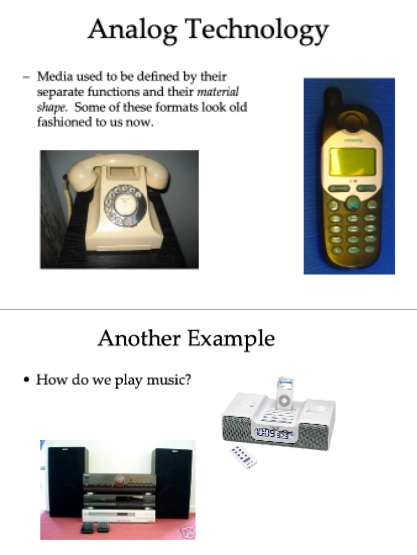
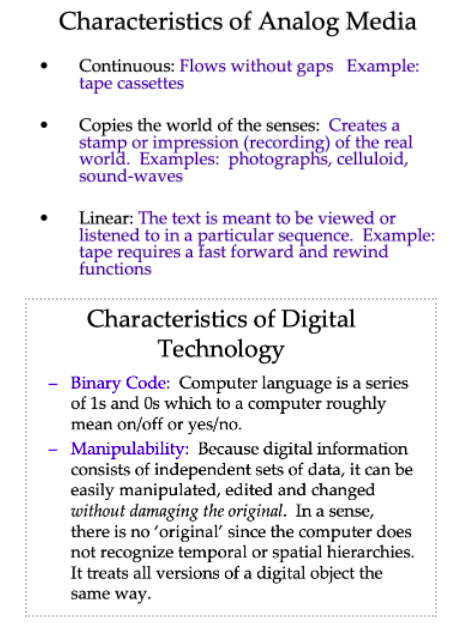
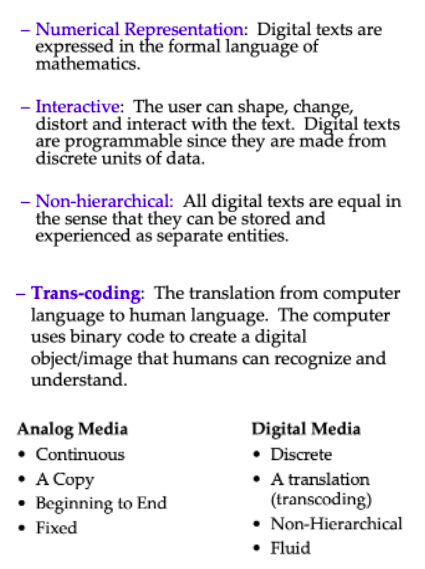
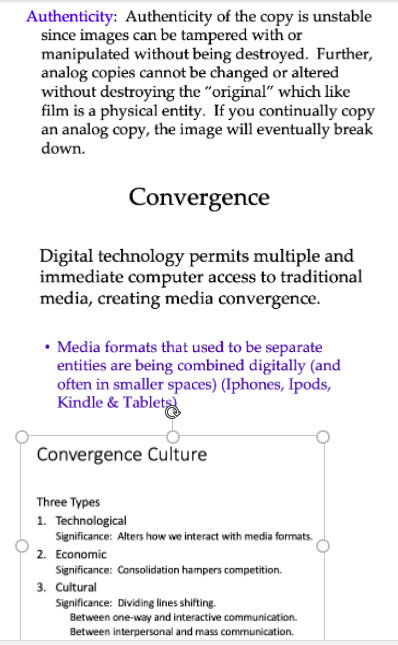
Analog Technology - Media used to be defined by their separate functions and their material shape. Some of these formats look old fashioned to us now. 000 06 190 9990 Another Example How do we play music? COS Characteristics of Analog Media Continuous: Flows without gaps Example: tape cassettes Copies the world of the senses: Creates a stamp or impression (recording) of the real world. Examples: photographs, celluloid, sound-waves Linear: The text is meant to be viewed or listened to in a particular sequence. Example: tape requires a fast forward and rewind functions Characteristics of Digital Technology Binary Code: Computer language is a series of 1s and Os which to a computer roughly mean on/off or yeso. - Manipulability: Because digital information consists of independent sets of data, it can be easily manipulated, edited and changed without damaging the original. In a sense, there is no 'original since the computer does not recognize temporal or spatial hierarchies. It treats all versions of a digital object the same way. - Numerical Representation: Digital texts are expressed in the formal language of mathematics. - Interactive: The user can shape, change, distort and interact with the text. Digital texts are programmable since they are made from discrete units of data. - Non-hierarchical: All digital texts are equal in the sense that they can be stored and experienced as separate entities. - Trans-coding: The translation from computer language to human language. The computer uses binary code to create a digital object/image that humans can recognize and understand. Analog Media Continuous A Copy Beginning to End Fixed Digital Media Discrete A translation (transcoding) Non-Hierarchical Fluid Authenticity: Authenticity of the copy is unstable since images can be tampered with or manipulated without being destroyed. Further, analog copies cannot be changed or altered without destroying the "original" which like film is a physical entity. If you continually copy an analog copy, the image will eventually break down. Convergence Digital technology permits multiple and immediate computer access to traditional media, creating media convergence. Media formats that used to be separate entities are being combined digitally (and often in smaller spaces) (Iphones, Ipods, Kindle & Tablets Convergence Culture Three Types 1. Technological Significance: Alters how we interact with media formats 2. Economic Significance: Consolidation hampers competition. 3. Cultural Significance: Dividing lines shifting. Between one-way and interactive communication Between interpersonal and mass communication
Step by Step Solution
There are 3 Steps involved in it
1 Expert Approved Answer
Step: 1 Unlock

Question Has Been Solved by an Expert!
Get step-by-step solutions from verified subject matter experts
Step: 2 Unlock
Step: 3 Unlock
 Study Help