



Question: According to your book, another potential problem for boundaryless organizational structures is that they can lack strong leadership and common vision. What resources does METRO
According to your book, another potential problem for boundaryless organizational structures is that they can lack strong leadership and common vision. What resources does METRO exploit to overcome this problem?
Group of answer choices
METRO is the worlds third largest retail chain.
An executive committee was created consisting of only of METRO and Platinum partners.
A METRO project manager headed each project team.
METRO also introduced new partners into the alliance, signaling to existing partners that they could not rest on their laurels.
All of the above
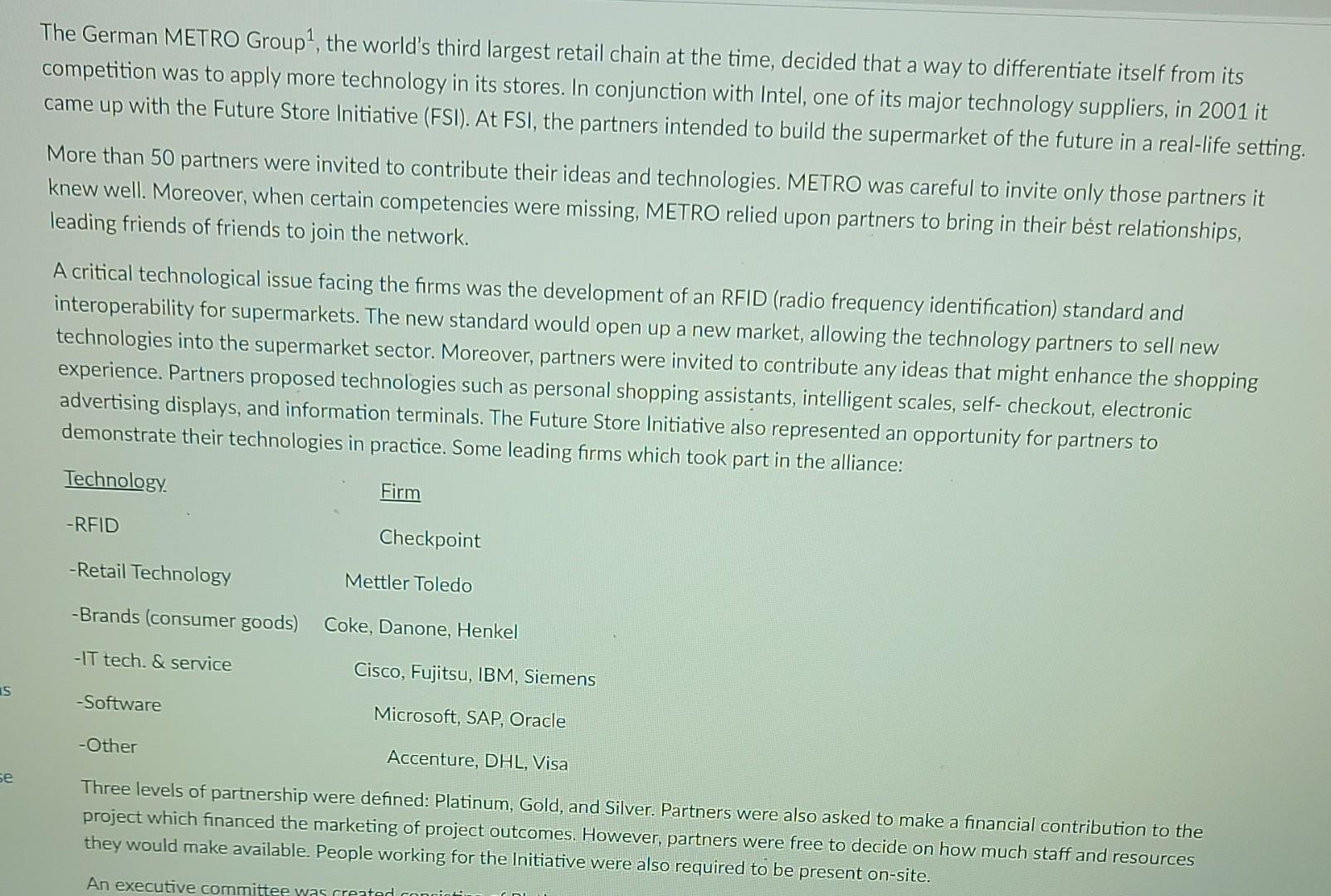
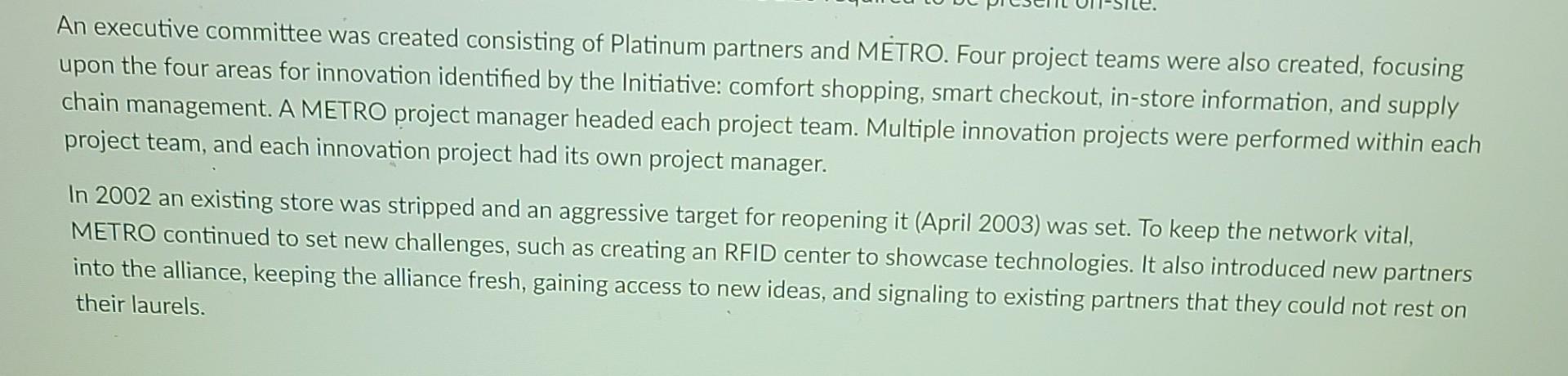
The German METRO Group, the world's third largest retail chain at the time, decided that a way to differentiate itself from its competition was to apply more technology in its stores. In conjunction with Intel, one of its major technology suppliers, in 2001 it came up with the Future Store Initiative (FSI). At FSI, the partners intended to build the supermarket of the future in a real-life setting. More than 50 partners were invited to contribute their ideas and technologies. METRO was careful to invite only those partners it knew well. Moreover, when certain competencies were missing, METRO relied upon partners to bring in their best relationships, leading friends of friends to join the network. A critical technological issue facing the firms was the development of an RFID (radio frequency identification) standard and interoperability for supermarkets. The new standard would open up a new market, allowing the technology partners to sell new technologies into the supermarket sector. Moreover, partners were invited to contribute any ideas that might enhance the shopping experience. Partners proposed technologies such as personal shopping assistants, intelligent scales, self-checkout, electronic advertising displays, and information terminals. The Future Store Initiative also represented an opportunity for partners to demonstrate their technologies in practice. Some leading firms which took part in the alliance: Technology. Firm -RFID Checkpoint -Retail Technology Mettler Toledo -Brands (consumer goods) Coke, Danone, Henkel -IT tech. & service Cisco, Fujitsu, IBM, Siemens IS -Software Microsoft, SAP, Oracle -Other Accenture, DHL, Visa se Three levels of partnership were defined: Platinum, Gold, and Silver. Partners were also asked to make a financial contribution to the project which financed the marketing of project outcomes. However, partners were free to decide on how much staff and resources they would make available. People working for the Initiative were also required to be present on-site. An executive committee was created concini An executive committee was created consisting of Platinum partners and METRO. Four project teams were also created, focusing upon the four areas for innovation identified by the Initiative: comfort shopping, smart checkout, in-store information, and supply chain management. A METRO project manager headed each project team. Multiple innovation projects were performed within each project team, and each innovation project had its own project manager. In 2002 an existing store was stripped and an aggressive target for reopening it (April 2003) was set. To keep the network vital, METRO continued to set new challenges, such as creating an RFID center to showcase technologies. It also introduced new partners into the alliance, keeping the alliance fresh, gaining access to new ideas, and signaling to existing partners that they could not rest on their laurelsStep by Step Solution
There are 3 Steps involved in it
1 Expert Approved Answer
Step: 1 Unlock

Question Has Been Solved by an Expert!
Get step-by-step solutions from verified subject matter experts
Step: 2 Unlock
Step: 3 Unlock