Question: .After putting the correct answer in the blank below, write down the questions and answers in your handwriting and submit them. ). 1. The definition
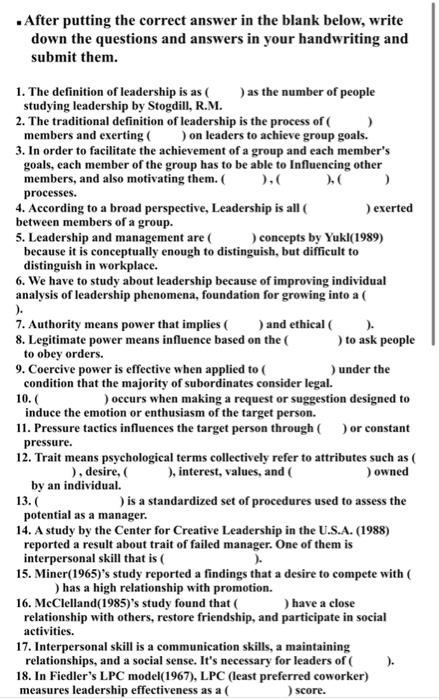
.After putting the correct answer in the blank below, write down the questions and answers in your handwriting and submit them. ). 1. The definition of leadership is as ) as the number of people studying leadership by Stogdill, R.M. 2. The traditional definition of leadership is the process of > members and exerting on leaders to achieve group goals. 3. In order to facilitate the achievement of a group and each member's goals, each member of the group has to be able to Influencing other members, and also motivating them.( ), .) processes. 4. According to a broad perspective, Leadership is all ) exerted between members of a group. 5. Leadership and management are ) concepts by Yukl(1989) because it is conceptually enough to distinguish, but difficult to distinguish in workplace. 6. We have to study about leadership because of improving individual analysis of leadership phenomena, foundation for growing into a ). 7. Authority means power that implies ( ) and ethical ). 8. Legitimate power means influence based on the ) to ask people to obey orders. 9. Coercive power is effective when applied to under the condition that the majority of subordinates consider legal. occurs when making a request or suggestion designed to induce the emotion or enthusiasm of the target person. 11. Pressure tactics influences the target person through() or constant pressure. 12. Trait means psychological terms collectively refer to attributes such as ), desire, ), interest, values, and ) owned by an individual. 13. ) is a standardized set of procedures used to assess the potential as a manager. 14. A study by the Center for Creative Leadership in the U.S.A. (1988) reported a result about trait of failed manager. One of them is interpersonal skill that is ( 15. Miner(1965)'s study reported a findings that a desire to compete with ) has a high relationship with promotion. 16. McClelland(1985)'s study found that ) have a close relationship with others, restore friendship, and participate in social activities. 17. Interpersonal skill is a communication skills, a maintaining relationships, and a social sense. It's necessary for leaders of 18. In Fiedler's LPC model(1967), LPC (least preferred coworker) measures leadership effectiveness as a ) score. 10









 Study Help