Question: After Reading the Attached Case Study, Fully answer the below : How would you assess AlphaGo's real-world implementation potential in terms of resource and process
After Reading the Attached Case Study, Fully answer the below :
- How would you assess AlphaGo's real-world implementation potential in terms of resource and process "distance", customer acceptability and "adjustment costs"?
- What context-specific issues would need to be taken into account when deploying technologies like AlphaGo in South Africa?
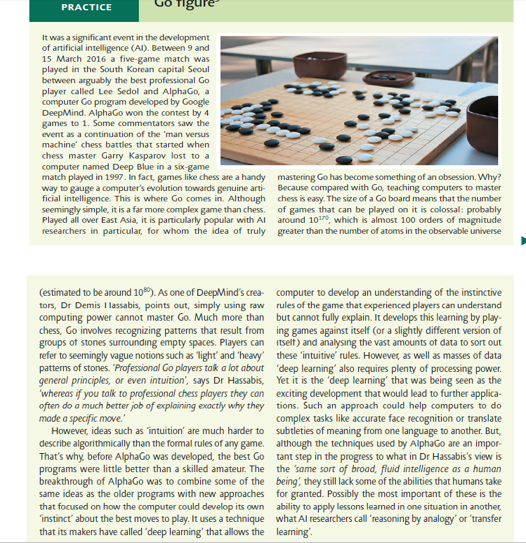
PRACTICE It was a significant event in the development of artificial intelligence (AI). Between 9 and 15 March 2016 a five-game match was played in the South Korean capital Seoul between arguably the best professional Go player called Lee Sedol and AlphaGo, a computer Go program developed by Google DeepMind. AlphaGo won the contest by 4 games to 1. Some commentators saw the event as a continuation of the 'man versus machine' chess battles that started when chess master Garry Kasparov lost to a computer named Deep Blue in a six-game match played in 1997. In fact, games like chess are a handy mastering Go has become something of an obsession. Why? way to gauge a computer's evolution towards genuine arts. Because compared with Go, teaching computers to master ficial intelligence. This is where Go comes in. Although chess is easy. The size of a Go board means that the number seemingly simple, it is a far more complex game than chess of games that can be played on it is colossal: probably Played all over East Asia, it is particularly popular with Al around 10170, which is almost 100 orders of magnitude researchers in particular, for whom the idea of truly greater than the number of atoms in the observable universe (estimated to be around 108). As one of DeepMind's crea- computer to develop an understanding of the instinctive tors, Dr Demis I lassabis, points out, simply using raw rules of the game that experienced players can understand computing power cannot master Go. Much more than but cannot fully explain. It develops this learning by play- chess, Go involves recognizing patterns that result from ing games against itself (or a slightly different version of groups of stones surrounding empty spaces. Players can itselt) and analysing the vast amounts of data to sort out refer to seemingly vague notions such as light' and 'heavy' these 'intuitive rules. However, as well as masses of data patterns of stones. "Professional Go players tak a lot about 'deep learning' also requires plenty of processing power. general principles, or even intuition', says Dr Hassabis. Yet it is the deep learning' that was being seen as the whereas if you talk to professional chess players they can exciting development that would lead to further applica- often do a much better job of explaining exactly why they tions. Such an approach could help computers to do made a specific move." complex tasks like accurate face recognition or translate However, ideas such as intuition' are much harder to subtleties of meaning from one language to another. But, describe algorithmically than the formal rules of any game although the techniques used by AlphaGo are an impor- That's why, before AlphaGo was developed, the best Go tant step in the progress to what in Dr Hassabis's view is programs were little better than a skilled amateur. The the 'some sort of broad, fluid intelligence as a human breakthrough of AlphaGo was to combine some of the being they still lack some of the abilities that humans take same ideas as the older programs with new approaches for granted. Possibly the most important of these is the that focused on how the computer could develop its own ability to apply lessons leared in one situation in another 'instinct about the best moves to play. It uses a technique what Al researchers call 'reasoning by analogy' or 'transfer that its makers have called 'deep learning' that allows the learning









 Study Help