After reading the case, answer the following questions. Your response to each prompt should be at least one paragraph in length (about 100 - 150 words).
Questions:
- What are the pros and cons of Egans performance appraisal system? Do you think it identifies the best employees? Do you think it helps develop employees to perform the best they can? Justify your responses, incorporating at least one topic discussed in the first "Performance Management" lecture.
- How do you account for the fact that absenteeism has decreased at Egans while turnover has increased?
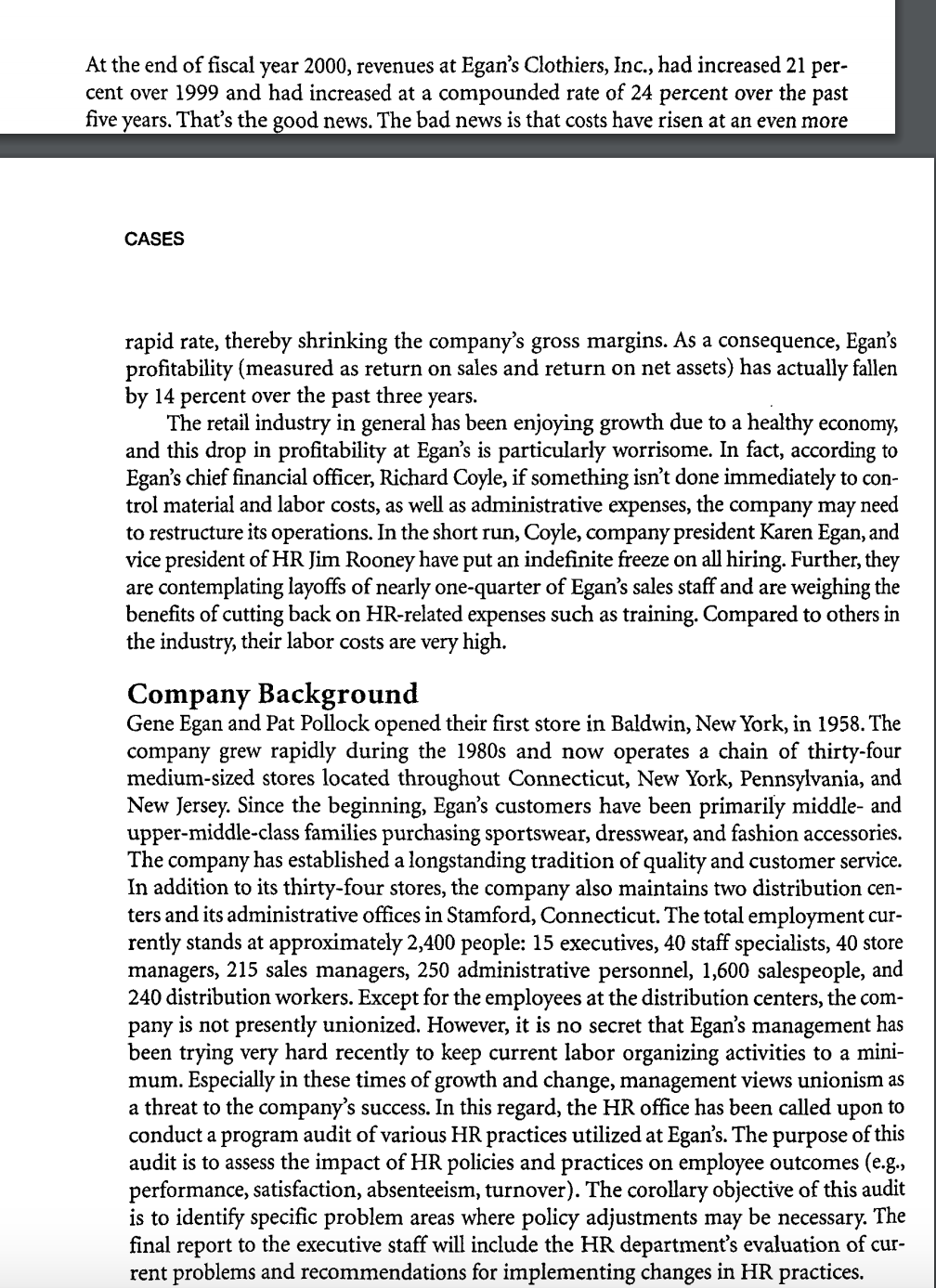
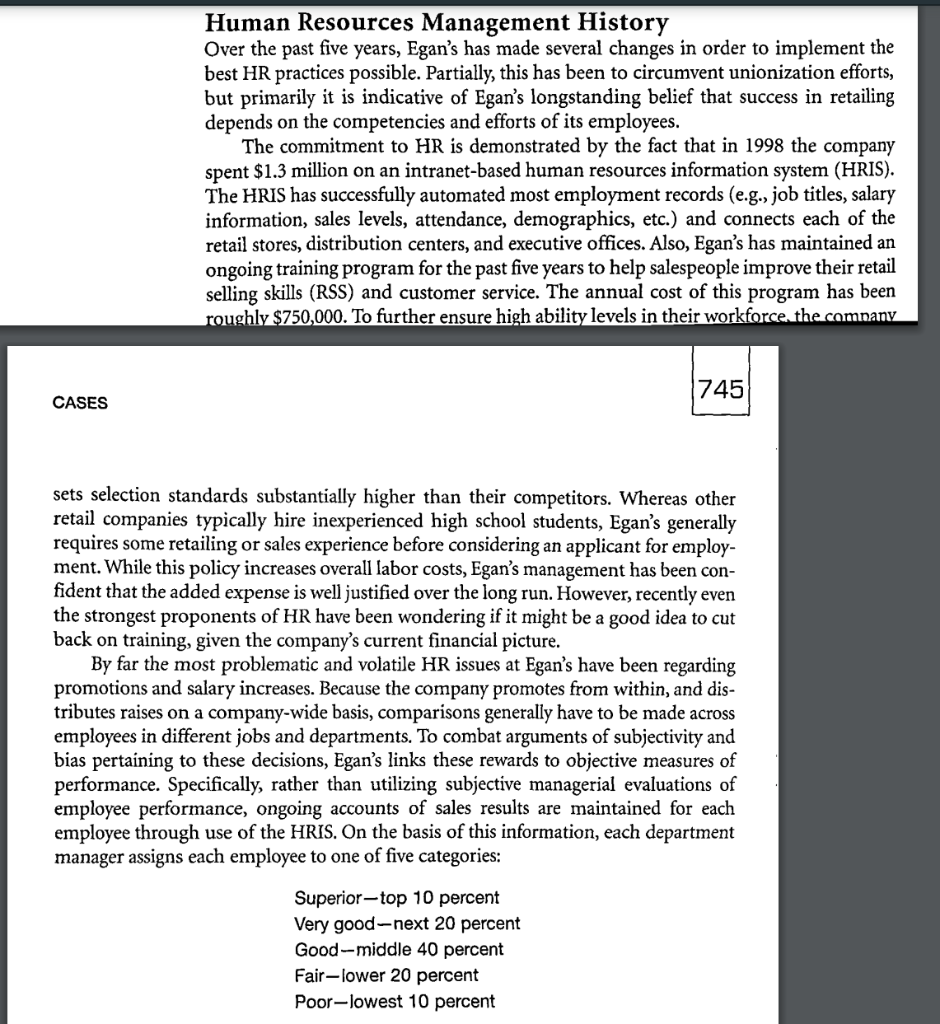
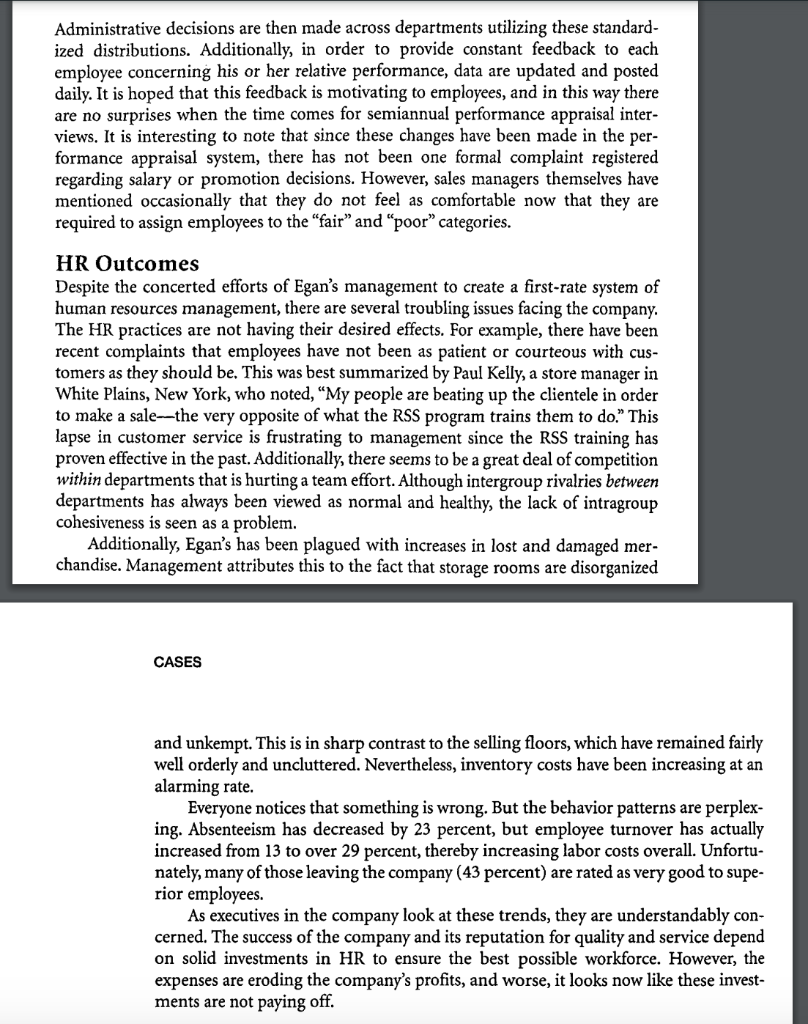
At the end of fiscal year 2000, revenues at Egan's Clothiers, Inc., had increased 21 per- cent over 1999 and had increased at a compounded rate of 24 percent over the past five years. That's the good news. The bad news is that costs have risen at an even more CASES rapid rate, thereby shrinking the company's gross margins. As a consequence, Egan's profitability (measured as return on sales and return on net assets) has actually fallen by 14 percent over the past three years. The retail industry in general has been enjoying growth due to a healthy economy, and this drop in profitability at Egan's is particularly worrisome. In fact, according to Egan's chief financial officer, Richard Coyle, if something isn't done immediately to con- trol material and labor costs, as well as administrative expenses, the company may need to restructure its operations. In the short run, Coyle, company president Karen Egan, and vice president of HR Jim Rooney have put an indefinite freeze on all hiring. Further, they are contemplating layoffs of nearly one-quarter of Egan's sales staff and are weighing the benefits of cutting back on HR-related expenses such as training. Compared to others in the industry, their labor costs are very high. Company Background Gene Egan and Pat Pollock opened their first store in Baldwin, New York, in 1958. The company grew rapidly during the 1980s and now operates a chain of thirty-four medium-sized stores located throughout Connecticut, New York, Pennsylvania, and New Jersey. Since the beginning, Egan's customers have been primarily middle- and upper-middle-class families purchasing sportswear, dresswear, and fashion accessories. The company has established a longstanding tradition of quality and customer service. In addition to its thirty-four stores, the company also maintains two distribution cen- ters and its administrative offices in Stamford, Connecticut. The total employment cur- rently stands at approximately 2,400 people: 15 executives, 40 staff specialists, 40 store managers, 215 sales managers, 250 administrative personnel, 1,600 salespeople, and 240 distribution workers. Except for the employees at the distribution centers, the com- pany is not presently unionized. However, it is no secret that Egan's management has been trying very hard recently to keep current labor organizing activities to a mini- mum. Especially in these times of growth and change, management views unionism as a threat to the company's success. In this regard, the HR office has been called upon conduct a program audit of various HR practices utilized at Egan's. The purpose of this audit is to assess the impact of HR policies and practices on employee outcomes (e.g., performance, satisfaction, absenteeism, turnover). The corollary objective of this audit is to identify specific problem areas where policy adjustments may be necessary. The final report to the executive staff will include the HR department's evaluation of cur- rent problems and recommendations for implementing changes in HR practices. to Human Resources Management History Over the past five years, Egan's has made several changes in order to implement the best HR practices possible. Partially, this has been to circumvent unionization efforts, but primarily it is indicative of Egan's longstanding belief that success in retailing depends on the competencies and efforts of its employees. The commitment to HR is demonstrated by the fact that in 1998 the company spent $1.3 million on an intranet-based human resources information system (HRIS). The HRIS has successfully automated most employment records (e.g., job titles, salary information, sales levels, attendance, demographics, etc.) and connects each of the retail stores, distribution centers, and executive offices. Also, Egan's has maintained an ongoing training program for the past five years to help salespeople improve their retail selling skills (RSS) and customer service. The annual cost of this program has been roughly $750,000. To further ensure high ability levels in their workforce, the company 745 CASES sets selection standards substantially higher than their competitors. Whereas other retail companies typically hire inexperienced high school students, Egan's generally requires some retailing or sales experience before considering an applicant for employ- ment. While this policy increases overall labor costs, Egan's management has been con- fident that the added expense is well justified over the long run. However, recently even the strongest proponents of HR have been wondering if it might be a good idea to cut back on training, given the company's current financial picture. By far the most problematic and volatile HR issues at Egan's have been regarding promotions and salary increases. Because the company promotes from within, and dis- tributes raises on a company-wide basis, comparisons generally have to be made across employees in different jobs and departments. To combat arguments of subjectivity and bias pertaining to these decisions, Egan's links these rewards to objective measures of performance. Specifically, rather than utilizing subjective managerial evaluations of employee performance, ongoing accounts of sales results are maintained for each employee through use of the HRIS. On the basis of this information, each department manager assigns each employee to one of five categories: Superior-top 10 percent Very good-next 20 percent Good-middle 40 percent Fair-lower 20 percent Poor-lowest 10 percent Administrative decisions are then made across departments utilizing these standard- ized distributions. Additionally, in order to provide constant feedback to each employee concerning his or her relative performance, data are updated and posted daily. It is hoped that this feedback is motivating to employees, and in this way there are no surprises when the time comes for semiannual performance appraisal inter- views. It is interesting to note that since these changes have been made in the per- formance appraisal system, there has not been one formal complaint registered regarding salary or promotion decisions. However, sales managers themselves have mentioned occasionally that they do not feel as comfortable now that they are required to assign employees to the fair and poor categories. HR Outcomes Despite the concerted efforts of Egan's management to create a first-rate system of human resources management, there are several troubling issues facing the company. The HR practices are not having their desired effects. For example, there have been recent complaints that employees have not been as patient or courteous with cus- tomers as they should be. This was best summarized by Paul Kelly, a store manager in White Plains, New York, who noted, My people are beating up the clientele in order to make a sale--the very opposite of what the RSS program trains them to do. This lapse in customer service is frustrating to management since the RSS training has proven effective in the past. Additionally, there seems to be a great deal of competition within departments that is hurting a team effort. Although intergroup rivalries between departments has always been viewed as normal and healthy, the lack of intragroup cohesiveness is seen as a problem. Additionally, Egan's has been plagued with increases in lost and damaged mer- chandise. Management attributes this to the fact that storage rooms are disorganized CASES and unkempt. This is in sharp contrast to the selling floors, which have remained fairly well orderly and uncluttered. Nevertheless, inventory costs have been increasing at an alarming rate. Everyone notices that something is wrong. But the behavior patterns are perplex- ing. Absenteeism has decreased by 23 percent, but employee turnover has actually increased from 13 to over 29 percent, thereby increasing labor costs overall. Unfortu- nately, of those leaving the company (43 percent) are rated as very good to supe- rior employees. As executives in the company look at these trends, they are understandably con- cerned. The success of the company and its reputation for quality and service depend on solid investments in HR to ensure the best possible workforce. However, the expenses are eroding the company's profits, and worse, it looks now like these invest- ments are not paying off




