







Question: After reading the case study, please answer the following questions: 1. What is the ethical dilemma facing Anthony? 2. How do you believe Anthony should
After reading the case study, please answer the following questions:
1. What is the ethical dilemma facing Anthony?
2. How do you believe Anthony should deal with this problem?
3. If you were in Anthonys shoes what do you believe YOU would do?
4. Do you believe that Mary is putting undo pressure on Anthony?
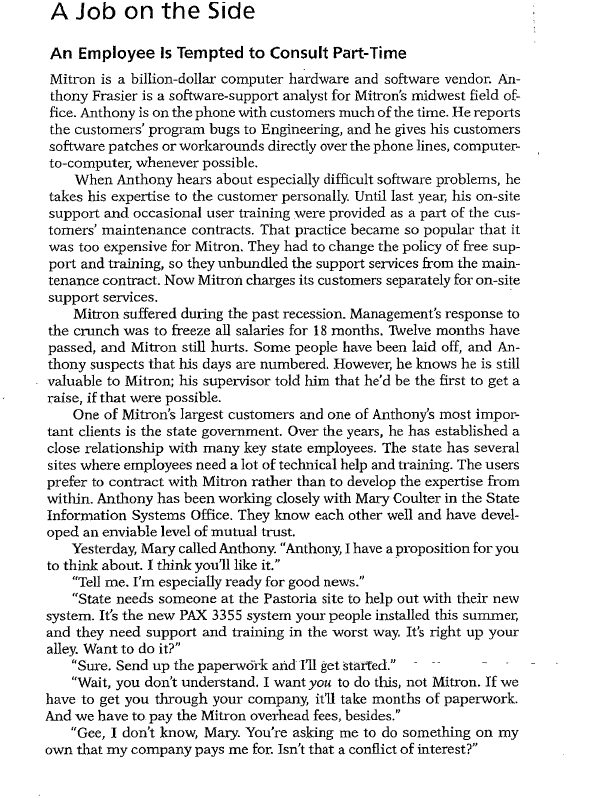
A Job on the Side An Employee Is Tempted to Consult Part-Time Mitron is a billion-dollar computer hardware and software vendor. An- thony Frasier is a software-support analyst for Mitron's midwest field of- fice. Anthony is on the phone with customers much of the time. He reports the customers' program bugs to Engineering, and he gives his customers software patches or workarounds directly over the phone lines, computer- to-computer, whenever possible. When Anthony hears about especially difficult software problems, he takes his expertise to the customer personally. Until last year, his on-site support and occasional user training were provided as a part of the cus- tomers' maintenance contracts. That practice became so popular that it was too expensive for Mitron. They had to change the policy of free sup- port and training, so they unbundled the support services from the main- tenance contract. Now Mitron charges its customers separately for on-site support services. Mitron suffered during the past recession. Management's response to the crunch was to freeze all salaries for 18 months. Twelve months have passed, and Mitron still hurts. Some people have been laid off, and An- thony suspects that his days are numbered. However, he knows he is still valuable to Mitron; his supervisor told him that he'd be the first to get a raise, if that were possible. One of Mitron's largest customers and one of Anthony's most impor- tant clients is the state government. Over the years, he has established a close relationship with many key state employees. The state has several sites where employees need a lot of technical help and training. The users prefer to contract with Mitron rather than to develop the expertise from within. Anthony has been working closely with Mary Coulter in the State Information Systems Office. They know each other well and have devel- oped an enviable level of mutual trust. Yesterday, Mary called Anthony. "Anthony, I have a proposition for you to think about. I think you'll like it." "Tell me. I'm especially ready for good news." "State needs someone at the Pastoria site to help out with their new system. It's the new PAX 3355 system your people installed this summer, and they need support and training in the worst way. It's right up your alley. Want to do it?" "Sure. Send up the paperwork and 1'11 get started." "Wait, you don't understand. I want you to do this, not Mitron. If we have to get you through your company, it'll take months of paperwork. And we have to pay the Mitron overhead fees, besides." "Gee, I don't know, Mary. You're asking me to do something on my own that my company pays me for. Isn't that a conflict of interestStep by Step Solution
There are 3 Steps involved in it
1 Expert Approved Answer
Step: 1 Unlock

Question Has Been Solved by an Expert!
Get step-by-step solutions from verified subject matter experts
Step: 2 Unlock
Step: 3 Unlock
 Study Help