







Question: After reading What do we do with all this big data? by Susan Etlinger, write a brief summary of what you learned. - Keep your

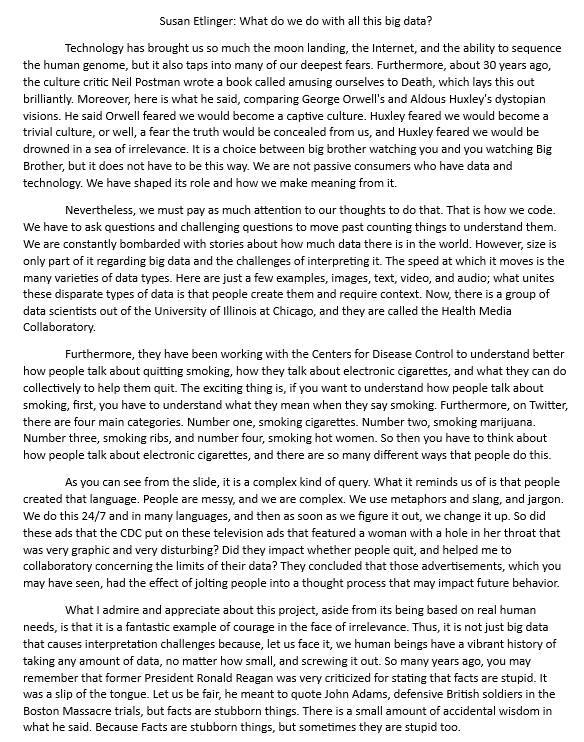
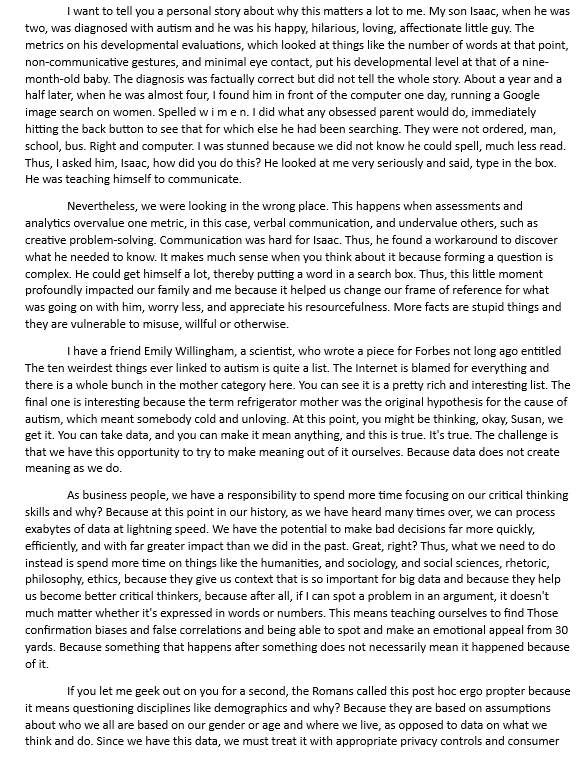
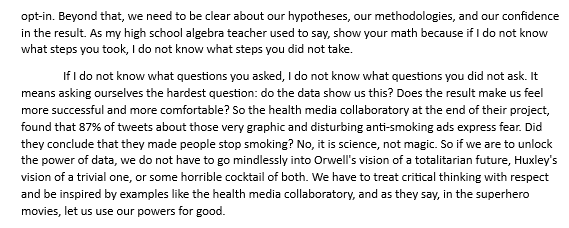
After reading "What do we do with all this big data?" by Susan Etlinger, write a brief summary of what you learned. - Keep your summary up to five sentences. Susan Etlinger: What do we do with all this big data? Technology has brought us so much the moon landing, the Internet, and the ability to sequence the human genome, but it also taps into many of our deepest fears. Furthermore, about 30 years ago, the culture critic Neil Postman wrote a book called amusing ourselves to Death, which lays this out brilliantly. Moreover, here is what he said, comparing George Orwell's and Aldous Huxley's dystopian visions. He said Orwell feared we would become a captive culture. Huxley feared we would become a trivial culture, or well, a fear the truth would be concealed from us, and Huxley feared we would be drowned in a sea of irrelevance. It is a choice between big brother watching you and you watching Big Brother, but it does not have to be this way. We are not passive consumers who have data and technology. We have shaped its role and how we make meaning from it. Nevertheless, we must pay as much attention to our thoughts to do that. That is how we code. We have to ask questions and challenging questions to move past counting things to understand them. We are constantly bombarded with stories about how much data there is in the world. However, size is only part of it regarding big data and the challenges of interpreting it. The speed at which it moves is the many varieties of data types. Here are just a few examples, images, text, video, and audio; what unites these disparate types of data is that people create them and require context. Now, there is a group of data scientists out of the University of Illinois at Chicago, and they are called the Health Media Collaboratory. Furthermore, they have been working with the Centers for Disease Control to understand better how people talk about quitting smoking, how they talk about electronic cigarettes, and what they can do collectively to help them quit. The exciting thing is, if you want to understand how people talk about smoking, first, you have to understand what they mean when they say smoking. Furthermore, on Twitter, there are four main categories. Number one, smoking cigarettes. Number two, smoking marijuana. Number three, smoking ribs, and number four, smoking hot women. So then you have to think about how people talk about electronic cigarettes, and there are so many different ways that people do this. As you can see from the slide, it is a complex kind of query. What it reminds us of is that people created that language. People are messy, and we are complex. We use metaphors and slang, and jargon. We do this 24/7 and in many languages, and then as soon as we figure it out, we change it up. So did these ads that the CDC put on these television ads that featured a woman with a hole in her throat that was very graphic and very disturbing? Did they impact whether people quit, and helped me to collaboratory concerning the limits of their data? They concluded that those advertisements, which you may have seen, had the effect of jolting people into a thought process that may impact future behavior. What I admire and appreciate about this project, aside from its being based on real human needs, is that it is a fantastic example of courage in the face of irrelevance. Thus, it is not just big data that causes interpretation challenges because, let us face it, we human beings have a vibrant history of taking any amount of data, no matter how small, and screwing it out. So many years ago, you may remember that former President Ronald Reagan was very criticized for stating that facts are stupid. It was a slip of the tongue. Let us be fair, he meant to quote John Adams, defensive British soldiers in the Boston Massacre trials, but facts are stubborn things. There is a small amount of accidental wisdom in what he said. Because Facts are stubborn things, but sometimes they are stupid too. I want to tell you a personal story about why this matters a lot to me. My son Isaac, when he was two, was diagnosed with autism and he was his happy, hilarious, loving, affectionate little guy. The metrics on his developmental evaluations, which looked at things like the number of words at that point, non-communicative gestures, and minimal eye contact, put his developmental level at that of a ninemonth-old baby. The diagnosis was factually correct but did not tell the whole story. About a year and a half later, when he was almost four, I found him in front of the computer one day, running a Google image search on women. Spelled w i m e n. I did what any obsessed parent would do, immediately hitting the back button to see that for which else he had been searching. They were not ordered, man, school, bus. Right and computer. I was stunned because we did not know he could spell, much less read. Thus, I asked him, Isaac, how did you do this? He looked at me very seriously and said, type in the box. He was teaching himself to communicate. Nevertheless, we were looking in the wrong place. This happens when assessments and analytics overvalue one metric, in this case, verbal communication, and undervalue others, such as creative problem-solving. Communication was hard for Isaac. Thus, he found a workaround to discover what he needed to know. It makes much sense when you think about it because forming a question is complex. He could get himself a lot, thereby putting a word in a search box. Thus, this little moment profoundly impacted our family and me because it helped us change our frame of reference for what was going on with him, worry less, and appreciate his resourcefulness. More facts are stupid things and they are vulnerable to misuse, willful or otherwise. I have a friend Emily Willingham, a scientist, who wrote a piece for Forbes not long ago entitled The ten weirdest things ever linked to autism is quite a list. The Internet is blamed for everything and there is a whole bunch in the mother category here. You can see it is a pretty rich and interesting list. The final one is interesting because the term refrigerator mother was the original hypothesis for the cause of autism, which meant somebody cold and unloving. At this point, you might be thinking, okay, Susan, we get it. You can take data, and you can make it mean anything, and this is true. It's true. The challenge is that we have this opportunity to try to make meaning out of it ourselves. Because data does not create meaning as we do. As business people, we have a responsibility to spend more time focusing on our critical thinking skills and why? Because at this point in our history, as we have heard many times over, we can process exabytes of data at lightning speed. We have the potential to make bad decisions far more quickly, efficiently, and with far greater impact than we did in the past. Great, right? Thus, what we need to do instead is spend more time on things like the humanities, and sociology, and social sciences, rhetoric, philosophy, ethics, because they give us context that is so important for big data and because they help us become better critical thinkers, because after all, if I can spot a problem in an argument, it doesn't much matter whether it's expressed in words or numbers. This means teaching ourselves to find Those confirmation biases and false correlations and being able to spot and make an emotional appeal from 30 yards. Because something that happens after something does not necessarily mean it happened because of it. If you let me geek out on you for a second, the Romans called this post hoc ergo propter because it means questioning disciplines like demographics and why? Because they are based on assumptions about who we all are based on our gender or age and where we live, as opposed to data on what we think and do. Since we have this data, we must treat it with appropriate privacy controls and consumer opt-in. Beyond that, we need to be clear about our hypotheses, our methodologies, and our confidence in the result. As my high school algebra teacher used to say, show your math because if I do not know what steps you took, I do not know what steps you did not take. If I do not know what questions you asked, I do not know what questions you did not ask. It means asking ourselves the hardest question: do the data show us this? Does the result make us feel more successful and more comfortable? So the health media collaboratory at the end of their project, found that 87% of tweets about those very graphic and disturbing anti-smoking ads express fear. Did they conclude that they made people stop smoking? No, it is science, not magic. So if we are to unlock the power of data, we do not have to go mindlessly into Orwell's vision of a totalitarian future, Huxley's vision of a trivial one, or some horrible cocktail of both. We have to treat critical thinking with respect and be inspired by examples like the health media collaboratory, and as they say, in the superhero movies, let us use our powers for good
Step by Step Solution
There are 3 Steps involved in it

Get step-by-step solutions from verified subject matter experts
 Study Help