







Question: Again consider the two-period model from Chapter 9, and assume for simplicity that there is one rep resentative consumer in the economy, so that A
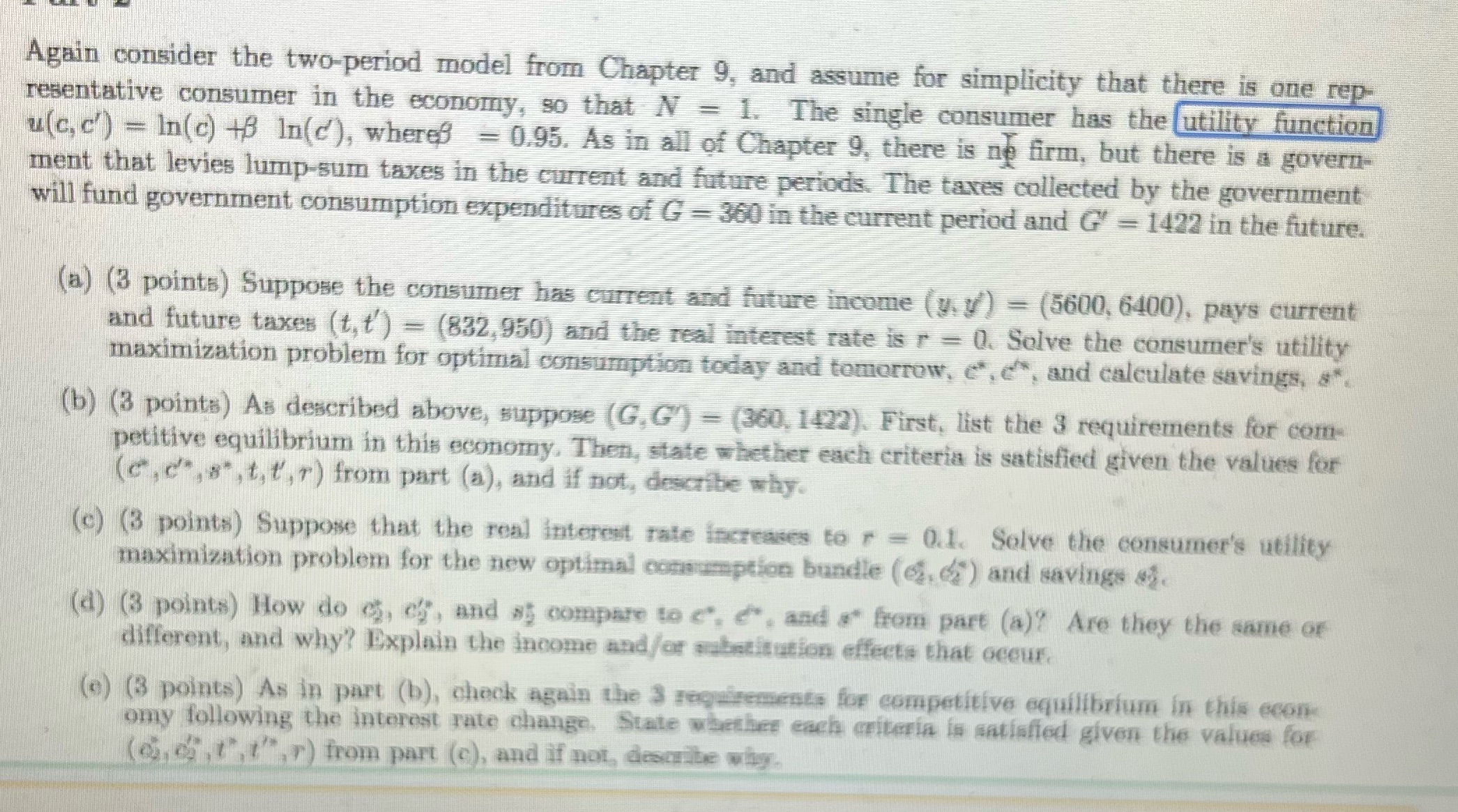
Again consider the two-period model from Chapter 9, and assume for simplicity that there is one rep resentative consumer in the economy, so that A = 1. The single consumer has the utility function u(c,c) = In(c) +8 In(c), where? = 0.95. As in all of Chapter 9, there is ne firm, but there is a govern- ment that levies lump-sum taxes in the current and future periods. The taxes collected by the government will fund government consumption expenditures of G = 360 in the current period and G' = 1422 in the future. (a) (3 points) Suppose the consumer has current and future income (y. y) = (5600, 6400), pays current and future taxes (t, t') = (832,950) and the real interest rate is r = 0. Solve the consumer's utility maximization problem for optimal consumption today and tomorrow, e", ", and calculate savings, a". (b) (3 points) As described above, suppose (G.G) = (360, 1422). First, list the 3 requirements for com- petitive equilibrium in this economy. Then, state whether each criteria is satisfied given the values for (c, c',s', t, t, ") from part (a), and if not, describe why. (c) (3 points) Suppose that the real interest rate increases to r = 0.1. Solve the consumer's utility maximization problem for the new optimal consumption bundle (. ( ) and savings s. (d) (3 points) How do c, cy, and at compare to c", ", and a" from part (a)? Are they the same or different, and why? Explain the income and /or sabatitution effects that occur. (e) (3 points) As in part (b), check again the 3 requirements for competitive equilibrium in this econ omy following the interest rate change, State whether each criteria is satisfied given the values for (0, of , t' t", r) from part (c), and if not, describe why
Step by Step Solution
There are 3 Steps involved in it

Get step-by-step solutions from verified subject matter experts
 Study Help