







Question: Section 2 - Consumption-Savings Decisions (27 points total) Consider the two-period model from Chapter 9. Assume that there is one representative consumer in the economy,
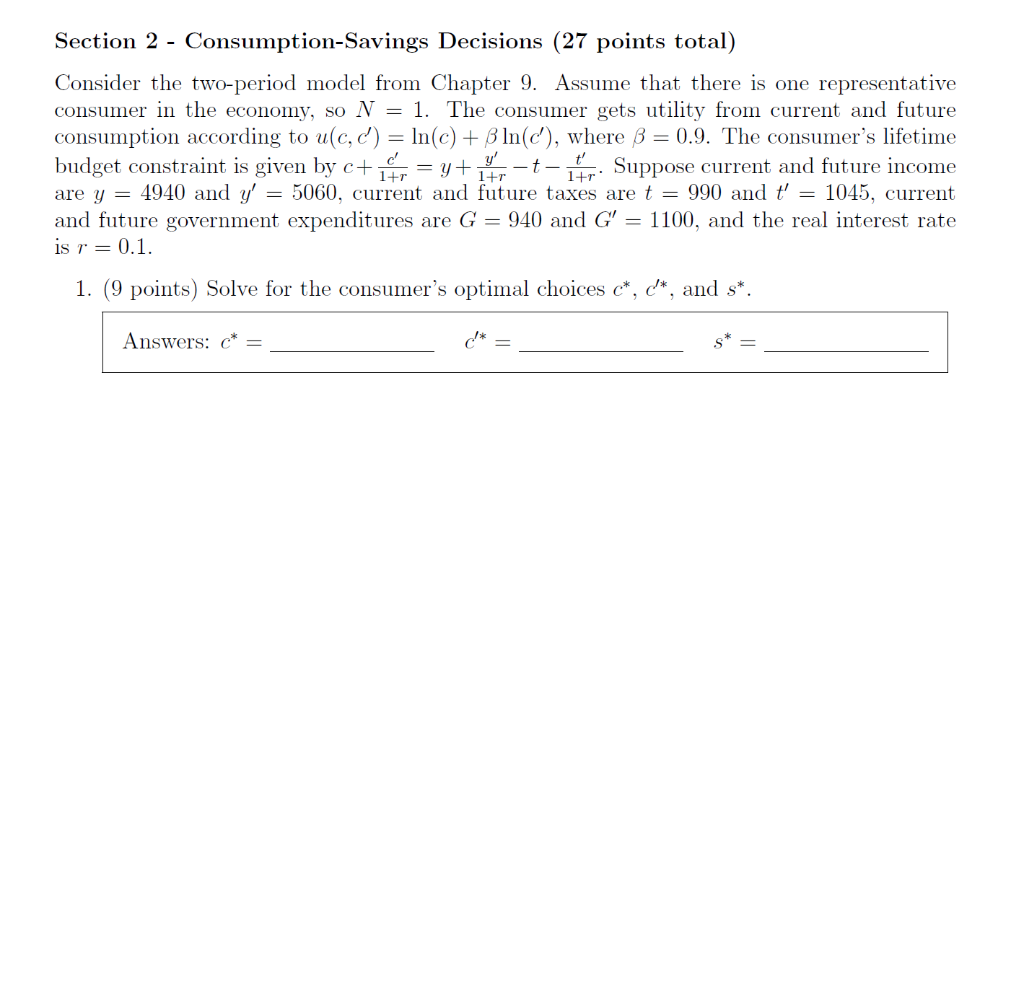
Section 2 - Consumption-Savings Decisions (27 points total) Consider the two-period model from Chapter 9. Assume that there is one representative consumer in the economy, so N = 1. The consumer gets utility from current and future consumption according to uc, c') = ln(C) + B ln(c'), where = 0.9. The consumer's lifetime budget constraint is given by c+ i =y+ 4.-t 14r. Suppose current and future income are y = 4940 and y' = 5060, current and future taxes are t = 990 and t' = 1045, current and future government expenditures are G = 940 and G' 1100, and the real interest rate is r=0.1. 1+r = 1. (9 points) Solve for the consumer's optimal choices c*, d*, and s*. Answers: c* = Section 2 - Consumption-Savings Decisions (27 points total) Consider the two-period model from Chapter 9. Assume that there is one representative consumer in the economy, so N = 1. The consumer gets utility from current and future consumption according to uc, c') = ln(C) + B ln(c'), where = 0.9. The consumer's lifetime budget constraint is given by c+ i =y+ 4.-t 14r. Suppose current and future income are y = 4940 and y' = 5060, current and future taxes are t = 990 and t' = 1045, current and future government expenditures are G = 940 and G' 1100, and the real interest rate is r=0.1. 1+r = 1. (9 points) Solve for the consumer's optimal choices c*, d*, and s*. Answers: c* =
Step by Step Solution
There are 3 Steps involved in it

Get step-by-step solutions from verified subject matter experts
 Study Help