


Question: Alex is a final year student in the Business Programme of a university. Like many of his peers, he has begun to think seriously about
Alex is a final year student in the Business

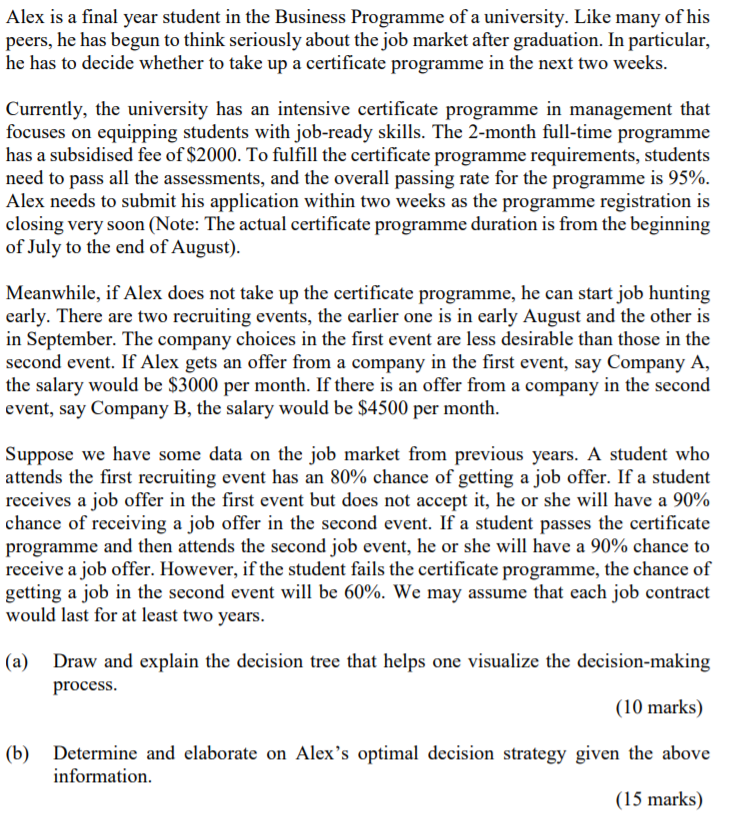
Alex is a final year student in the Business Programme of a university. Like many of his peers, he has begun to think seriously about the job market after graduation. In particular, he has to decide whether to take up a certificate programme in the next two weeks. Currently, the university has an intensive certificate programme in management that focuses on equipping students with job-ready skills. The 2-month full-time programme has a subsidised fee of $2000. To fulfill the certificate programme requirements, students need to pass all the assessments, and the overall passing rate for the programme is 95%. Alex needs to submit his application within two weeks as the programme registration is closing very soon (Note: The actual certificate programme duration is from the beginning of July to the end of August). Meanwhile, if Alex does not take up the certificate programme, he can start job hunting early. There are two recruiting events, the earlier one is in early August and the other is in September. The company choices in the first event are less desirable than those in the second event. If Alex gets an offer from a company in the first event, say Company A, the salary would be $3000 per month. If there is an offer from a company in the second event, say Company B, the salary would be $4500 per month. Suppose we have some data on the job market from previous years. A student who attends the first recruiting event has an 80% chance of getting a job offer. If a student receives a job offer in the first event but does not accept it, he or she will have a 90% chance of receiving a job offer in the second event. If a student passes the certificate programme and then attends the second job event, he or she will have a 90% chance to receive a job offer. However, if the student fails the certificate programme, the chance of getting a job in the second event will be 60%. We may assume that each job contract would last for at least two years. (a) Draw and explain the decision tree that helps one visualize the decision-making process. (10 marks) (b ) Determine and elaborate on Alex's optimal decision strategy given the above information. (15 marks)

Step by Step Solution

There are 3 Steps involved in it

1 Expert Approved Answer
Step: 1 Unlock blur-text-image

Question Has Been Solved by an Expert!

Get step-by-step solutions from verified subject matter experts

Step: 2 Unlock
Step: 3 Unlock

Students Have Also Explored These Related General Management Questions!