



Question: ALL l 1. Growth in 2 Dimensions Start with an infinite two dimensional grid filled with zeros, indexed from (1,1) at the bottom left
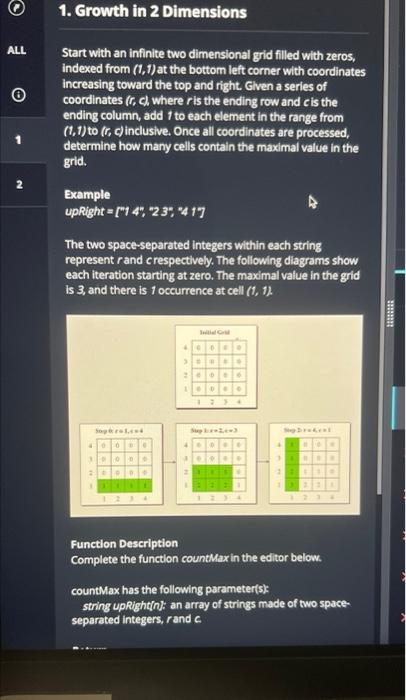
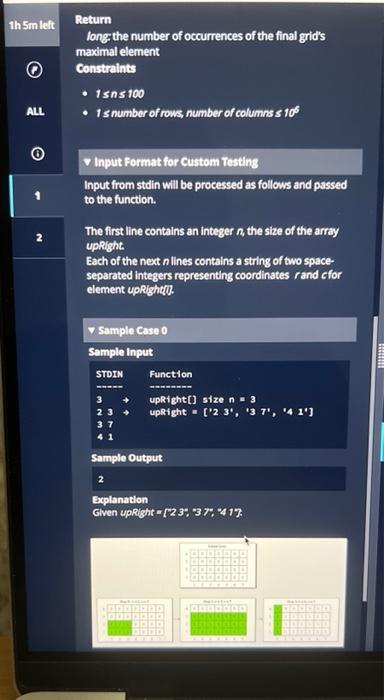
ALL l 1. Growth in 2 Dimensions Start with an infinite two dimensional grid filled with zeros, indexed from (1,1) at the bottom left corner with coordinates increasing toward the top and right. Given a series of coordinates (r, c), where ris the ending row and c is the ending column, add 7 to each element in the range from (1, 1) to (r, c) inclusive. Once all coordinates are processed, determine how many cells contain the maximal value in the grid. Example upRight=["14","23", "41"] The two space-separated integers within each string represent rand crespectively. The following diagrams show each iteration starting at zero. The maximal value in the grid is 3, and there is 7 occurrence at cell (1, 1). ** 3 Sop=1,004 0 0 HE . 10 D # R P 40 3* 20 1 1 #19 4 a ** Sup 1:x=2,003 214 DIR 25 Function Description Complete the function countMax in the editor below. countMax has the following parameter(s): string upRight[n]: an array of strings made of two space- separated integers, rand c. 1h 5m left ALL O - N Return long: the number of occurrences of the final grid's maximal element Constraints 1sns 100 1 s number of rows, number of columns s 106 Input Format for Custom Testing Input from stdin will be processed as follows and passed to the function. The first line contains an integer n, the size of the array upRight. Each of the next in lines contains a string of two space- separated integers representing coordinates rand cfor element upRight[i]. Sample Case 0 Sample Input STDIN 23 37 Function upRight[] size n = 3 upRight = ['2 3', '37', '4 1'] Sample Output Explanation Given upRight -["23", "37","417 !!!!!!!!
Step by Step Solution
3.45 Rating (152 Votes )
There are 3 Steps involved in it
I read the link you provided and it is a question about how to start with an infinite ... View full answer

Get step-by-step solutions from verified subject matter experts