







Question: all questions please 3. The eigenfunctions for an electron (j) confined to a circular ring are Um(j) 1 eimo, 271 where m is the quantum
all questions please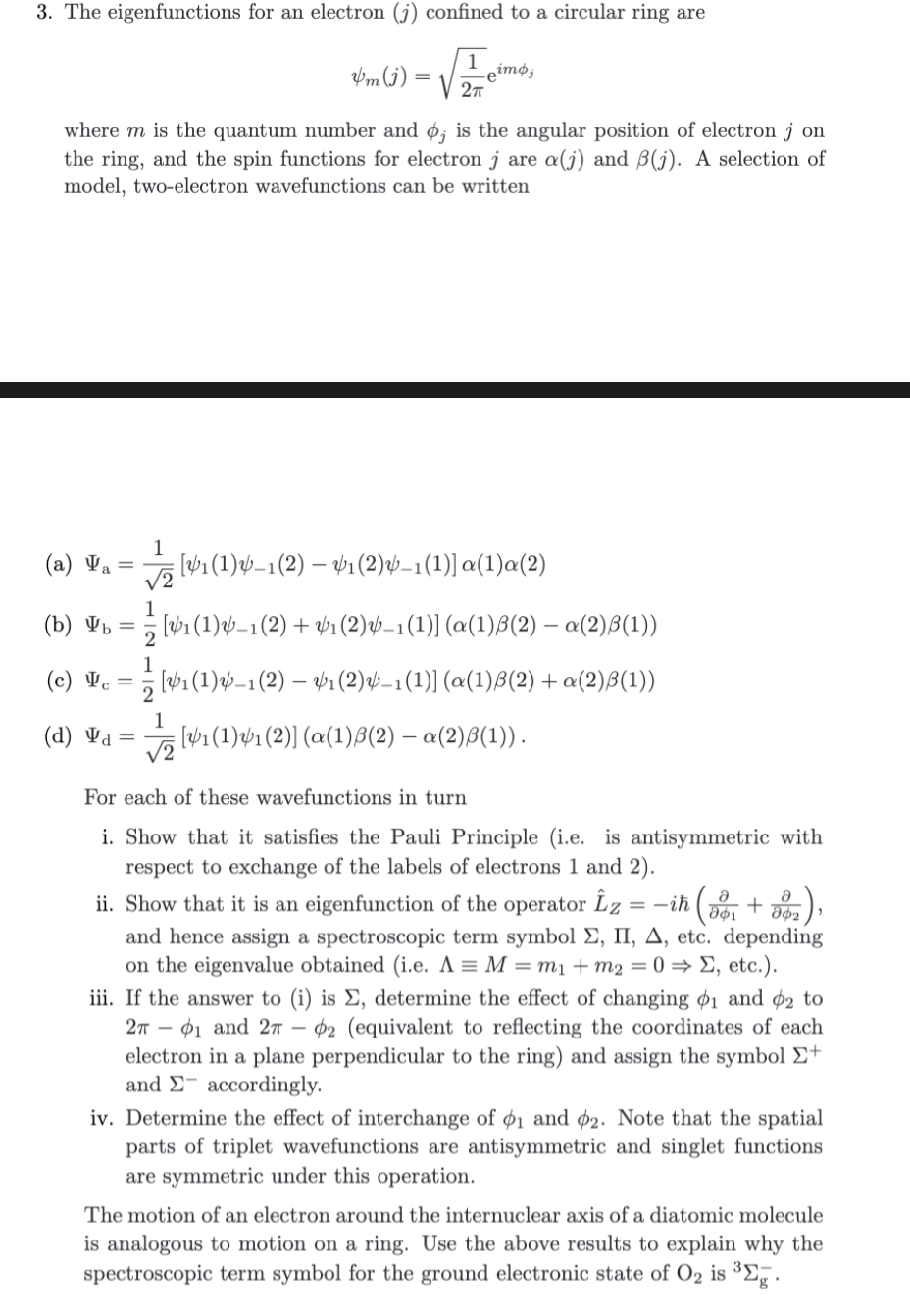
3. The eigenfunctions for an electron (j) confined to a circular ring are Um(j) 1 eimo, 271 where m is the quantum number and 0; is the angular position of electron j on the ring, and the spin functions for electron j are a(j) and B(). A selection of model, two-electron wavefunctions can be written 1 (a) Va= v (41(1)41(2) 41(2)41(1))a(1)a(2) (b) b = [4:1(1)1(2) +41 (2)41(1)] (a(1)B(2) a(2)B(1)) (c) Vc = [41(1)41(2) 41(2)41(1)) (a(1)B(2) + a(2)B(1)) (d) Vd = [431 (1)41(2)] (a(1)B(2) a(2)B(1)). 1 1 For each of these wavefunctions in turn i. Show that it satisfies the Pauli Principle (i.e. is antisymmetric with respect to exchange of the labels of electrons 1 and 2). ii. Show that it is an eigenfunction of the operator z =-i (+ oema), a02 and hence assign a spectroscopic term symbol E, II, A, etc. depending on the eigenvalue obtained (i.e. A = M = mi + m2 = 0) + E, etc.). iii. If the answer to (i) is E, determine the effect of changing pi and 2 to 27 01 and 27 02 (equivalent to reflecting the coordinates of each electron in a plane perpendicular to the ring) and assign the symbol E+ and E- accordingly. iv. Determine the effect of interchange of oi and 02. Note that the spatial parts of triplet wavefunctions are antisymmetric and singlet functions are symmetric under this operation. The motion of an electron around the internuclear axis of a diatomic molecule is analogous to motion on a ring. Use the above results to explain why the spectroscopic term symbol for the ground electronic state of O2 is 35
Step by Step Solution
There are 3 Steps involved in it

Get step-by-step solutions from verified subject matter experts
 Study Help