







Question: am stuck please guide me on this step by step (a) Let s. = (ble-1, 62-1, 21-1, 21-2,2:) denote the state vector where bl, and
am stuck please guide me on this step by step
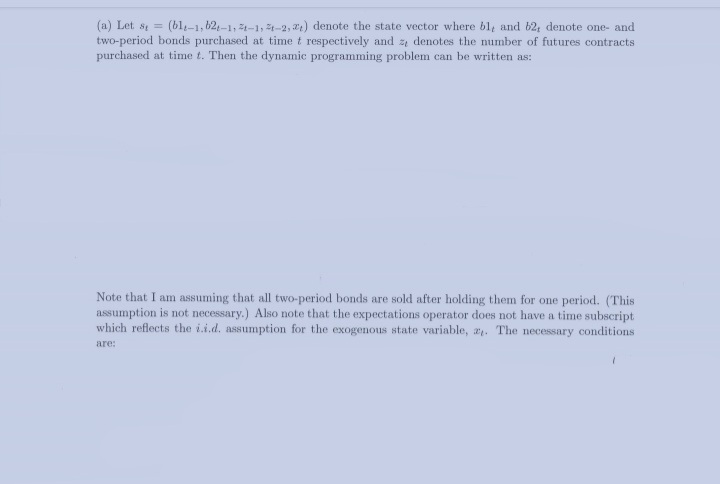
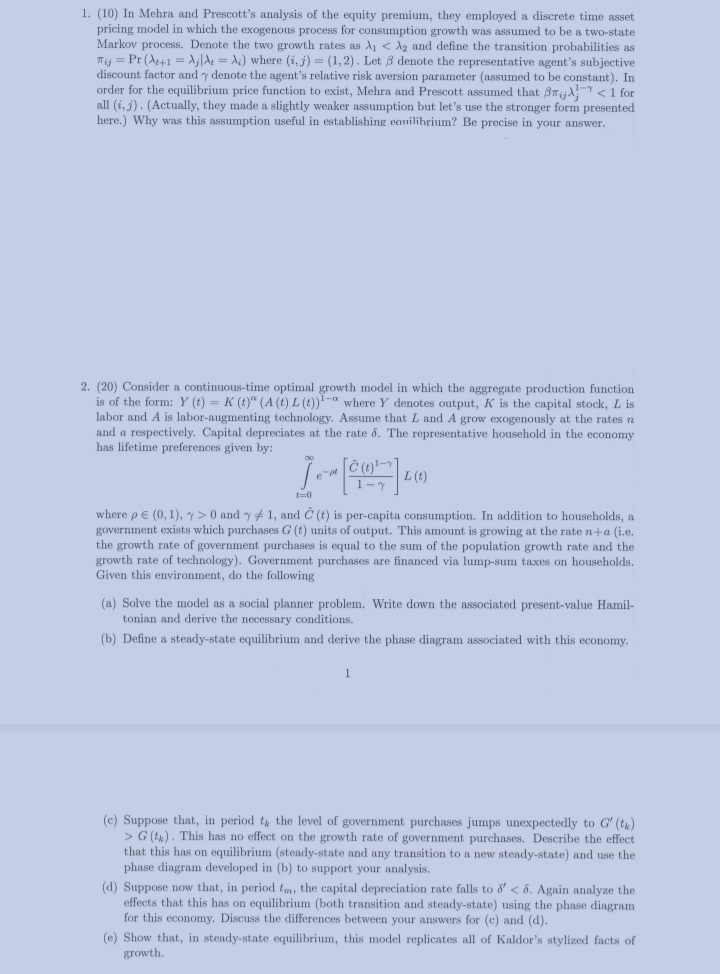
(a) Let s. = (ble-1, 62-1, 21-1, 21-2,2:) denote the state vector where bl, and 62, denote one- and two-period bonds purchased at time & respectively and & denotes the number of futures contracts purchased at time t. Then the dynamic programming problem can be written as: Note that I am assuming that all two-period bonds are sold after holding them for one period. (This assumption is not necessary.) Also note that the expectations operator does not have a time subscript which reflects the wi.d. assumption for the exogenous state variable, 2. The necessary conditions are:1. (10) In Mehra and Prescott's analysis of the equity premium, they employed a discrete time asset pricing model in which the exogenous process for consumption growth was assumed to be a two-state Markov process. Denote the two growth rates as dj 0 and y # 1, and C (t) is per-capita consumption. In addition to households, a government exists which purchases G (t) units of output. This amount is growing at the rate n to (i.e. the growth rate of government purchases is equal to the sum of the population growth rate and the growth rate of technology). Government purchases are financed via lump-sum taxes on households. Given this environment, do the following (a) Solve the model as a social planner problem. Write down the associated present-value Hamil- tonian and derive the necessary conditions. (b) Define a steady-state equilibrium and derive the phase diagram associated with this economy. (c) Suppose that, in period to the level of government purchases jumps unexpectedly to G' (tx) > G (tx) . This has no effect on the growth rate of government purchases. Describe the effect that this has on equilibrium (steady-state and any transition to a new steady-state) and use the phase diagram developed in (b) to support your analysis. (d) Suppose now that, in period tm, the capital depreciation rate falls to o'
Step by Step Solution
There are 3 Steps involved in it

Get step-by-step solutions from verified subject matter experts
 Study Help