







Question: amount Most gaseous and solid solutes will dissolve only to a certain extent in a given liquid solvent at a given The of a solute
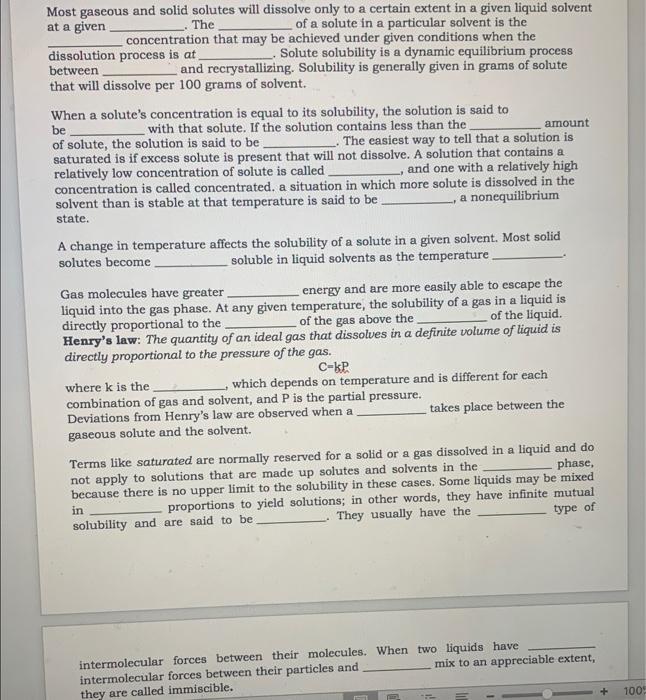
amount Most gaseous and solid solutes will dissolve only to a certain extent in a given liquid solvent at a given The of a solute in a particular solvent is the concentration that may be achieved under given conditions when the dissolution process is at Solute solubility is a dynamic equilibrium process between and recrystallizing. Solubility is generally given in grams of solute that will dissolve per 100 grams of solvent. When a solute's concentration is equal to its solubility, the solution is said to be with that solute. If the solution contains less than the of solute, the solution is said to be The casiest way to tell that a solution is saturated is if excess solute is present that will not dissolve. A solution that contains a relatively low concentration of solute is called and one with a relatively high concentration is called concentrated. a situation in which more solute is dissolved in the solvent than is stable at that temperature is said to be a nonequilibrium state, A change in temperature affects the solubility of a solute in a given solvent. Most solid solutes become soluble in liquid solvents as the temperature Gas molecules have greater energy and are more easily able to escape the liquid into the gas phase. At any given temperature, the solubility of a gas in a liquid is directly proportional to the of the gas above the of the liquid. Henry's law: The quantity of an ideal gas that dissolves in a definite volume of liquid is directly proportional to the pressure of the gas. C-KP where k is the which depends on temperature and is different for each combination of gas and solvent, and Pis the partial pressure. Deviations from Henry's law are observed when a takes place between the gaseous solute and the solvent. Terms like saturated are normally reserved for a solid or a gas dissolved in a liquid and do not apply to solutions that are made up solutes and solvents in the phase, because there is no upper limit to the solubility in these cases. Some liquids may be mixed in proportions to yield solutions; in other words, they have infinite mutual solubility and are said to be They usually have the type of intermolecular forces between their molecules. When two liquids have intermolecular forces between their particles and mix to an appreciable extent, they are called immiscible. 100
Step by Step Solution
There are 3 Steps involved in it

Get step-by-step solutions from verified subject matter experts
 Study Help