







Question: An atomic force microscope (AFM) is a device for measuring the height of surface at the microscopic level. An AFM works by moving a probe
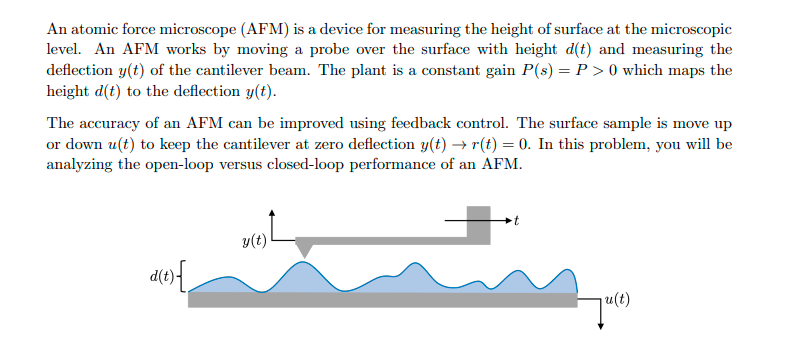

An atomic force microscope (AFM) is a device for measuring the height of surface at the microscopic level. An AFM works by moving a probe over the surface with height d(t) and measuring the deflection y(t) of the cantilever beam. The plant is a constant gain P(s)=P>0 which maps the height d(t) to the deflection y(t). The accuracy of an AFM can be improved using feedback control. The surface sample is move up or down u(t) to keep the cantilever at zero deflection y(t)r(t)=0. In this problem, you will be analyzing the open-loop versus closed-loop performance of an AFM. b) (2 points) Closed-loop AFM typically uses a PII controller C(s)=Kp+sKi+s2Kii=s2Kps2+Kis+Kii What is the highest order k disturbance d(t)=L1(1/sk) this controller can perfectly rejected? An atomic force microscope (AFM) is a device for measuring the height of surface at the microscopic level. An AFM works by moving a probe over the surface with height d(t) and measuring the deflection y(t) of the cantilever beam. The plant is a constant gain P(s)=P>0 which maps the height d(t) to the deflection y(t). The accuracy of an AFM can be improved using feedback control. The surface sample is move up or down u(t) to keep the cantilever at zero deflection y(t)r(t)=0. In this problem, you will be analyzing the open-loop versus closed-loop performance of an AFM. b) (2 points) Closed-loop AFM typically uses a PII controller C(s)=Kp+sKi+s2Kii=s2Kps2+Kis+Kii What is the highest order k disturbance d(t)=L1(1/sk) this controller can perfectly rejected
Step by Step Solution
There are 3 Steps involved in it

Get step-by-step solutions from verified subject matter experts
 Study Help