







Question: Intermolecular Forces: Atomic Force Microscopy An atomic force microscope (AFM) is capable of measuring molecular-scale dimensions. The tip of the AFM cantilever (shown below) is
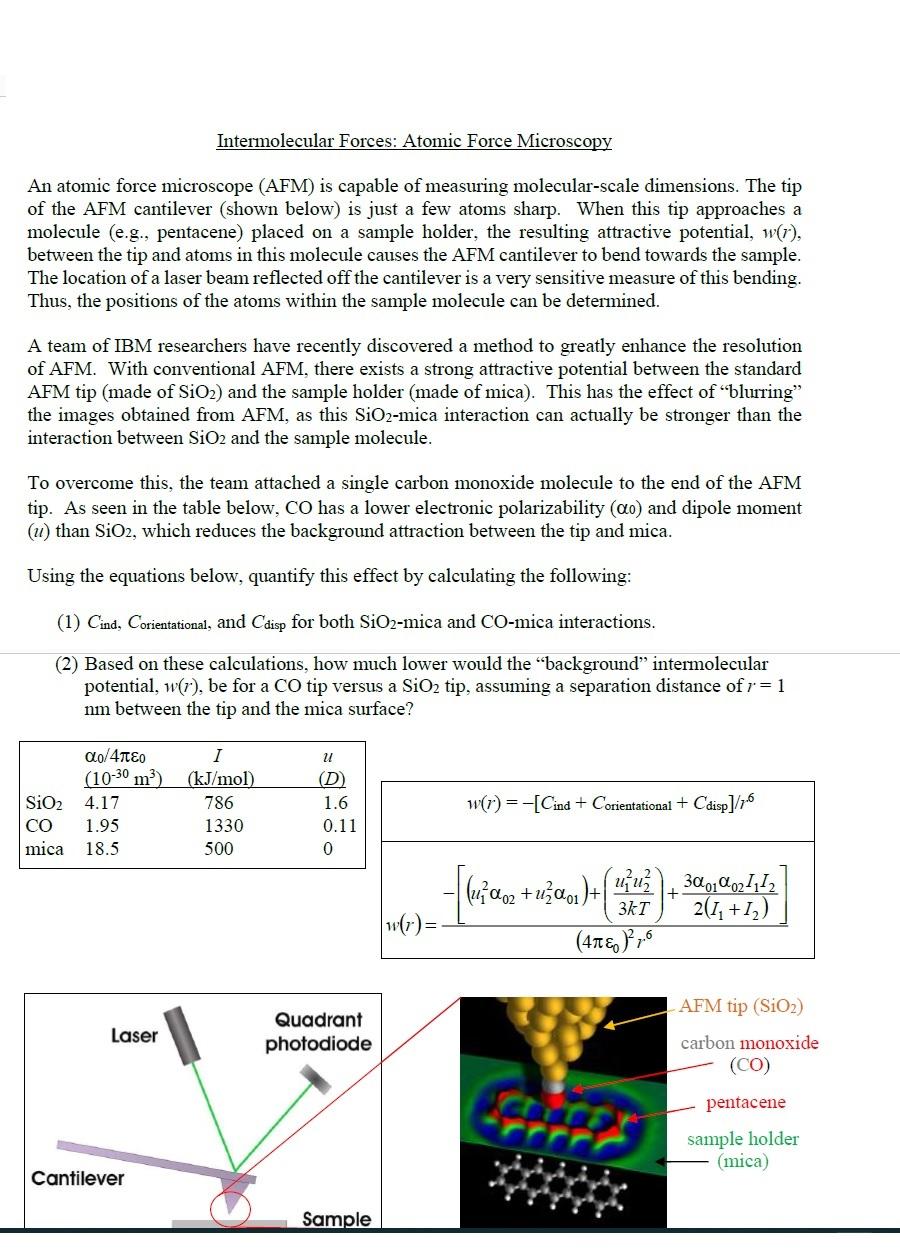
Intermolecular Forces: Atomic Force Microscopy An atomic force microscope (AFM) is capable of measuring molecular-scale dimensions. The tip of the AFM cantilever (shown below) is just a few atoms sharp. When this tip approaches a molecule (e.g., pentacene) placed on a sample holder, the resulting attractive potential, w(r), between the tip and atoms in this molecule causes the AFM cantilever to bend towards the sample. The location of a laser beam reflected off the cantilever is a very sensitive measure of this bending. Thus, the positions of the atoms within the sample molecule can be determined. A team of IBM researchers have recently discovered a method to greatly enhance the resolution of AFM. With conventional AFM, there exists a strong attractive potential between the standard AFM tip (made of SiO2) and the sample holder (made of mica). This has the effect of "blurring" the images obtained from AFM, as this SiO2-mica interaction can actually be stronger than the interaction between SiO2 and the sample molecule. To overcome this, the team attached a single carbon monoxide molecule to the end of the AFM tip. As seen in the table below, CO has a lower electronic polarizability (Co) and dipole moment (u) than SiO2, which reduces the background attraction between the tip and mica. Using the equations below, quantify this effect by calculating the following: (1) Cind, Corientational, and Cdisp for both SiO2-mica and CO-mica interactions. (2) Based on these calculations, how much lower would the background" intermolecular potential, w(r), be for a CO tip versus a SiO2 tip, assuming a separation distance of r= 1 nm between the tip and the mica surface? /4 (10-30 m) 4.17 1.95 18.5 SiO2 CO mica 1 (kJ/mol) 786 1330 500 u (D) 1.6 0.11 0 w(r)=-[Cind + Corientational + Cdisp]/r6 | (u? Qo2 +1 +uza,1)+( u{u + 30010021,12 2(1+12) W(r) = 3k (41&)* 7,6 AFM tip (SiO2) Laser Quadrant photodiode carbon monoxide (CO) pentacene sample holder (mica Cantilever Sample Intermolecular Forces: Atomic Force Microscopy An atomic force microscope (AFM) is capable of measuring molecular-scale dimensions. The tip of the AFM cantilever (shown below) is just a few atoms sharp. When this tip approaches a molecule (e.g., pentacene) placed on a sample holder, the resulting attractive potential, w(r), between the tip and atoms in this molecule causes the AFM cantilever to bend towards the sample. The location of a laser beam reflected off the cantilever is a very sensitive measure of this bending. Thus, the positions of the atoms within the sample molecule can be determined. A team of IBM researchers have recently discovered a method to greatly enhance the resolution of AFM. With conventional AFM, there exists a strong attractive potential between the standard AFM tip (made of SiO2) and the sample holder (made of mica). This has the effect of "blurring" the images obtained from AFM, as this SiO2-mica interaction can actually be stronger than the interaction between SiO2 and the sample molecule. To overcome this, the team attached a single carbon monoxide molecule to the end of the AFM tip. As seen in the table below, CO has a lower electronic polarizability (Co) and dipole moment (u) than SiO2, which reduces the background attraction between the tip and mica. Using the equations below, quantify this effect by calculating the following: (1) Cind, Corientational, and Cdisp for both SiO2-mica and CO-mica interactions. (2) Based on these calculations, how much lower would the background" intermolecular potential, w(r), be for a CO tip versus a SiO2 tip, assuming a separation distance of r= 1 nm between the tip and the mica surface? /4 (10-30 m) 4.17 1.95 18.5 SiO2 CO mica 1 (kJ/mol) 786 1330 500 u (D) 1.6 0.11 0 w(r)=-[Cind + Corientational + Cdisp]/r6 | (u? Qo2 +1 +uza,1)+( u{u + 30010021,12 2(1+12) W(r) = 3k (41&)* 7,6 AFM tip (SiO2) Laser Quadrant photodiode carbon monoxide (CO) pentacene sample holder (mica Cantilever Sample
Step by Step Solution
There are 3 Steps involved in it

Get step-by-step solutions from verified subject matter experts
 Study Help