







Question: An n-bit Gray code is a 1 to 1 mapping from the numbers [0 - (2n - 1)] such that the binary representation of consecutive
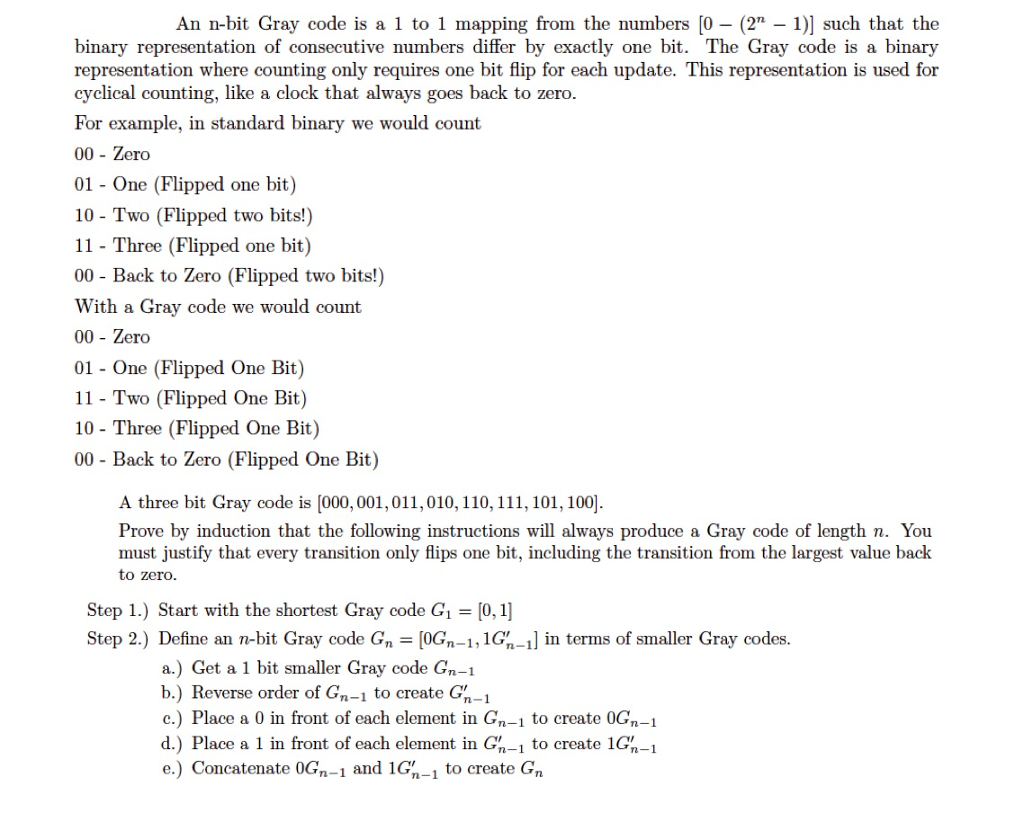
An n-bit Gray code is a 1 to 1 mapping from the numbers [0 - (2n - 1)] such that the binary representation of consecutive numbers differ by exactly one bit. The Gray code is a binary representation where counting only requires one bit flip for each update. This representation is used for cyclical counting, like a clock that always goes back to zero For example, in standard binary we would count 00 - Zero 01 - One (Flipped one bit) 10 - Two (Flipped two bits!) 11 - Three (Flipped one bit) 00 Back to Zero (Flipped two bits!) With a Gray code we would count 00 Zero 01 - One (Flipped One Bit) 11 - Two (Flipped One Bit) 10 - Three (Flipped One Bit) 00 - Back to Zero (Flipped One Bit) A three bit Gray code is [000, 001,011,010, 110, 111,101, 100] Prove by induction that the following instructions will always produce a Gray code of length n. Yoiu must justify that every transition only flips one bit, including the transition from the largest value back to zero. Step 1.) Start with the shortest Gray code G1 [0,1] Step 2.) Define an n-bit Gray code GnOGn-1,1G1] in terms of smaller Gray codes a.) Get a 1 bit smaller Gray code Gn-1 b.) Reverse order of Gn-i to create n-1 c.) Place a 0 in front of each element in Gn-1 to create 0Gn1 d.) Place a 1 in front of each element in Gn-1 to create 1G e.) Concatenate 0Gn-1 and 1G to create Gn
Step by Step Solution
There are 3 Steps involved in it

Get step-by-step solutions from verified subject matter experts
 Study Help